Perfectionist Auto Sound and Security

Alaska's Most Award Winning Auto Customizer

  • About Us
    • Why Choose Us
    • Meet Our Team
    • Our Awards
    • Virtual Tour
    • Community Engagement
  • Signature Products
    • DroneMobile
    • SoundShield®
  • Services
    • Remote Car Starters
      • Vehicle Security
    • Car Audio
      • Sound Deadening
    • Custom Fabrication
    • Driver Safety
      • Bluetooth
      • Blind Spot Safety Systems
      • Camera Systems
      • Navigation Systems
    • Laser And Radar Detectors
    • Lighting
    • Offroad and Marine
      • Motorcycle Audio
    • Custom Interiors
    • Performance
      • Tires and Wheels
      • Suspensions / Lift & Lower
    • PRO Commercial Division
  • Gallery
    • Photos
    • Videos
    • Wallpaper Downloads
  • Contact Us
    • FAQ
    • Feedback
    • Join Our Team

Understanding Specifications – Car Audio Amplifier Frequency Response

04/11/2021 By John Schwartz

Amplifier Frequency ResponseAs the next topic in our series explaining amplifier specifications, we will look at the frequency response information that manufacturers provide and explain how to interpret this information. In the simplest of statements, the frequency response spec will tell you about the low- and high-frequency limits of the amplifier based on its design. As with all the specs we have looked at, the information provided is as telling as the information that may be missing from the spec page. Let’s dive in and have a look.

Understanding Amplifier Frequency Response Specifications

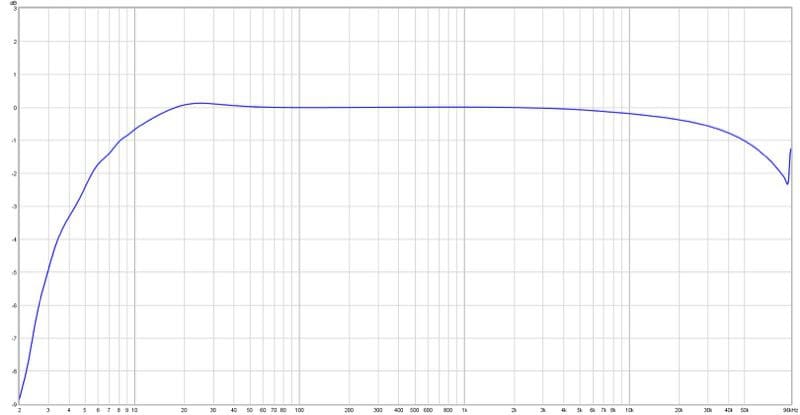
Let’s take a look at a good amplifier with a specification of 4 Hz to 50 kHz. In this particular example, there is no tolerance provided, so we don’t know if those low- and high-frequency limits represent a 1dB or 3dB tolerance. Let’s fire up the amp and see what we can find out.

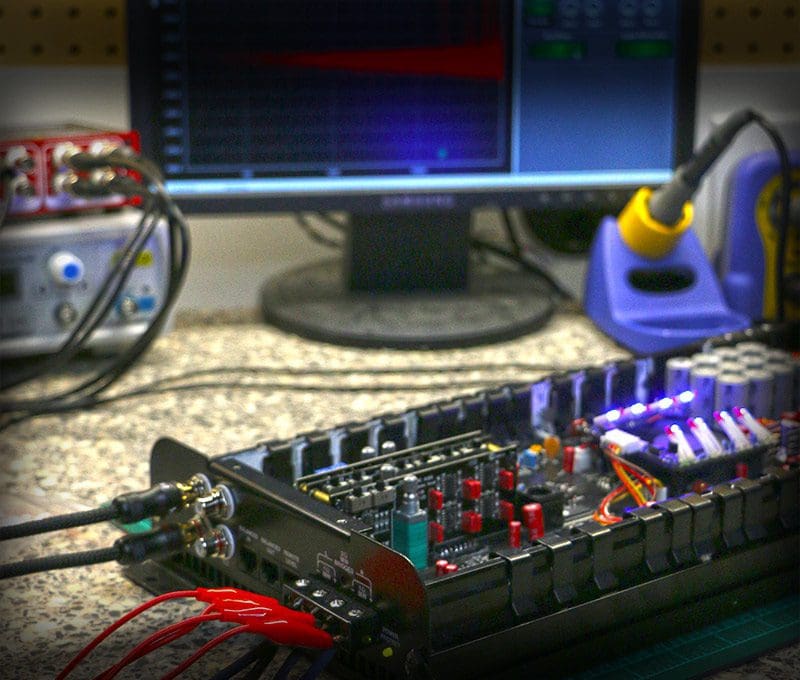
Connected to our digital interface and bank of load resistors, the amp shows a -1 dB frequency response of 8.21 Hz on the bottom end and 48.7 kHz on the top. Allowing for a tolerance of 3 dB, the measurement is 4.36 Hz on the bottom and above the 96 kHz measurement limit of my equipment on the top.

In short, this information tells us that this amp won’t dramatically affect the response of your audio system anywhere in the audible spectrum, and well beyond.
Amplifier Frequency Response
Frequency response of our reference amplifier when connected to a resistive 4-ohm load. Note: Ignore the spike at 95.3 kHz and the waviness below 10 Hz – those are caused by limits in the calibration of the measurement equipment.

Speakers Are Not Resistors

Several factors govern the frequency response of an amplifier. Outside of a discussion of the circuit design and components used for the amp, what most people realize is that the speaker system you connect your amp to can affect its performance. In the lab, we use resistive loads. In the real world, speakers add a level of inductive reactance that opposes AC current flow and affects frequency response. When you add a passive crossover network, the load now includes capacitive reactance. Ultimately, even in a simple two-way passive crossover network, the load the amp sees varies a great deal depending on frequency.

I contacted John Atkinson, editor at Stereophile magazine, and asked permission to recreate his reactive speaker simulation network. His use of a reactive load for amplifier response testing was the result of an Audio Engineering Society paper by Eric Benjamin titled, “Audio Power Amplifiers for Loudspeaker Loads.” Atkinson consulted with Ken Kantor of NHT and International Jensen on the passive network, and the result was a version of the network you see below.
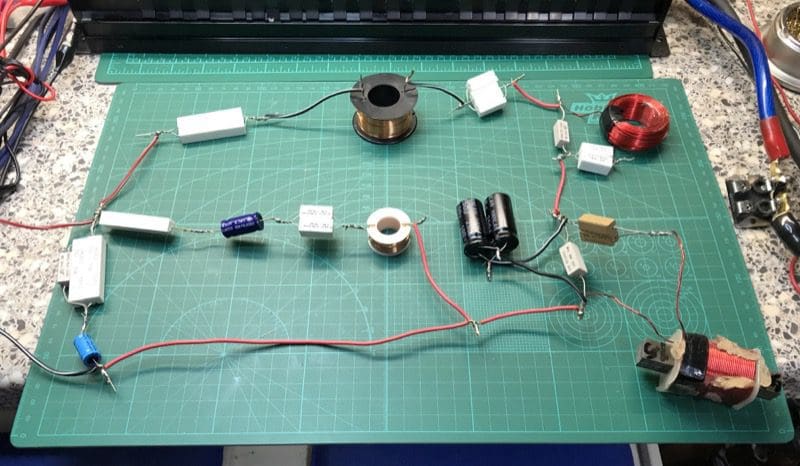
The purpose of this network is to present different impedances to the amplifier at different frequencies to evaluate its performance. The network replicates what an amplifier would see when powering a two-way, sealed-enclosure bookshelf speaker with a nominal impedance of 8 ohms. I created this network with the help of Frank Fabian at The Speaker Shop in Toronto. His store has an impressive supply of capacitors, resistors and inductors in stock. If you have a home speaker that needs repair or reconing, he’s the man to talk to!
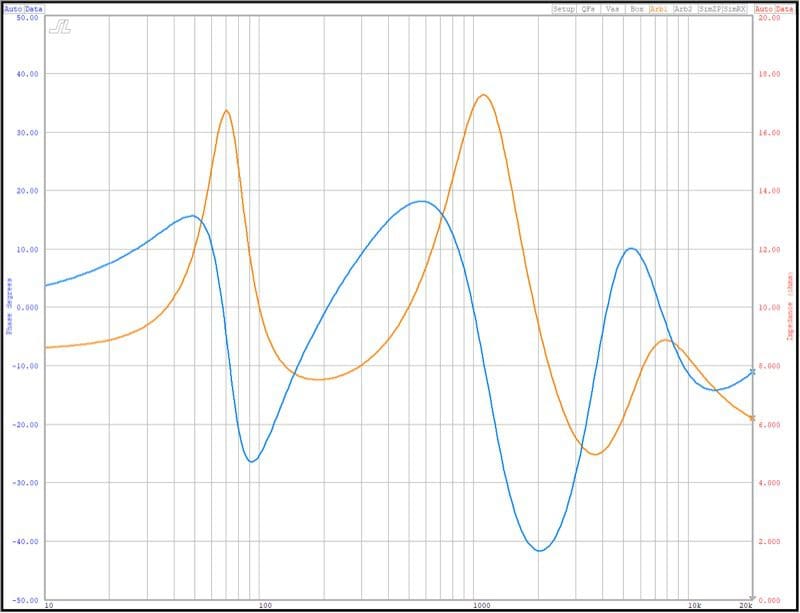
Amplifier Frequency Response
As can be seen from the orange trace, the network starts with an impedance of just under 9 ohms at 10 Hz, then peaks at over 16 ohms at 70 Hz, and again at just under 12 ohms at 1 kHz. It drops 5.5 ohms at 3.4 kHz before another resonance at 7.5 kHz of 8.4 ohms. The blue trace indicates the phase of the load and shows that this is both somewhat capacitive (positive phase shift) and quite inductive (negative phase shift).

Amplifier Response into Reactive Loads

The next step was to repeat the frequency response measurement of our reference amp using a 4-ohm load, a 2-ohm load and our reactive load to demonstrate just how much effect there is on the response.
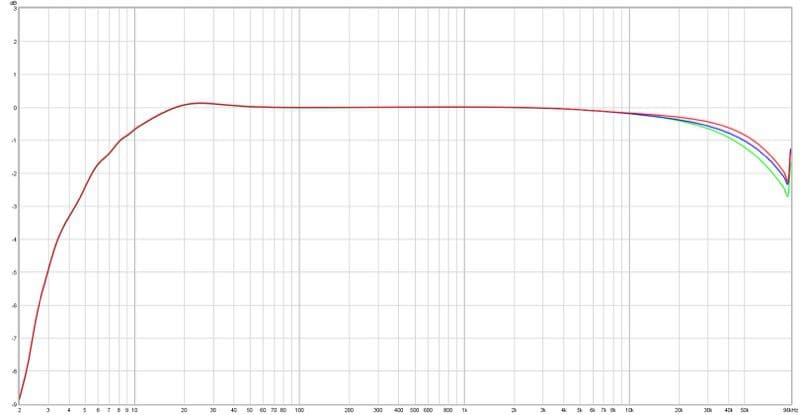
Amplifier Frequency Response
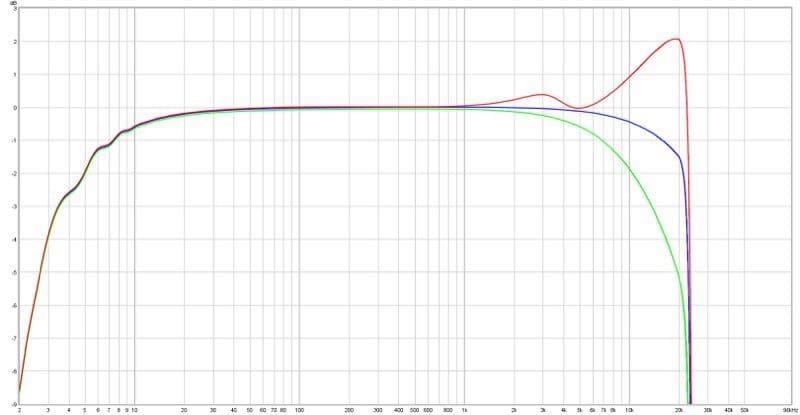
The blue line represents the 4-ohm load, the green is the 2-ohm load and the red is our reactive network.

As you can see, there is a small change in high-frequency response from this amp depending on the impedance of the load. The amp includes some filter chokes on the outputs as part of its variable voltage power supply design. The difference between the 4-ohm and the reactive trace is 0.85 dB at 20 kHz.

What About Inexpensive Amplifiers?

Our reference amp is just that – a high-quality amp that sounds amazing. So, what happens when you perform these same tests on an inexpensive amp? Let’s look and see!
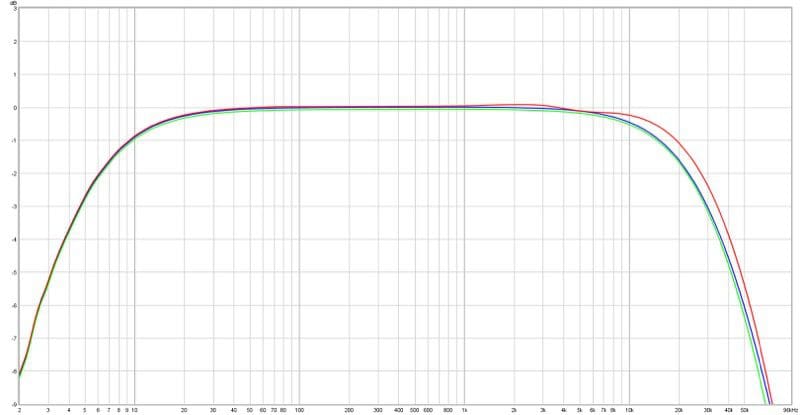
Amplifier Frequency Response

Our cheap amp does a fair job with the resistive loads, rolling off by 1dB around 16kHz on the top and below 10 Hz on the bottom. The red trace shows that there is some emphasis between 2 and 3 kHz caused by the inductive characteristics of the passive filter network. Would that emphasis be audible? That would depend on your level of obsession. You can hear the difference of a few tenths of a dB when adjusting an EQ.

How About Our Class-D Amplifier Friends?

As we mentioned, the small filters on the output of our good amp resulted in a measurable change in frequency response between the varying loads. What happens when we measure a Class-D amplifier that uses large filters on the outputs?
Amplifier Frequency Response

Here we can see that there is a half-dB bump around 3 kHz and more than 2 dB of additional output at 20 kHz as compared to the 1 kHz reference level. Compared to a purely resistive load, the bump at 20 kHz is 3.5 dB more than a 4-ohm resistive load and about 7 dB louder than 2 ohms. If you’ve ever wondered why Class-D amplifiers sound different than a high-quality Class-AB, this is one of the reasons.

Working with Frequency Response Specifications
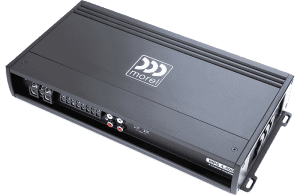
Amplifier Frequency ResponseFor most applications, you can ignore the frequency response measurements of the amplifiers you choose. The majority will be adequately flat from 20 Hz to 20 kHz. If you plan on driving a low-impedance load (low-impedance drivers or many drivers wired in parallel), the added impedance will dramatically reduce the high-frequency performance of a Class-D amp.

If you are planning on building an audio system that is truly high-resolution audio-ready, and capable of playing audio signals beyond 20 kHz, you are going to need to do some homework. Odds are, you’ll want a Class-AB amp for the tweeters, at the very least.

Finally, designing an audio system that uses active filtering will help reduce the variations in impedance caused by passive crossovers.

If you need help choosing an amplifier for your car audio system, drop into your local specialist mobile electronics retailer and talk to one of their product specialists.

Please check out other articles in our series on Understanding Specifications.

This article is written and produced by the team at www.BestCarAudio.com. Reproduction or use of any kind is prohibited without the express written permission of 1sixty8 media.

Filed Under: ARTICLES, Car Audio, RESOURCE LIBRARY

Product Spotlight: WeatherTech FloorLiner HP Floor Mats

04/07/2021 By John Schwartz

WeatherTech FloorLinerWeatherTech, the top brand in vehicle-specific floor mats, has recently released a new product: the FloorLiner HP. Like the original product, these mats are designed specifically to protect your vehicle from dirt, sand, slush and snow, so it looks great and maintains its value. Let’s look at what’s new and unique with these laser-measured, molded-to-fit car mats.

New Rubber Compound

The original FloorLiner products are molded from a durable and somewhat stiff high-density thermoplastic. The new FloorLiner High Performance (HP) mats are made from a more flexible extruded rubber material that lies flat on the carpet in your vehicle. This new rubber maintains the durability you’ve come to expect from WeatherTech while allowing for improved performance in the extreme weather conditions we experience here in Alaska.

Floor Mat Safety Features

WeatherTech FloorLinerAll WeatherTech FloorLiner mats are designed to ensure that you’re safe when driving. In vehicles where there are tethers for the OE carpeted mats on the floor, your new FloorLiner HP mats will lock into place and remain secure. WeatherTech integrates anti-skid nibs and a specially designed retention system into the bottom of the mats to help keep them from sliding when you get in or out of your vehicle. The last thing you want is a floor mat wedged under the gas or brake pedal. The beveled edge of the mats helps to ensure they don’t curve in and allow liquids to get into the carpet.
Environmentally Friendly and Made in the USA

The High Performance mats are made from 100% recyclable materials right here in the U.S. The thermoplastic elastomer (TPE) compound contains no latex, polyvinyl chloride (PVC), lead or cadmium. When it’s time to retire them, they can be transformed into new products without harming the environment.

Of course, WeatherTech stands behind the mats with a lifetime limited warranty. If there are any defects in materials or workmanship while you have the mats in your vehicle, they have you covered.

Upgrade Your Interior Protection with WeatherTech FloorLiner HP Mats

If you have a new vehicle or want to protect your existing pride and joy, drop by Perfectionist Auto Sound and Security in Anchorage and ask a member of our team about the new WeatherTech FloorLiner HP mats for your car, truck or SUV.

Filed Under: PRODUCTS, Truck Accessories Tagged With: Floor Liners, Floor Mats, WeatherTech

Understanding Specifications – Car Audio Amplifier Input Sensitivity

04/04/2021 By John Schwartz

Input SensitivityThe next topic in our look at car audio amplifier specifications is input sensitivity. This specification is easy to understand but is important to choose an amp that will work with the system your local car stereo shop has designed. In the simplest of terms, the sensitivity specification determines how much voltage is required on the input of the amplifier for it to produce full power. Let’s look at it in more detail.

Understanding Amplifier Input Sensitivity Range

Using our high-quality two-channel amp, our measurement equipment can show us just how much, or little, signal is required to produce a specific signal from the amp. We are going to use an output level of 10 watts for this example to keep our bank of load resistors cool and power supply happy.

Input Sensitivity

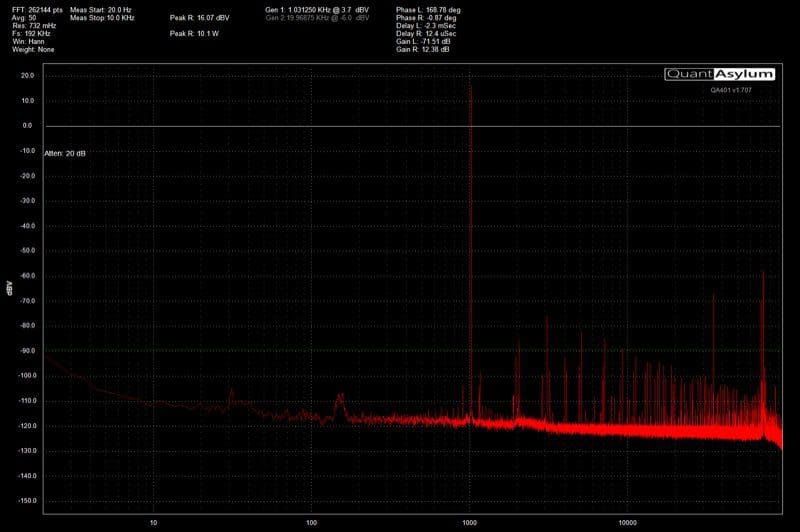
With the sensitivity controls set to their lowest level, our amplifier produces 10 watts of output (6.32 Vrms) from about 1.4 V of input signal. This ratio equates to a system gain of 12.34 dB.

Input Sensitivity

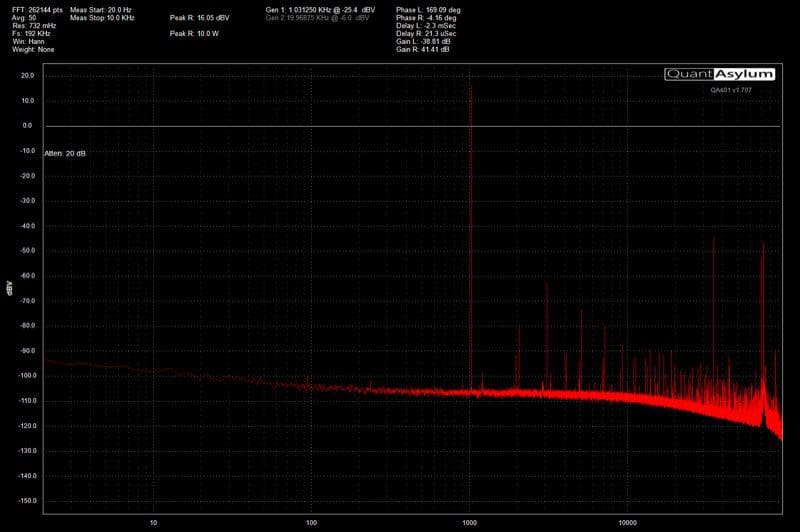
With the sensitivity controls on the amplifier turned to their highest setting, the amp amplifier is capable of producing 10 watts of output (6.32 Vrms) from a mere 54 millivolts rms of signal. This ratio equates to a gain of 41.41 dB.

Why Does Amplifier Sensitivity Matter?

Input SensitivityBeing able to get full power from your amplifier from a variety of signal sources is important to ensuring that your installer can make that amp work with any source. If you have a high-quality aftermarket source unit, the preamp outputs should provide 2 or 4 Vrms of signal with the volume at maximum and a recording at 0 dB.
If you are trying to power an audio system from something like an iPod, you may find that the signal from the headphone jack peaks around 1 Vrms. I tested one of my iPod Nanos at 1.03 Vrms. This lower maximum level means you need more gain from your amplifier.

At the other end of the scale, you may want your installer to connect your amplifier to the speaker outputs of your factory radio or factory-installed amplifier. The voltage from these sources may be as much as 8 V from a radio and could be as high as 40 V from a high-powered factory subwoofer amp. In those cases, you need to choose an amp that has dedicated speaker-level inputs or implement some sort of level converter to reduce the signal to something that the amp can accept.

System Tuning with Input Sensitivity Controls

Input SensitivityWhen it comes to having a fully active audio system installed in your vehicle, unless you choose to implement a stand-alone digital signal processor (DSP), you will want to choose an amp with a lot of adjustability so that your installer can use the sensitivity control to reduce the output of the amp for the tweeters and midrange speakers, relative to the subwoofers and mid-bass drivers. You may find it useful to choose an amp for your tweeters that doesn’t produce a lot of power. Less maximum power output capability will reduce the amount of gain designed into the amp and result in a system that is easy to balance.
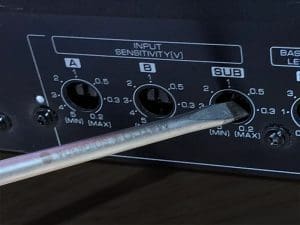
We would strongly recommend using a DSP since it enables you to configure crossover and output level adjustments quickly, but we understand that every audio system upgrade has budget limits. You can always upgrade later.

A Comment on Background Noise

Input SensitivityIf you have understood this article fully, then you realize that more signal from your source unit doesn’t necessarily represent an ability for your amplifier to produce more power, assuming the input sensitivity control is adjusted properly.
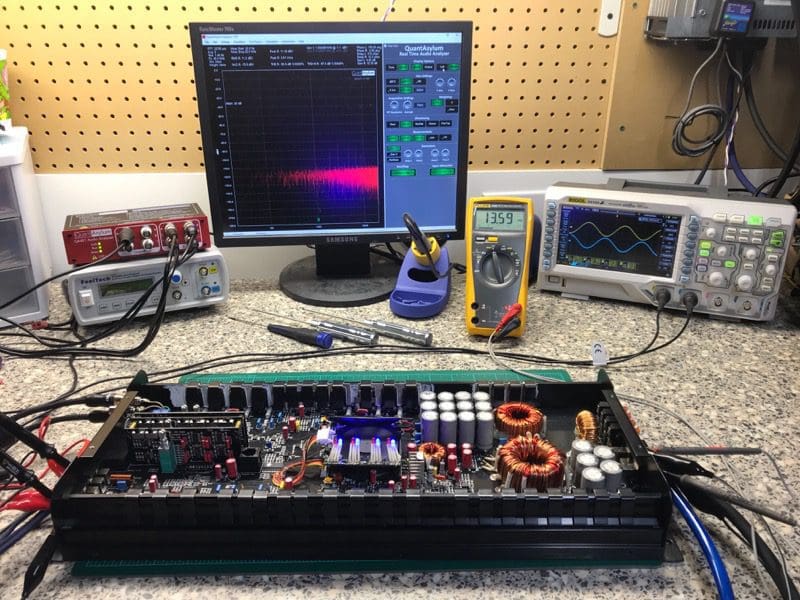
Years ago, when aftermarket source units with high-voltage preamp outputs were introduced, some companies marketed them as allowing stereo systems to play louder. If you didn’t adjust the sensitivity controls on your amp, this was a true statement.

The real benefit of a strong preamp signal is that you can turn down the gains on your amp and subsequently reduce the background noise in your system. Look at the difference in background noise of our high-end audio amp with the gain set at minimum and at maximum. Not all amps perform this well. As long as you can get full power from your amp, less gain means less background noise.

Choose an Amp That Works with Your Car Audio System

In most cases, the name-brand amplifiers available on the market today have the input voltage flexibility required to work in almost any application. Your local mobile enhancement retailer would be happy to work with you to pick a solution that will maximize the performance of your system.

This article is written and produced by the team at www.BestCarAudio.com. Reproduction or use of any kind is prohibited without the express written permission of 1sixty8 media.

Filed Under: ARTICLES, Car Audio, RESOURCE LIBRARY

Understanding Specifications – Car Audio Amplifier Signal-to-Noise Ratio

03/28/2021 By John Schwartz

Amplifier Power RatingsWelcome to our new series about understanding product specifications. Our goal in these articles is to help you understand what the amplifier power ratings mean when you start to compare solutions. We’ll not only explain which numbers are good, but we’ll include a detailed description of what each specification means, how it’s measured and how it affects what you hear or experience. To start the series, let’s look at amplifiers. It’s a subject we’ve chosen because people tend to focus on amplifier specifications more than anything else when shopping.
Why Your Car Audio System Needs Power

Amplifier Power RatingsWithout a doubt, the most popular specification that consumers look at when purchasing a car audio amplifier is its power rating. An amplifier takes the small signal from your source unit and increases it in voltage and current to drive a low-impedance speaker. In a nutshell, the more power you have, the more loudly you can play your car stereo system before the signal going to the speakers distorts. The limit of how much power is required is determined by the power handling specifications of the speakers in the vehicle, their cone excursion limits and their distortion characteristics. We’ll look at those limits in a future article about speaker specifications.
How We Measure Power

When an amplifier is set up in a lab to measure power, it’s typically connected to a power supply and a set of load resistors. Many manufacturers use test equipment from companies like Audio Precision to measure the distortion characteristics of the output signal to determine the point at which you would hear the distortion.

Amplifier Power Ratings
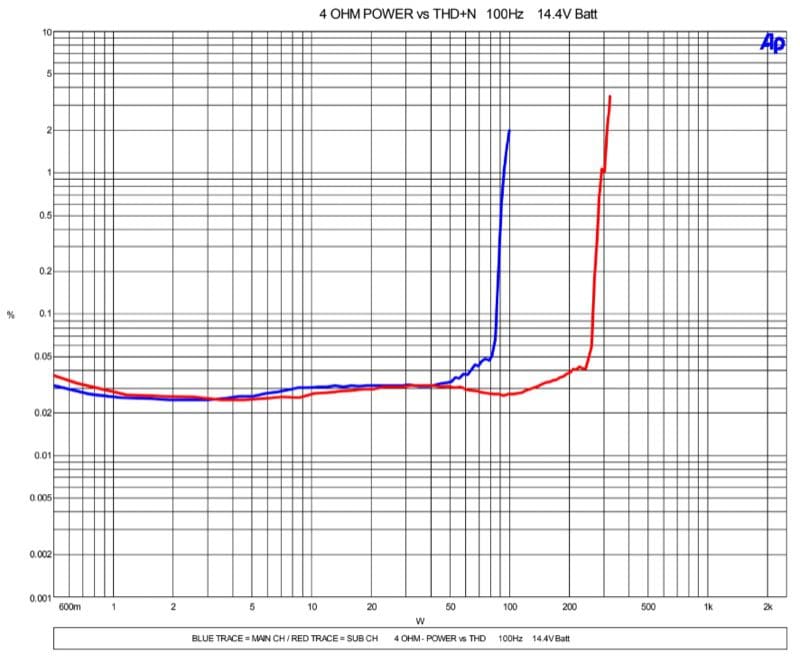
The graph above shows the distortion of two channels of a five-channel amp relative to their power level. The blue trace is one of the four main channels and produces about 95 watts of power at 1 percent distortion. The red trace is the subwoofer channel and shows that the amp produces just under 300 watts at 1 percent distortion.

The Consumer Technology Association (formerly the Consumer Electronics Association) has established a standard for the power and signal-to-noise ratio measurements of car audio amplifiers called CTA-2006-B (formerly CEA-2006-B). The specification states that power measurements are to be taken with the amplifier powered with a voltage of 14.4 volts, and the measurement is taken into a specified load (typically 4 ohms) with no more than 1 percent total harmonic distortion and noise, across the entire bandwidth of the amp.

Amplifier Power RatingsIn layman’s terms, the amp must perform as well producing bass as it does high-frequency information, and the specified power rating cannot include large amounts of distortion. While the 14.4V rating is somewhat high, it establishes a level playing field from which consumers can compare results.
Several companies include additional power measurements to highlight different characteristics and performance features of their products. JL Audio, for example, includes output power ratings tested at 12.5 volts. Rockford Fosgate includes dynamic power ratings taken using the IHF-202 standard. Essentially, the dynamic power rating demonstrates the reserve capacity of an amplifier’s power supply to drive transient signals that last no more than 20 milliseconds.

Do Some Manufacturers Cheat?

Amplifier Power RatingsIf you don’t see the CTA-2006 logo associated with a product you are considering, there are several ways that the numbers may not be directly comparable with other options. One easy way to inflate numbers is to increase the supply voltage to the amp. Depending on the design of an amplifier’s power supply, each additional volt provided to that power supply could theoretically increase the amplifier’s output by about 0.6 dB. That would be like a 100-watt amp being able to make about 115 watts.
Not specifying a distortion rating is another great way to fudge the numbers. Most Class AB amps can produce 60 percent to 70 percent more than their 1 percent rated power if they are driven hard into clipping. Of course, the music no longer sounds like music and you run the risk of damaging speakers because they’ve been over-powered.

Finally, some amplifiers have problems with producing power at the extreme ends of the frequency spectrum. To be compliant with the spec, the amp needs to make the rated power level at 20 Hz through 20 kHz, or whatever the upper limit is for the design.

Do Amplifier Power Ratings Really Matter?

Amplifier Power RatingsIf you are shopping for an amplifier, the power rating does nothing to tell you about the quality of one amplifier compared to another. You don’t need 100 watts to drive your tweeters and you certainly won’t be happy with a 25-watt amp driving a subwoofer in your car.
When you are comparing amplifiers, don’t get your knickers in a knot over a few watts. This applies specifically to amplifiers that come with birth certificates (documentation that states a particular amplifier’s power production capabilities). You can’t hear the difference between an amp that makes 300 watts and one that makes 305 watts. That difference would be a mere 0.07 decibels. You will hear a difference between a subwoofer amp that produces 100 watts and one that can deliver 300 watts.

We’ll add a note about “how things work” here. To increase the output of your audio system by 3dB, you need an amp that can produce twice as much power. So, to go from 90 dB in your car, you need twice as much power from the amp to raise the volume to 93dB and twice as much again to get to 96dB.

Shopping for a Car Audio Amplifier

When it’s time to go shopping for a car audio amplifier to provide more power to your speakers, drop into your local car stereo shop and speak with one of their product specialists. They can help you determine how much power is appropriate for the system you have in mind and choose an amp that sounds great and works with your budget.

This article is written and produced by the team at www.BestCarAudio.com. Reproduction or use of any kind is prohibited without the express written permission of 1sixty8 media.

Filed Under: ARTICLES, Car Audio, RESOURCE LIBRARY

Product Spotlight: Compustar CS697-A Vehicle Security System

03/25/2021 By John Schwartz

Compustar Security

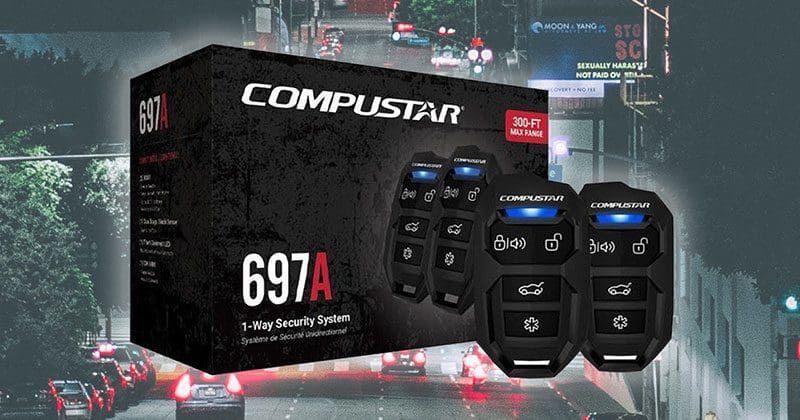
Though best known for its class-leading remote car starters, Compustar is rolling out a new line of vehicle security systems that includes the affordable CS697-A to protect your car or truck. While many vehicle owners believe the security system that comes with their vehicle is adequate, the reality is that those solutions are limited in their capabilities. An aftermarket alarm is the only way to completely protect your vehicle.

Features of the Compustar CS697-A Vehicle Security System

The CS697-A car alarm includes a dual-stage shock sensor, starter disable circuitry and two remote controls. The shock sensor monitors the body of the car or truck for sudden impacts from door dings in a parking lot or an attempt to break a window. Moderate impacts will result in the system honking the vehicle horn and flashing the parking lights. Significant impacts set off the full alarm, flashing the lights and honking the horn for 30 seconds. The system also includes dedicated door monitoring inputs and the ability to monitor the hood and trunk or hatch of your car or SUV. Additional sensors and door switches can be added for commercial vehicles or heavy-equipment applications.

Compustar Security
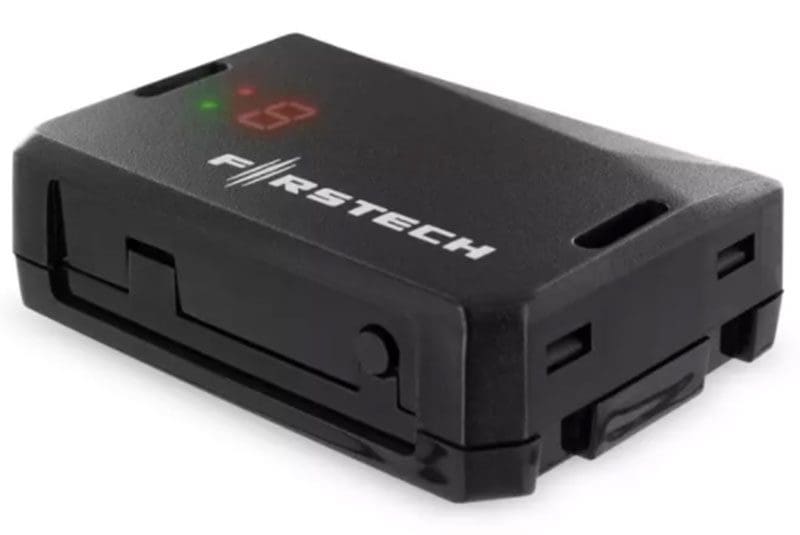
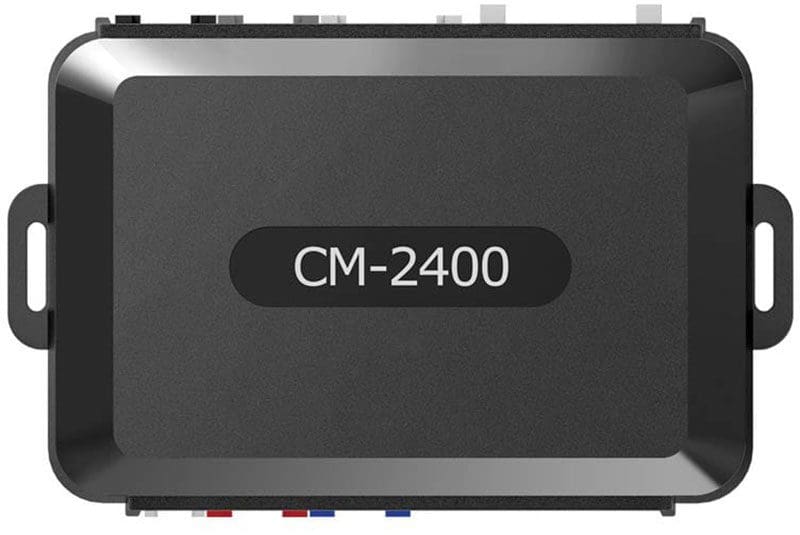
The CS697-A is based on the easily expandable Compustar CM2400 control module.

The system includes keyless entry functionality that will let you lock or unlock your doors remotely. Your installer can integrate the 697-A system with the remote trunk or hatch release function to make loading or unloading easier. The system activates the interior dome light for 45 seconds after receiving the unlock command so you can make sure everything inside is safe before you get in. Finally, two auxiliary outputs are provided to control options like a power sliding door or power window control module for added convenience.

Compustar Security
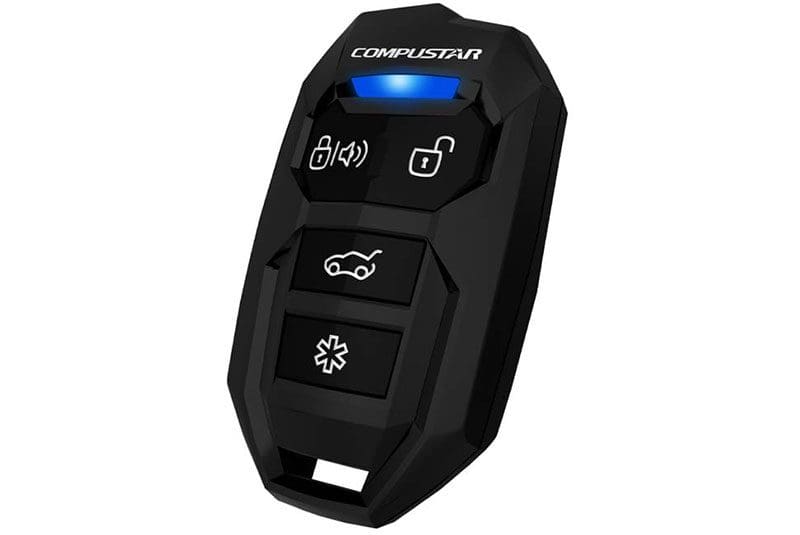
The CS697-A includes a pair of four-button remotes that control the alarm and keyless entry functions.

According to the FBI, almost 250,000 vehicles are stolen in the United States every year. To help combat this, Compustar includes its E-LOCK relay in the 697-A. When properly integrated into your vehicle, this relay functions as a stand-alone starter-kill to further complicate the efforts of thieves hoping to steal your vehicle.

Vehicle Protection Upgrade Options

While this vehicle security system provides a solid set of features, just like Compustar’s remote car starters, it’s based around a control unit that’s easily upgradable. A high-output siren can be added to attract additional attention to the vehicle. Likewise, the DAS-II four-in-one sensor is another popular upgrade as it adds a digital tilt/motion sensor with glass breakage detection. If you’re concerned about wheel or catalytic converter theft, DAS-II is a great option.

You can also add the KP2 touchpad that mounts to the inside of your windshield. You can enter a user-defined code by touching the glass to disarm and unlock the vehicle. You can also choose to upgrade to a two-way remote control that will alert you when the alarm is triggered. If you choose a remote upgrade package like the PRO R5 or PRO T13, the proximity unlock function will unlock the doors automatically when you are within about 6 feet of the vehicle.

Compustar Security
The optional DAS-II sensor adds tilt, motion and glass-breakage monitoring to the CS697-A.

The ultimate upgrade is the Drone telematics system. You can be anywhere on the planet and still receive security warning notifications from your car or truck, so long as your smartphone can access the Internet. Better yet, Drone includes options to add GPS-based features that will send alerts if the car or truck moves while the system is armed or during user-programmable curfew hours. Impact, motion, tilt and glass breakage alerts from the DAS-II sensor are also relayed to your smartphone using the DroneMobile app.

Compustar Security
The DroneMobile app on your smartphone will display alerts from the CS697-A, including those from the optional DAS-II sensor.

Protect Your Investment with an Aftermarket Car Alarm

In 2019, Ford and Ram pickup trucks were the top two most stolen vehicles in the U.S. While these trucks came with factory-installed security, their popularity made them key targets for thieves. An aftermarket security system adds valuable damage and vandalism protection and a second starter-kill circuit that, when appropriately integrated, makes unauthorized starting of the vehicle nearly impossible.

Drop by your local Compustar retailer today to learn more about the CS697-A and its security and convenience options. You can learn more about Compustar car alarm and remote starter solutions by visiting their website, Facebook Page, Instagram Page or their YouTube channel.

This article is written and produced by the team at www.BestCarAudio.com. Reproduction or use of any kind is prohibited without the express written permission of 1sixty8 media.

Filed Under: ARTICLES, PRODUCTS, Remote Car Starters, RESOURCE LIBRARY Tagged With: Compustar

  • « Previous Page
  • 1
  • …
  • 12
  • 13
  • 14
  • 15
  • 16
  • …
  • 82
  • Next Page »

801 EAST 82ND AVE
ANCHORAGE ALASKA 99518
907-563-8112

Copyright © 2026 | Site design by award-winning creative agency D'zine Alaska , with site support by 1sixty8 Media and Modern Media Geeks.