Perfectionist Auto Sound and Security

Alaska's Most Award Winning Auto Customizer

  • About Us
    • Why Choose Us
    • Meet Our Team
    • Our Awards
    • Virtual Tour
    • Community Engagement
  • Signature Products
    • DroneMobile
    • SoundShield®
  • Services
    • Remote Car Starters
      • Vehicle Security
    • Car Audio
      • Sound Deadening
    • Custom Fabrication
    • Driver Safety
      • Bluetooth
      • Blind Spot Safety Systems
      • Camera Systems
      • Navigation Systems
    • Laser And Radar Detectors
    • Lighting
    • Offroad and Marine
      • Motorcycle Audio
    • Custom Interiors
    • Performance
      • Tires and Wheels
      • Suspensions / Lift & Lower
    • PRO Commercial Division
  • Gallery
    • Photos
    • Videos
    • Wallpaper Downloads
  • Contact Us
    • FAQ
    • Feedback
    • Join Our Team

How to Buy a Car Audio Subwoofer

07/03/2016 By John Schwartz

Car Audio SubwooferAdding a subwoofer to a car audio system is the best bang for the buck regarding audio performance upgrades. You can instantly hear the difference, and it dramatically improves the realism and enjoyment of your system. Let’s look at how to pick a car audio subwoofer for your vehicle.

Factory Audio System Limitations

Subwoofer SystemBefore we get into how to choose a car audio subwoofer system for your vehicle, let’s examine why a subwoofer is such a great upgrade. In a nutshell, factory audio systems are designed around a budget – both monetary and weight-related. When automakers start looking at car audio products, price is often their primary concern. Automakers also work hard to reduce vehicle weight as much as possible, thereby reducing fuel consumption and, subsequently, environment emissions from the vehicle. This means that the performance of even these so-called “premium” factory audio systems is mediocre at best, and typically can be quantified as disappointing.

A factory audio systems that does happen to include a subwoofer is often limited in the amount of power available for the sub. The subs themselves are typically small, and the speaker cones can’t move very far to produce sound. Finally, the enclosures are often extremely compact, further limiting low-frequency sound reproduction. These limitations combine to produce bass that, if it seems to exist at all, won’t play very loud, doesn’t play very deep, and lacks clarity and definition.

Retail To The Rescue!

Subwoofer SystemA specialist car audio retailer can work with you to design a subwoofer system that can offer an octave or two more low-frequency output. With the availability of subwoofers designed specifically to fit into small enclosure volumes, these subwoofers can be hidden inside storage compartments, inside your spare tire or in the footwell of almost any vehicle. Gone are the days when all your storage space has to be sacrificed for great sub-bass.

Before we delve into how to pick a sub, don’t let the stereotype of “booming bass” sway you from adding a subwoofer. Just as every home theater system includes a subwoofer to accurately reproduce low frequencies, the addition of a subwoofer to your vehicle will add accuracy and realism. Subwoofers make your music sound bigger and more lifelike by letting you hear and feel frequencies as low as 20 Hz. A sub also takes the load off the smaller door and dash speakers that aren’t capable of making accurate or deep bass.

Starting The Process

Car Audio SubwooferBefore you head out to your local car audio specialist to inquire about a subwoofer system, there are a few things you should do. Accurately quantify your goals for the subwoofer – are you looking to “warm up” the system, are you trying to rattle your fillings loose or something in between? It’s important that you know what you want. A properly designed system with adequate speaker cone area and power will sound dramatically better than an undersized system pushed to its limits.

As with any purchase, have a rough idea of your budget ahead of time. Consider that there will be some installation cost and additional expenses for wiring for the amplifier and vehicle integration.

Finally, have a look at your vehicle and consider how much space you want to dedicate to the subwoofer system. As mentioned, it doesn’t need to be much these days, but every subwoofer needs a proper-size, properly built enclosure.

Auditioning Car Audio Subwoofers

Listening to a subwoofer in a vehicle is highly useful. The small space inside the vehicle boosts low frequencies more than a larger listening room. Once you have established a reference for how a specific subwoofer in a specific enclosure sounds in the vehicle, then you can listen to different options in the showroom for changes compared to that reference.

As with any listening session, you will want to use music you are familiar with, preferably something you have listened to dozens, if not hundreds, of times. In the case of a subwoofer, the performance of the speakers that are playing with it can affect the perception of its quality, so choose something similar to what you will be using. You will want to focus on three aspects of the subwoofers performance: frequency response, how loud it will play and how accurate it is.

Regarding frequency response, you will want to listen to how loud different frequencies are. Some subwoofers produce a lot of energy in the 50–70 Hz range, some between 30 and 50 Hz, and some play well below 20 Hz. You need a find a balance that accurately reproduces your music and meets your performance goals. High-quality subwoofers can be very musical, accurately defining subtle nuances between each different frequency. A pipe organ, piano, harp, bass guitar, contrabassoon and even a tuba all play into the range of a common car audio subwoofer. In fact, some male voices extend down to 65 Hz or lower. The best subwoofers offer smooth and extended frequency response while remaining tight and dynamic.

Quantifying how loud a subwoofer will play has a great deal to do with what type of enclosure it is installed in, and how much power you have to drive it. The limiting factor on output is cone area and how far the speaker cone can move – we call this excursion. Without accurate measurement equipment, all you can do is decide if the combination of the subwoofer, amplifier and enclosure you have chosen meets your needs.

A Word On Car Audio Subwoofer Enclosures

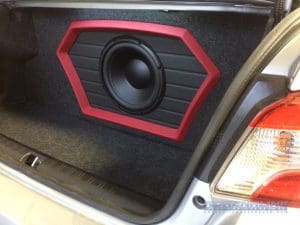
Subwoofer System
Image Courtesy Of Adrenaline Autosound

There are four common ways of installing a subwoofer in a vehicle. If you have a trunk, you can have your installer create a baffle that separates the trunk from the interior of the vehicle, and install the subwoofer in that baffle. That is known as an infinite baffle installation. You need a subwoofer that was designed specifically for that kind of application.

More common is a sealed enclosure, known formally as an acoustic suspension enclosure. These are forgiving regarding their volume requirements and can offer very smooth frequency response when combined with the output gain that most vehicles offer.

Perhaps the “most fun” of all subwoofer enclosures is the ported design, known as a bass reflex enclosure. In these, which are larger than a sealed enclosure, there is a vent of a specific area and length that uses the back-wave (sound coming off the back of the subwoofer cone) to help reinforce the output. You get more bass output for the same size subwoofer.

Finally, the most complex of enclosures commonly used is the bandpass design. In these, the enclosure acts to filter out high-frequency information. These enclosures sound the best when you have great-quality midbass drivers in the system.

An entire article could be dedicated to the benefits of one enclosure design over another, but your car audio retailer can help steer you toward the correct one for your application.

If you are thinking of upgrading your car audio system and you do not already have a subwoofer, drop in at your local car audio specialist right away! There are enclosures not much larger than a shoe box that can make a dramatic difference in the way your system sounds. If you want something more significant, that is easily arranged. Take along your favorite music and have a listen. Adding a subwoofer not only makes a huge improvement, but can be a lot of fun!

This article is written and produced by the team at www.BestCarAudio.com. Reproduction or use of any kind is prohibited without the express written permission of 1sixty8 media.
Filed Under: ARTICLES, Car Audio, RESOURCE LIBRARY Tagged With: Subwoofers

Car Audio Amplifier Buying Guide

06/26/2016 By John Schwartz

Car Audio AmplifierOne of the most critical components in a high-quality vehicle entertainment system is your car audio amplifier. While the concept of increasing the power of an audio signal is simple, it can be somewhat complex to execute elegantly the process. Amplifier design is as much as science as it is an art form. In this article, we will look at everything you need to know to buy the right amplifier for your system.

How We Measure Car Audio Amplifiers

Car Audio AmplifierFor more than 100 years, people have been using amplifiers to take a small audio signal and increase its power so it can move a speaker. We measure an amplifier’s capacity to do work in watts. Before the industry had a reference set of guidelines for measuring amplifier power, we would see outrageous claims from otherwise minuscule products. The Consumer Technology Association (formerly the Consumer Electronics Association) has worked with industry experts and manufacturers to produce a set of standards to allow the power produced by different brands, makes and models of amplifiers to be comparable. This standard is currently known as CEA-2006A. When you see the associated logo on a product, you can be confident that the power specifications are real and directly comparable.

Features Help Increase Performance

Modern car audio amplifiers are equipped with many different features. These can include crossovers, bass boost circuits, remote level controls and equalization. Crossovers allow your installer to limit the range of frequencies that the amp will reproduce. In the case of a subwoofer amplifier, we can send the entire audio spectrum to the amp. With a low-pass crossover set, only those frequencies below the crossover point will be amplified and sent to the speaker. A high-pass crossover does the opposite, sending only high-frequency information from the input to the output of the amp.

Car Audio AmplifierLimiting which frequencies pass through the amplifier allows the speakers to operate within the frequency range for which they were designed. You wouldn’t want bass information to be sent to your tweeters, nor would you want midrange and high-frequency information to be sent to your subwoofer. Almost every car audio amplifier includes crossovers.

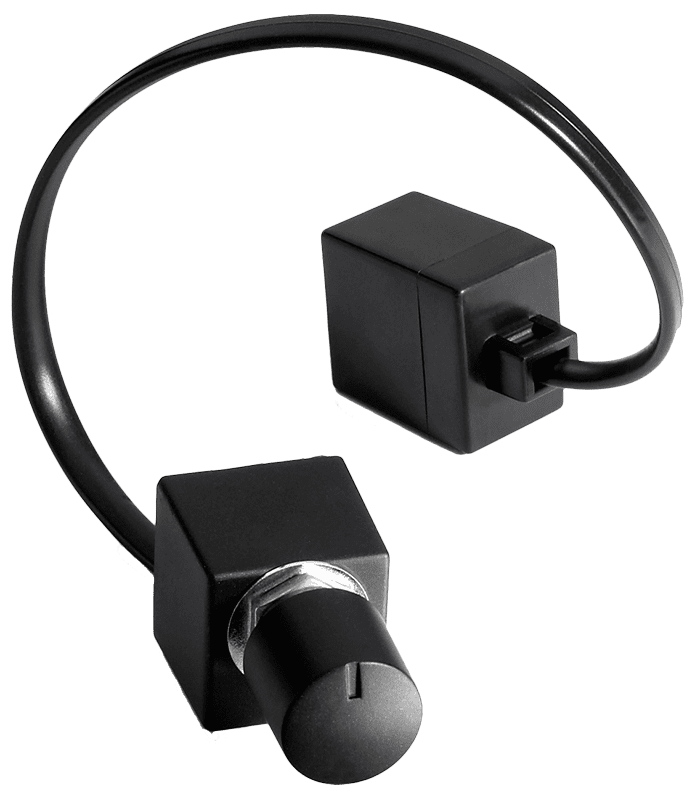
Infrasonic or subsonic filters and bass boost controls are additional tuning options that can be used to help maximize the performance of a dedicated subwoofer amplifier. A remote level control – something also found on most subwoofer amplifiers is a volume control for the amp that can be mounted in the front of the vehicle. This control gives you the option of fine-tuning the amount of bass right at your fingertips.

Auditioning a Car Audio Amplifier

Car Audio Amplifier
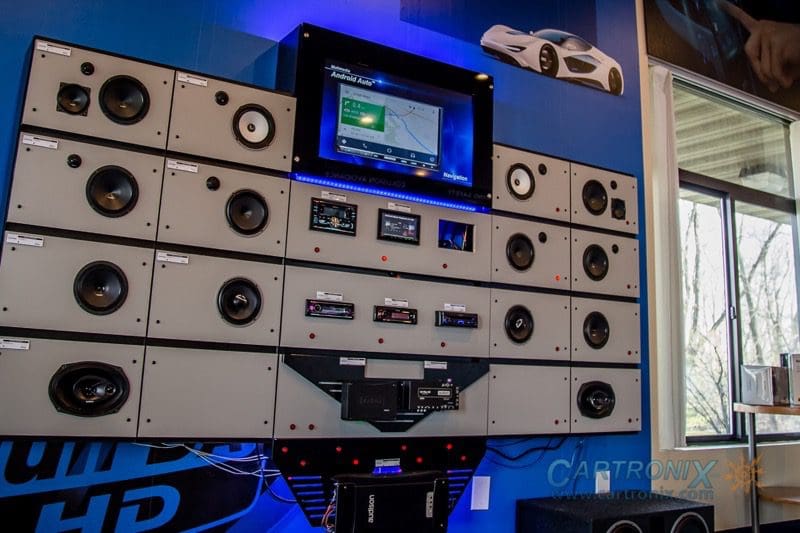
Image Courtesy Of Cartronix.com

Quantifying the performance of a car audio amplifier can be very difficult. The speakers connected to the amplifier are an infinitely bigger contributing factor to how a system sounds. To properly audition an amp, you need to compare it to another using the same set of speakers. A display board in a car audio specialty retailer is a great way to do this. You will want to ensure that the volume level of all amplifiers is the same for the comparison to be valid.

How can the design of an amplifier affect the way it sounds? There are always exceptions, but for the most part, whether the amp is a Class AB or Class D design can have an effect on the high-frequency performance. Class AB amps are often more detailed in the highest of frequencies. Switch back and forth between amplifiers on a display and listen to the ring of a crash or ride cymbal, or that of a triangle. You want to hear clarity and detail.

At the opposite end of the spectrum, the impact and definition of lower frequency information can show off differences in the design of an amplifier’s power supply and the way the amp behaves when amplifying a complex signal. What you want to listen for is the perceived “speed” of the car audio amplifier. When a drummer hits the rim of a tom with his stick or the skin of the bass drum with the pedal, you want be startled. It should be very tight and controlled. The sound should be clear and natural.

One thing you don’t want to hear is warmth. While this goes against what many people perceive as good, warmth can be a sign of even-order harmonic distortion. The best amplifiers don’t change the sound; they just make the signal louder.

What’s Right For You?

When it comes to choosing an amplifier for your mobile entertainment system, the right amp for you is the one that fulfills your system requirements. A four-channel amplifier has always been a great starting point for system upgrades. They can be used to run four speakers and a subwoofer. If a dedicated subwoofer amp is added later on, that four-channel amp can do an even better job of powering those same four speakers. A lot of specialists like to use a four-channel amp to power a set of midrange tweeters and some form of electronic crossover to split up the audio signal between the two.

Amplifiers are available with one to eight channels at power levels from 35 watts per channel to almost 20,000 watts. Always make sure you have enough power for your system. If saving for another few weeks will let you purchase a more powerful amp instead of one that is “just enough,” it is well worth waiting.

The Latest And Greatest

Car Audio AmplifierIn the past few years, many companies have introduced car audio amplifiers that include powerful DSP processors. These signal processors provide your installer with more control over system crossovers and add time-alignment and advanced equalization options. In the hands of an expert installer, this can add amazing accuracy and realism to a system. When tuned properly, they are the icing on the cake!

A Word About Installation

While car audio amplifiers seem like one of the easiest components to install in a vehicle, the challenge of sourcing a proper audio signal for that amp from a factory radio and dealing with varying current delivery challenges found in today’s automobiles can make proper installation difficult. Having an experienced technician at a car audio shop install and configure your amp is highly recommended. In many cases, manufacturers offer an extended warranty when their products are installed by an authorized dealer.

Visit your local car audio specialist retailer and bring along your favorite music. Listen to as many different amplifiers as you can, then choose the one that meets your system needs, your performance goals and your budget.

This article is written and produced by the team at www.BestCarAudio.com. Reproduction or use of any kind is prohibited without the express written permission of 1sixty8 media.
Filed Under: ARTICLES, Car Audio, RESOURCE LIBRARY

The Importance Of Professional Mobile Electronics Installation

06/20/2016 By John Schwartz

Installation
Photo courtesy of Prestige Car Audio And Marine

Several aspects of the automotive industry have always been embraced by hobbyists and do-it-yourself enthusiasts. Being able to say that you created something with your own bare hands would make anyone feel proud. In the mobile electronics industry, carmakers have been rapidly advancing the technology used in new cars. From computer data networks and advanced vehicle construction materials to elaborate factory audio system tuning, all of these technologies present unique challenges that many people simply aren’t aware of. Failure to compensate for these can wreak havoc with your vehicle’s electrical system, damage the products you are installing or simply result in poor performance from your audio equipment.

Let’s look closely at why it’s best to put the reliability of your vehicle, and the performance of your audio equipment, in the hands of a shop offering professional installation.

Computers

Installation
Photo courtesy of Cartronix.

Automobile manufacturers are always striving to make their vehicles as fuel-efficient as possible while offering the latest technologies and features. One way they save weight is by putting different devices and computers on a computer data network. Rather than running a myriad of control wires from component to component, they run power and ground, and a pair of data wires. Everything from door locks and trunk release modules to ABS brake and traction control systems can talk to each other on the data network.

Where these networks pose a challenge is when you want to add or remove something from the vehicle. Say you have a vehicle that has a secondary radio display in the dash, but you want to upgrade your audio system. The display may get very upset when you take the radio away. Likewise, you typically can’t add new devices to the data network to add new features.

Your car audio specialist retailers have the experience to work with these data networks. They know what interfaces are available for options like a remote starter or backup camera integration, and they have the manufacturer support to program and install them without causing Check Engine or MIL lights.

Reliability

When working on a vehicle, there are many different ways to run wires and make electrical connections. Automotive mechanics know that it’s hard to beat the knowledge and experience that a veteran car audio installer possesses when it comes to working on vehicle electrical systems. They make dozens, if not hundreds, of electrical connections each and every day.

InstallationThe connections are electrically sound, offering little to no resistance to current flow. Equally, the connections are mechanically sound, ensuring that they will be at least as reliable as the factory connections, if not much better.

Finally, many shops use materials like split loom, nylon sleeves or cloth tape to protect wires as they run through the vehicle. These protective coverings also make the wiring look as if it came from the factory.

Product Warranty

Many mobile electronics manufacturers offer extensions on their product warranties when the products are sold and installed by an authorized dealer. Authorized retailers have been trained on the features of the products they sell. In the case of high-end brands, this training often extends to techniques and methodologies that make the products sound better in your vehicle, and subsequently last longer. The proper installation and configuration of mobile electronic components is the key to their performance and reliability.

Audio Integration

Installation
Photo courtesy of Prestige Car Audio And Marine.

Factory audio systems are becoming more and more complicated. They still don’t rival what is available from the aftermarket, but they have improved. One big step automakers have made in the performance of their audio systems is in their tuning. More and more factory source units and amplifiers include advanced equalization and time correction to maximize the performance of the audio system. When it comes time to upgrade these systems, installers have the techniques and equipment required to test the signals going to the speakers to determine if signal correction is required. If you omit signal correction when installing a new speaker, the tuning that made a cheap factory speaker sound mediocre will work against you, and make a great speaker sound only so-so. Factory audio system signal measurement and correction is now a way of life for a car audio installer.

Modern Vehicle Chassis Design

Did you know that automakers are now using aluminum panels in the construction of their vehicles? In the ongoing battle to reduce weight, the use of aluminum will continue to increase year after year. The downside for the mobile electronics enthusiast is that aluminum is not as good a conductor of electrical current as steel is. In fact, pound for pound, it offers 30% more resistance to the flow of electrical current. This dramatically affects the amount of current we can deliver to high-power audio amplifiers.

Worse than the fact that they are using aluminum is that they have also started using structural adhesives to bond panels together. Spot welds are quick, but they only connect a small area. A good bead of 3M, Loctite or Proform structural adhesive between two aluminum panels connects the entire overlapping surface of the panel together. There is less chance of movement and less chance of corrosion. There’s a downside to this as well: These structural adhesives do not conduct electricity.

If you work with experienced installers, they know how to deal with vehicles that have aluminum chassis and/or adhesive construction. Failure to compensate for these modern construction methods could result in damaged equipment and poor performance.

Choose Professional Installation

For most people, their vehicle is their second-most expensive purchase after their homes. When it comes time to have work done, the knowledge and experience of a trained professional can help ensure that you get all the performance you want from your purchase without any of the headaches of non-professional installation. Contact your local car audio specialist retailer today.

This article is written and produced by the team at www.BestCarAudio.com. Reproduction or use of any kind is prohibited without the express written permission of 1sixty8 media.

Filed Under: ARTICLES, Car Audio, RESOURCE LIBRARY

Adding an Auxiliary Input to Your Factory Radio

06/14/2016 By John Schwartz

Auxiliary InputA message that mobile enhancement retailers strive to share is that we want you to come to us with your feature requests or ideas. If you want a remote starter or audio system upgrade, you know to come to us – but did you know we also can install heated seats, auto-dimming mirrors or auxiliary input jacks on factory audio systems? We can, and our prices are often much less than dealer options or upgraded trim packages on new vehicles. Let’s look at a few options for auxiliary input additions.

Why Would You Want an Auxiliary Input?

Auxiliary InputWe all seem to have at least few hundred of our favorite songs stored on our cellphones or portable media players. We listen to them while we are out for a walk, grocery shopping or even at our desks at work, but we can’t always listen in our cars or trucks. If your factory radio doesn’t have Bluetooth or a USB port to which you can connect your phone, then there is no easy way to enjoy your music. In addition, in many states and provinces, it is illegal to wear headphones while driving. What is the solution? We can add an auxiliary input to your factory radio.

An auxiliary input interface allows you to connect the 1/8-inch headphone jack output of your smartphone or media player to your radio. Once it is connected, you can listen to your music through the factory radio and speakers.

Optical Connection

Auxiliary Input
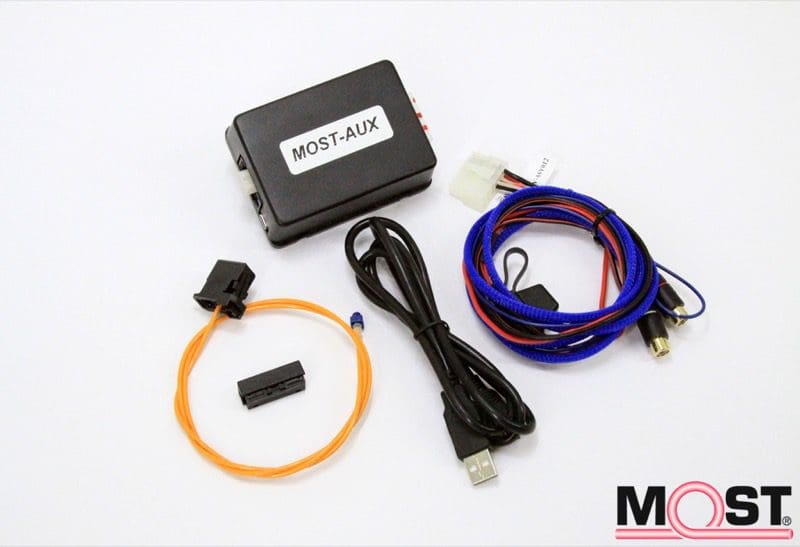
NAV-TV MOST AUX adapter

Many European vehicles, such as Porsche, Mercedes-Benz, Range Rover, Audi, BMW, Aston Martin, Jaguar and Bentley, use a digital fiber optic bus communication system called MOST for multimedia and audio transfer. MOST stands for Media Oriented Systems Transport. This fiber optic system handles audio signals between the radio, Bluetooth, and iPod modules and amplifiers. In many models of the vehicle brands listed above, we can add an in-line module that provides a stereo auxiliary input. No need to replace the expensive radio. Just connect to your smartphone’s headphone jack and enjoy.

Wired Connections

Auxiliary InputSeveral companies manufacture auxiliary input interfaces that mimic the presence of an optional satellite radio tuner module. The interface will have a stereo input connection for your music and will connect to your factory radio via the satellite radio tuner interface port. Just press the Sat button to activate the input.

Many older vehicles on the road had the option for a CD changer. We can provide an auxiliary input interface for many of these vehicles that allow you to connect your portable media player or cellphone to these radios. To select the aux input, just press the CD changer button.

RF Connection

For decades, one of the most popular methods of feeding and audio signal into a radio that didn’t have a dedicated auxiliary input was to use an FM Modulator. These devices would take the audio signal from your media player or phone, and transmit that into your radio via the FM receiver. You would turn the modulator on, tune to a specific radio station (which is selectable so it doesn’t interfere with a local station), and voila – you could hear your music. These are still available when a wired connection is simply not possible. The sound quality is limited by the FM receiver of your radio, but it’s better than listening to your music via the speaker built into your phone.

Visit Your Local Car Audio Specialist Today

While there isn’t an auxiliary input interface available for every make, model and trim level of vehicle, a lot are covered. Drop by your local car audio specialist retailer to see if one is available for your vehicle. You will likely want to have the shop install the interface for you – they know how to take apart the dash or remove the radio without damaging anything. And they know the best places to power the new interface. Boy, are they ever smart!

This article is written and produced by the team at www.BestCarAudio.com. Reproduction or use of any kind is prohibited without the express written permission of 1sixty8 media.
Filed Under: ARTICLES, Bluetooth, Car Audio, RESOURCE LIBRARY

Your Amplifier’s Gain Control Is Not A Volume Control

06/10/2016 By John Schwartz

Gain ControlFor decades, car audio enthusiasts have been fiddling around with the gain control on their amplifiers in hopes of “getting more out of them.” Many professional installers have scientific, repeatable processes in place to ensure these controls are set to provide the maximum performance and reliability from your audio system. Let’s look at the most misunderstood, and most often adjusted, control on car audio amplifiers – the gain control.

What Is a Gain Control?

When a manufacturer decides to develop an amplifier, they need to decide how many channels it will have, how much power it will produce, what additional features it will include and what source units it will work with. Because modern source units have maximum preamp output voltages that range from 1.7 to 5 volts, amplifiers have to be adjustable to make their full rated power when driven with these signals.

Gain ControlLet’s make up an example: Imagine a 100 watt mono amplifier that was designed to produce full power (100 watts) when it receives 2 volts of audio signal. This is a reasonable amount of signal gain, but leaves us open to two significant problems. What if we want to use this amplifier with a source unit that can only produce 1.7 volts? We can’t get the amplifier to full power even with the volume control on our radio turned all the way up. In fact, we only get 72.25 watts out of our amplifier. On the flip side, if we have a source unit that can put out 4 volts of signal, then the amp would attempt to make 400 watts with our fixed gain setting. Since the power supply of the amp was only designed to provide enough voltage to produce 100 watts, the signal would be severely clipped and distorted, and there is a great chance that the amplifier and your speakers might be damaged.

The Solution

For a single amplifier to work with multiple sources, amplifier manufacturers have to make the input signal level adjustable. We call this the gain or sensitivity control. It doesn’t adjust how much power the amplifier will make, but it does adjust how much of the input signal the amp uses to make full power.

There is a secondary reason for adjustability: Not every speaker has the same sensitivity. This means that sometimes you have more power than you need. Let’s say your front speakers produce 90 dB of output from 1 watt of power, but your rear speakers are much larger and produce 93 dB of output from the same 1 watt of power. For them to appear to be of equal loudness at the listening position, we only need half the power to the rear speakers. We turn down the sensitivity of the rear channels of an amplifier to balance these out.

Making Gains (Using Your Gain Control!)

Your installer may use one of many different processes to adjust the gain controls of your amplifier. We want the gain controls to be as low as possible, but still allow you to get full power from the amplifier. Why do we want the gain low? That is, perhaps, the fundamental key to this article.

We want the amplifier to accept an input signal with as much voltage as possible for it to produce full power. Having more voltage on your interconnect cables helps drown out noise. Less amplifier sensitivity (lower gain setting) also helps to reduce noise. When the amplifier gains are set properly, you get full power from your amp without unnecessary hiss or background noise.

There are four common methods for adjusting gain controls: by ear, with a small amplified speaker, with an oscilloscope or with a distortion detection device. Setting by ear with music is very difficult and can lead to inconsistent settings. That being said, if your installer uses a test tone, the “by ear” process can work quite reliably. Using a small amplified speaker is similar to that process – there is a test tone, but the small speaker allows your installer to check the preamp signal from the source unit, and in and out of any signal processors.

Gain ControlUsing an oscilloscope to set an amplifier’s gain control is one of the best ways to get an accurate reading. Oscilloscopes work for any frequency, so they are very flexible. Your installer can see exactly when the amp has reached its peak voltage.

Finally, companies like D’Amore Engineering and SMD have developed products designed specifically for mobile electronic installers to check for signal distortion on preamp or speaker signals. All you have to do is plug the device in and turn it up until the red Distortion LED comes on. Bam – done! A word of warning on these devices, though: They are very accurate and can detect distortions other than signal clipping. Many product design problems have been found when attempting to set gains with these.

How Can You Check Your Gains?

If the sensitivity controls on your amplifiers are set properly, you should be able to get your amplifiers to distort a little bit with the source unit at full volume. If you are wondering why a properly set amplifier will distort, that’s a great question. It’s called gain overlap. We want to have a little extra sensitivity in case we are playing a song that is recorded quietly. A great example of this is the well-known “Brothers In Arms” album by Dire Straits. It needs a good 5 extra dB of gain to get rocking. In fact, the original 1985 release from Warner Brothers Records had several songs where the loudest part of the song was below -5 dB. “Why Worry” has a peak level of -13.27 dB. A nightmare for an installer trying to set gains, but, luckily, that’s not a song most people rock out to.

If you can’t turn your volume control past halfway without your amplifiers running out of power (distorting), then it’s time to visit your local mobile electronics specialist. Likewise, if you hear a significant amount of hiss at low volume levels, then you likely need an adjustment.

Properly set gain controls won’t make your system quieter, and turning up the sensitivity doesn’t make your amplifier more power. Gain controls exist to ensure that your system is always working the best it can. Please leave them alone, or ask your installer about how they are set.

This article is written and produced by the team at www.BestCarAudio.com. Reproduction or use of any kind is prohibited without the express written permission of 1sixty8 media.

Filed Under: ARTICLES, Car Audio, RESOURCE LIBRARY

  • « Previous Page
  • 1
  • …
  • 39
  • 40
  • 41

801 EAST 82ND AVE
ANCHORAGE ALASKA 99518
907-563-8112

Copyright © 2026 | Site design by award-winning creative agency D'zine Alaska , with site support by 1sixty8 Media and Modern Media Geeks.