Perfectionist Auto Sound and Security

Alaska's Most Award Winning Auto Customizer

  • About Us
    • Why Choose Us
    • Meet Our Team
    • Our Awards
    • Virtual Tour
    • Community Engagement
  • Signature Products
    • DroneMobile
    • SoundShield®
  • Services
    • Remote Car Starters
      • Vehicle Security
    • Car Audio
      • Sound Deadening
    • Custom Fabrication
    • Driver Safety
      • Bluetooth
      • Blind Spot Safety Systems
      • Camera Systems
      • Navigation Systems
    • Laser And Radar Detectors
    • Lighting
    • Offroad and Marine
      • Motorcycle Audio
    • Custom Interiors
    • Performance
      • Tires and Wheels
      • Suspensions / Lift & Lower
    • PRO Commercial Division
  • Gallery
    • Photos
    • Videos
    • Wallpaper Downloads
  • Contact Us
    • FAQ
    • Feedback
    • Join Our Team

Music Listening Preferences

06/21/2020 By John Schwartz

Music ListeningWhen it comes to designing car audio systems, retailers need to take into account how their clients want their music to sound. Everyone seems to have different preferences for the amount of bass or high-frequency content. These tonal balance preferences can change based on the choice of music and the listener’s mood. In most cases, a well-designed sound system can handle any music listening preferences.

A preference that is harder to change is where the music seems to come from. Many mobile audio aficionados prefer the music to come from a virtual soundstage as much in front of them as possible. Many people also prefer their music to wrap around them, with as much coming from behind as in front.

There is no right or wrong, so long as you are happy with the way your system sounds.

In this article, we discuss how the client’s preferences can affect the way a mobile audio system is designed. We’ll also look at a few options for the performance of these systems.

Recording Studio Sound

Music ListeningUp until recently, most recording studios used a pair of high-quality speakers placed equidistantly in front of the mixing console. The recording engineer would balance the level and placement of the instruments and performers, using these speakers as his reference. The result was a soundstage that spanned the distance between the speakers.

Attending an outdoor concert may yield a similar listening experience. In a venue like that, the sound comes from in front of you – be it the sound created directly by the instruments, or from the PA gear set up on or beside the stage.

In your car, this can be recreated by focusing on the placement and quality of the front speakers. A good set of components can offer similar performance. Adding a digital signal processor (DSP) can dramatically improve the accuracy of the system by compensating for frequency response, arrival time and speaker volume level differences. When you listen to a quality recording, each performer will seem to be in a specific location on the soundstage.

What about Club Sound?

Music ListeningThere are lots of ways to describe the experience of having the music come from all around the vehicle, but the analogy of a nightclub or – as we old fogies like to call them – a disco might work best. The concept here is that the music will seem to come from all around you. Unlike a performance where you can point to the source of sound from each instrument, it envelops the listening space. In most of these systems, we still balance the system with dedicated left and right channels.

What about those cars and trucks with all the PA speakers in the doors? Not a pair of speakers, but something like eight speakers in each door, with several high-efficiency bullet tweeters. In these designs, if indeed the goal is sheer volume, it might make more sense to forego keeping the music in stereo and use a processor to combine the left and right channel, so it’s simply as loud as possible.

You Haven’t Mentioned a Concert Hall

Music ListeningYou may have noticed that we haven’t talked about a live performance that takes place in a concert hall or indoor venue. This has been quite deliberate.

Imagine heading out for dinner to a local restaurant that has a small band playing. Maybe it’s rock music with a guitarist, bassist, drummer and lead singer. Or perhaps it’s a three-piece jazz ensemble with a piano, saxophone and upright bass. If the performance is acoustic, other than for an amp for an electric guitar or bass, the source of the music will be easy to define as coming from the instruments – but that isn’t the extent of the experience.

Every confined space, except an anechoic chamber, causes the sound to reflect off the floors, walls and ceiling. You hear the music directly from the instrument or performer first, then those same sounds as they reflect off objects and surfaces. The total experience is defined by the mixture of all these sounds.

Live Performance Sound

Music Listening
Ryman Auditorium in Nashville, TN

A great example of a live performance sound would be a venue like the Ryman Auditorium in Nashville. Known primarily as the home of the Grand Ole Opry, this amazing auditorium continues in operation today and has hosted performers like Bruce Springsteen, Mumford and Sons, Tom Petty, the Foo Fighters, Coldplay and Kesha, along with classic country music performers. The Ryman Auditorium is considered by many as having the best acoustics in the world. Coldplay said it is “the greatest theatre in the world,” bested only by the Mormon Tabernacle in Salt Lake City.

What does this mean? If you have been to the Ryman or the Mormon Tabernacle, you know that these spaces have distinctive echoes, reflections and reverberations. You can quite literally hear a pin drop on the stage from almost any seat in the house. It is this incredible live sound that performers and attendees enjoy. How do we recreate that experience in our cars and trucks?

If the music you are listening to was recorded in a live venue and not in a studio, then the reflections and reverberations will be contained in the recording. Recordings of orchestras and choirs performing classical music are good examples of this. If your sound system is tuned well and offers an accurate soundstage with excellent imaging, it will reproduce the ambiance and a sense of the room size of these recordings.

Signal Processing Solutions

Music ListeningAnother option is to use a signal processor to create a sense of room size. In the 1990s and 2000s, lots of processors had presets for jazz, concert and club settings that added reverberation and delay to dedicated rear channel outputs. These technologies have evolved to more-advanced processing algorithms like Bose Panaray and Quantum Logic Surround from Harman. These systems can analyze the content of a stereo recording and extract information that should be reproduced by side and rear speakers to create an immersive listening experience. If your vehicle has one of these technologies, your local mobile enhancement retailer can make it sound even better by adding a premium subwoofer system, since factory stereo systems rarely offer great bass performance.

The forthcoming Audiofrog Multiseat processor works similarly, analyzing the content of the music and directing it to left, center, right, left and right side, and left and right rear speaker outputs. Sure, you need a lot of speakers and amplifier channels to make full use of the system, but enjoying a realistic musical experience from any seat in the vehicle is worth the effort.

What to Know Before Going Shopping

If you want to upgrade the sound system in your car, truck or SUV, do a little homework before you start shopping. Play with the fader control in your car to determine how you want the new system to sound. If you can tell the salesperson how you want your new system to sound, they can help you choose the right products much more quickly and let the installer know how to configure the system so it sounds exactly the way you want. If you aren’t sure which you prefer, ask if they have a demo vehicle you can audition. That’s a great way to experience a high-end audio system.

This article is written and produced by the team at www.BestCarAudio.com. Reproduction or use of any kind is prohibited without the express written permission of 1sixty8 media.
Filed Under: ARTICLES, Car Audio, RESOURCE LIBRARY

Car Audio Technologies

06/14/2020 By John Schwartz

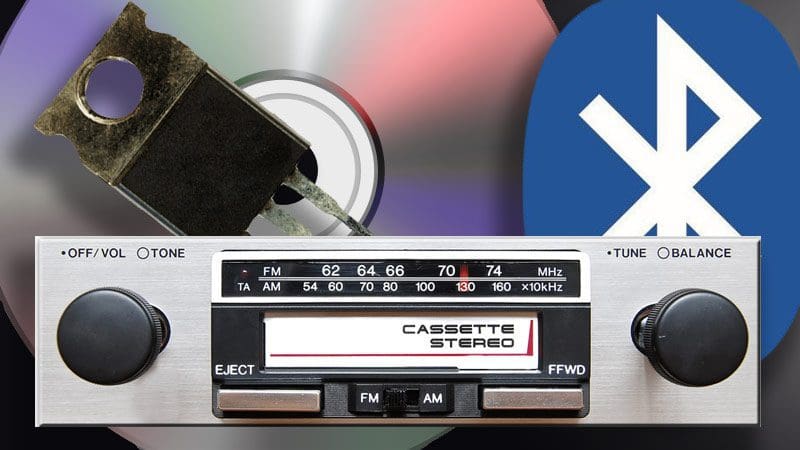
Car Audio TechnologiesJust as the invention of the transistor eliminated the need for vacuum tubes, advances in technology allow us to create new and unique entertainment solutions with more and more features. We thought it would be fun to take a quick look at a few important car audio technologies throughout history.
Transistors

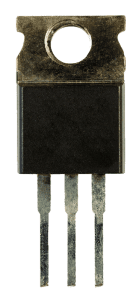
Car Audio TechnologiesThe first car radios used vacuum tubes as integral parts of their tuner and amplifier circuitry. Tubes required high-voltage power supplies and consumed a lot of power. They produce a lot of heat and are fragile. The result was finicky products with limited performance. The first transistor was theorized in 1926 but wasn’t built for the first time until 1947. It wasn’t until 1955 that we saw Chrysler and Philco announce the first automotive transistor radio – the Mopar model 914HR.

The transistor is considered one of the greatest inventions of the 20th century. Transistors improved the efficiency and reliability of electronics components and led to the creation of microchips and ultimately computers. The Apple A11 Bionic CPU, found in the iPhone 8, 8 Plus and iPhone X, has 4.3 million transistors built into it. The Microsoft Xbox One main CPU has more than 7 million transistors inside. More impressively, a 128 gigabyte stick of DRAM memory has more than 137 quadrillion transistors!

Broadcast Radio

Car Audio TechnologiesRadio was truly the technology that drove car audio systems. The first radio broadcasts were weekly special events that included concerts in 1914 and daily news broadcasts in 1916. On May 20, 1920, XWA – the experimental station of the Canadian Marconi Co. – began regular broadcasts in Montreal. XWA claims status as the first commercial broadcaster in the world. These were all AM (amplitude modulation) stations. FM (frequency modulation) radio was patented in 1933, but it wasn’t until the late ’30s that FM broadcasts became popular. The broadcast of a stereo FM signal was first considered by the FCC in the late 1950s, and a standard was approved in 1961.
The Compact Cassette and 8-Track Tape

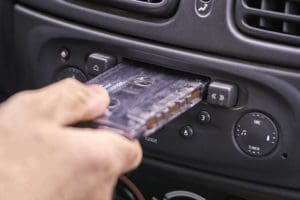
Car Audio TechnologiesReel-to-reel recording on magnetic tapes was popular in the 1940s but wasn’t suitable for use in mobile applications. The 8-track was preceded by the Stereo-Pak 4-track cartridge in 1962. The endless-loop cartridge could store both sides of a vinyl album. The 8-track, known originally as the Lear Jet Stereo 8 Track Cartridge, was launched by Bill Lear in 1963. In 1965, Ford offered factory and dealer-installed 8-track options on its Mustang and Thunderbird and on several high-end Lincoln vehicles.

Call it a tape or a cassette, the first compact cassette (as we know it) was introduced by the Phillips Corp. in 1963 as a storage medium for dictation machines. Widespread use of the compact cassette in the mid-’70s and the introduction of chromium dioxide (CrO2) as a premium recording medium and Dolby B noise reduction spelled the end of the 8-track.

Digital Audio

Car Audio TechnologiesMost people don’t realize that digital audio (known then as pulse code modulation) was invented in 1937 in Britain and was used in telecommunications. In the late ’60s, Denon pioneered commercial digital recording. The BBC used digital audio transmissions to link its broadcast center to its transmitter in 1972. Sony and Mitsubishi drove the consumer popularization of digital audio in the early ’80s and brought about acceptance by major record companies. The first compact disc was released in 1982 using the Red Book Compact Disc Digital Audio (CD-DA) standard that is still in use today. The first OEM-installed CD players were in the 1987 Lincoln Town Car.
Class D Amplifiers

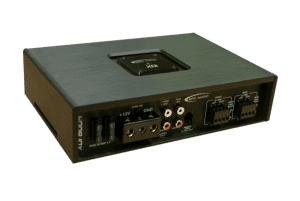
Car Audio TechnologiesThe benefit of Class D amplifiers is their efficiency and low-to-moderate power levels. Class D amps use high-frequency pulse-width modulation waveforms to switch MOSFETs (metal-oxide-semiconductor field-effect transistors) on and off very quickly to amplify signals. Filter networks on the output of the circuits remove high-frequency noise so that only the audio signal is left to drive our speakers. Class D amplifiers allow manufacturers to produce much more powerful amplifiers that take up very little space. These amplifiers consume less current than their Class AB counterparts.

Computerized Source Units

Around 1980, we saw the first digitally tuned car radios. Mechanical tuning knobs and presets were replaced with vacuum fluorescent displays and electronic buttons. This would lead to computerized source units that included electronically controlled cassette players and equalizers with spectrum displays around 1982. By the late ’80s, with the growing popularity of CD players, having a microcontroller built into a car radio was commonplace.

Around 1992, companies like Alpine and Clarion were selling in-vehicle navigation systems that included LCD screens, and by 1993, digital communication solutions were available to transmit computer information to vehicles. In 1998, Clarion launched the AutoPC in conjunction with Microsoft to become the first in-vehicle computer. Modern multimedia receivers now run embedded versions of Windows and Linux operating systems.

The Apple iPod

Car Audio TechnologiesThe Apple iPod was introduced in the fall of 2001. The original compact digital media players were only compatible with computers running the Apple Macintosh operating system and as such, sales were limited. In 2003, the iPod 3G was launched with a standard USB port instead of Firewire, making it compatible with Windows-based PCs as well. By June 2003, Apple had sold 1 million iPods.

In June 2005, BMW announced that an iPod adapter would be available for the 3 Series, the Z4 Roadster, the X3 and X5 and the Mini Cooper, and was backward compatible to many 2002 models.

By 2005, the iPod was a popular solution for carrying thousands of songs, and Clarion launched its VRX745VD – a single-DIN multimedia receiver with a dedicated iPod interface. The iPod quickly replaced the CD changer as a means of storing a large number of songs in vehicles.

Bluetooth

Car Audio TechnologiesThough incorrectly perceived as a hands-free and audio streaming technology, Bluetooth was created in 1994 as an alternative to RS-232 wired communication. Within the Bluetooth communication standards are dozens of profiles, including fax, cordless telephony, printing, file transfer, dial-up networking and of course, the hands-free and audio distribution profiles that we know and love! In 2002, the Audi R8 was the first to apply Bluetooth technology in a car. DaimlerChrysler, Acura and BMW joined in 2003.
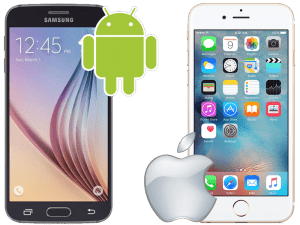
Apple CarPlay and Android Auto

Car Audio TechnologiesSince the very first car radios were built, people were concerned about them being a distraction. Turning the tuner knob to find a local station meant you weren’t focused on the road in front of you. In the late ’90s, we saw drivers with headsets and earpieces making phone calls while they drove. Adding a headset was a common purchase with a new phone. In the mid-2000s, Bluetooth communication replaced wired hands-free connections.
Data distractions took off in the late ’90s and early 2000s with the Blackberry. When smartphone technology took off in the 2000s, so did text messaging. We now had lots of ways to distract us from our driving duties.

Apple realized that the smartphone was as much of a problem as it was a solution in the early 2010s. In 2013, Siri Eyes Free was offered as a dealer-installed accessory for several Honda and Acura vehicles. In 2014, the Ferrari FF became the first new vehicle to come equipped with Apple CarPlay.

CarPlay is a software application that runs on the multimedia source unit in the vehicle and uses the Siri voice recognition engine built into the iPhone to allow voice commands to be executed. You can send a text message, make a phone call or choose the music you want by simply asking. Turn-by-turn navigation is also included.

The Open Automotive Alliance announced in 2014 that it would introduce a competing technology for Android-based smartphones called Android Auto. The 2015 Hyundai Sonata was the first OEM implementation of Android Auto. Few car audio technologies have rivaled the importance of CarPlay and Android Auto.

Technology for Safety and Entertainment

There have been hundreds, if not thousands, of milestones throughout the 100-plus years of automotive technology advances. These innovations are just a sampling of the way mobile electronics have evolved and changed. If you are looking for the latest and greatest car audio technologies, or simply want to improve the performance of your entertainment system, visit your local mobile electronics specialist retailer.

This article is written and produced by the team at www.BestCarAudio.com. Reproduction or use of any kind is prohibited without the express written permission of 1sixty8 media.

(ipod photo:KAMiKAZOW [CC BY or CC BY 3.0-2.5-2.0-1.0 (https://creativecommons.org/licenses/by/3.0-2.5-2.0-1.0)], from Wikimedia Commons)

Filed Under: ARTICLES, Car Audio, RESOURCE LIBRARY

Bang for Your Buck – What Separates One Amplifier from Another?

06/07/2020 By John Schwartz

What Separates One Amplifier from AnotherIn our Bang for your Buck series, we talk about product features and component designs that offer increased value and performance. We’ve discussed source units and speakers, and now it’s time to take a deep look into amplifiers and what separates one amplifier from another.
Years ago, a prominent mobile audio enthusiast claimed that all amplifiers sound the same under strict test conditions. He even backed up the statement by offering a large cash reward to anyone who could pick one amp 10 times out of 10 under controlled listening tests. While there is value in his claim and it would be very hard to determine the difference between two amplifiers in blind testing 10 out of 10 times, that doesn’t mean that all amplifiers are the same. In fact, there are some big differences.

This articles focuses on two widely different areas of performance that many manufacturers refuse to discuss in detail: distortion and noise.

Is Power Important?

Does the ability of one amplifier to make more power than another determine its quality or performance capabilities? Well, if the less-powerful amplifier is driven into distortion, then certainly the more-powerful amplifier will sound better. While they’re operating within their rated power ranges, though, does maximum power matter? Not so much.

What’s this Damping Factor Thing?

What Separates One Amplifier from AnotherFor decades, manufacturers of high-end amplifiers have provided damping factory specifications. This number is a ratio of the output impedance of the amplifier to a specified load impedance. The story goes that an amplifier with a higher number would produce a tighter, more-controlled sound because the low impedance of the amp would short the back-EMF signal from the speaker.
Depending on your version of physics, the damping factor can be a large number, or a very small one – making it potentially relevant or a complete red herring.

For solid-state amplifiers, the damping factor or output impedance ratio is high enough that the load impedance has very little effect on the resulting frequency response of the system. For tube amplifiers with impedance-matching transformers, this isn’t always the case. Worrying about, or even considering, the damping factor is way down the list of concerns.

Background Noise

We’ve talked about signal to noise ratio in detail in our discussion of head units. It’s a big deal in a discussion of amplifiers and will rear its head again when we talk about signal processors.

What Separates One Amplifier from AnotherAny electronic device creates unwanted noise when a signal passes through it. Even something as simple as a resistor creates a small amount of noise. In this example, it’s likely too small to be audible – but it’s there. In a complex circuit with gain (an increase in signal amplitude), creating unwanted noise is a common byproduct of questionable design.
How does noise manifest itself in an amplifier? It’s the background hiss you hear from your speakers when no music is playing. Ideally, you don’t want any noise adding content to your music.

If you have those really efficient PA speakers, then choosing amplifiers with excellent noise specifications is crucial. The speakers themselves offer 5 to 10 dB more output for a given input signal, so any noise that is present will be 5 to 10 dB louder.

Signal to Noise Ratio Specification

We’ve covered this before, but we are going to do it again now because it’s important. There are two ways manufacturers publish SNR or S/N Ratio specs: either rated to a specific output level (1 watt into 4 ohms) or relative to the maximum power production capabilities of the amplifier. You can’t compare the two directly, but you can estimate.

Let’s look at two full-range amplifiers. In this example, we’ll use a pair of similarly rated four-channel amplifiers. Amplifier A has a S/N Ratio published at -104 dB and amplifier B amplifier rated at -88 dB. Assuming the numbers are published using the same standard, amplifier A produces 16 dB less noise than amplifier B. Unfortunately, in this example, the -104 specification of amplifier A is published related to its rated power, while amp B is relative to 1 watt of output. Using the same specifications, amp A produces -84 dB of noise, 4 dB more than amp B.

Distortion Considerations

Distortion is, in the simplest of terms, the addition of unwanted information to a signal. Just as with noise, all electronic devices add some amount of distortion to signals as the signals pass through. In most cases, unless something has gone very wrong, the original signal passes through the device unchanged. Distortion is generated by the addition of unwanted information.

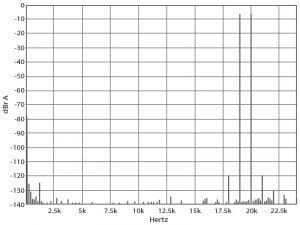
Harmonic distortion is the addition of multiple instances of the original signal. Many high-end home amplifiers are tested using a 50 Hz tone at rated power. Analysis of the resulting spectral content shows just how much unwanted information is produced.

What Separates One Amplifier from AnotherThe image above shows amazing performance from a very high-end solid-state home amplifier. As you can see, there is a little bit of 150 and 175 Hz content, but it is at almost -120 dB below the stimulus signal.
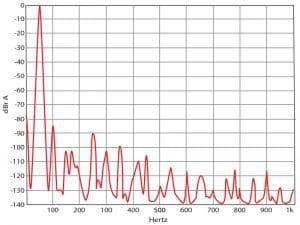
What Separates One Amplifier from AnotherIn this example, we can see the harmonics created in a high-end home audio Class D amplifier. A 100 Hz signal is present at a level of -85 dB and a 250 Hz signal is present at a level of -90 dB.
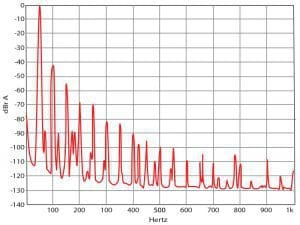
What Separates One Amplifier from AnotherTo really highlight the potential for unwanted behavior, we have included the spectral content of a high-end vacuum tube amplifier. You can see that there is spectral content at 100 Hz at a level of -42 dB, 150Hz content at -54 dB and 200 Hz content at -67 dB. This distortion would be audible during listening.
Intermodulation Distortion

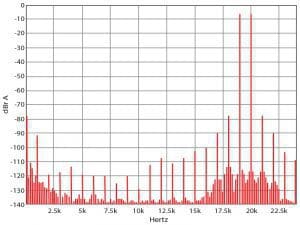
Another kind of distortion is created when two signals passing through an amplifier interact with one another to produce distortion that is the difference between the two signals. The industry standard test for intermodulation distortion is to play a test signal that contains two sine waves – one at 19 kHz and a second at 20 kHz. Two things will happen when distortion is produced using these stimulae: Content will be created on either side of these tones and at a difference between them, i.e., at 1 kHz.

What Separates One Amplifier from AnotherThis graph shows a high-end home amp with excellent IMD behavior. The two side-bands are at -119 dB and would be completely inaudible.

What Separates One Amplifier from AnotherThis graph shows the same Class D as in the discussion of harmonic distortion. It is easy to see that the test stimulae created a significant amount of information. The peak is at -78 dB, so it’s not a complete disaster.
Shopping for a Car Audio Amplifier

Since nobody in the mobile electronics industry seems willing to submit their products for this level of scrutiny, how does one go about picking an amplifier that offers exceptional performance? The only way is through extensive listening. A handful of amplifiers on the market offer exceptional performance, and not all of them are expensive. At the same time, some very expensive amplifiers perform poorly.

If you want to find the best, then see if you can borrow that amp in question from a friend and put it into a reference system. If your music suddenly sounds warmer, that’s a sign that there is additional harmonic content. It is “nice” to listen to in some cases, but it is certainly not accurate.

Once you have developed a strong reference for accuracy, you will be able to pick out amplifiers that offer excellent performance. Your local mobile electronics retailer should have a demo vehicle that you can audition. Happy shopping!

This article is written and produced by the team at www.BestCarAudio.com. Reproduction or use of any kind is prohibited without the express written permission of 1sixty8 media.

Filed Under: ARTICLES, Car Audio, RESOURCE LIBRARY

Bang For Your Buck: Car Audio Amplifier Features

05/31/2020 By John Schwartz

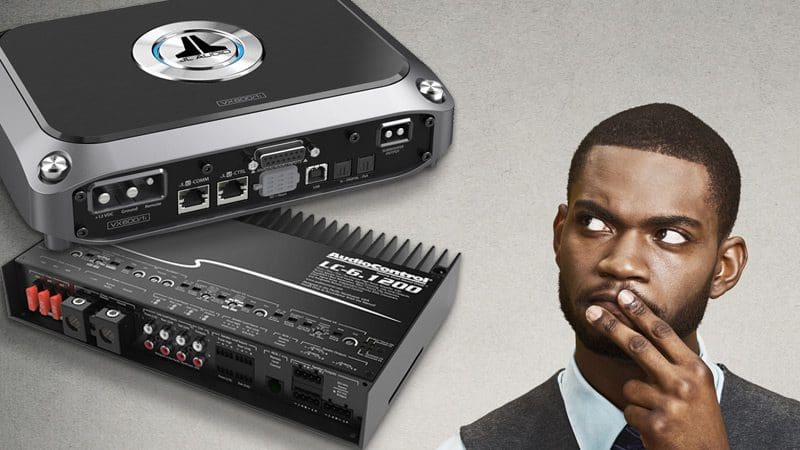
Car Audio Amplifier FeaturesShopping for a new car audio amplifier is tricky. There are thousands of amplifiers available from at least a hundred car audio companies. Picking the right amp for your system requires balancing an expectation of performance with the cost and features of the amp in question. In this issue of Bang for Your Buck, we are going to talk about car audio amplifier features that will make your audio system sound better and more enjoyable while maximizing your investment.

Amplifier Channels

Car Audio Amplifier Features
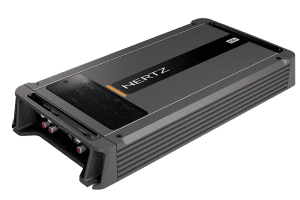
5 Channel amps like this model from Hertz can power an entire audio system.

Decades ago, you could choose from two- or four-channel amplifiers to power your audio system. Most people used a four-channel amp for the front and rear speakers and a high-power stereo amp bridged to drive a subwoofer or two. The rise in popularity of class D monoblock amplifiers in the ’90s replaced the big stereo amp on the subs with something more efficient, and often more powerful.

No matter how you divvy up the work, you are going to need multiple amplifier channels. Let’s look at two amplifier options for a starting point. A four-channel amplifier is extremely flexible. It can power your front and rear speakers, a set of components and a subwoofer or be dedicated to a set of components using active filters instead of passive networks. It’s rare that a high-quality four-channel amp can’t remain an important part of your system.

Another alternative for an amplifier is a five-channel model. In most cases, these amplifiers provide between 50 and 100 watts of power from the four main channels and 300 to 600 watts from the subwoofer channel. A significant advantage of these amplifiers is that they are housed in a single chassis. This design reduces the need for power and ground distribution blocks and simplifies installation.

Built-in Crossovers

Car Audio Amplifier Features
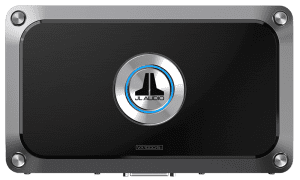
Amplifiers like the new JL Audio VXi line include digital crossovers and more.

When you are starting out on an audio system upgrade, you will want to take a close look at the crossovers built into the amplifier you are looking at. Assuming you go with a four channel amp, each channel pair will likely include crossovers that can be configured in a high- or low-pass mode. This crossover design makes the amp suitable to drive speakers or a subwoofer. If you plan on using the amp to drive a set of components in an active configuration (something that you should aspire to), then look for crossovers that can reach higher frequencies – in the 4 to 5 kHz range. If you are planning on using a digital signal processor to handle crossovers (another wise aspiration), then the crossover frequencies matter less.

Vehicle Integration Features

Car Audio Amplifier Features
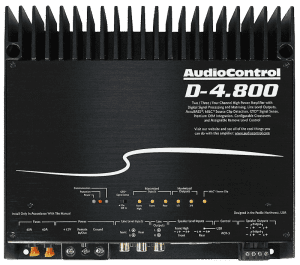
AudioControl amplifiers feature many OEM integration features.

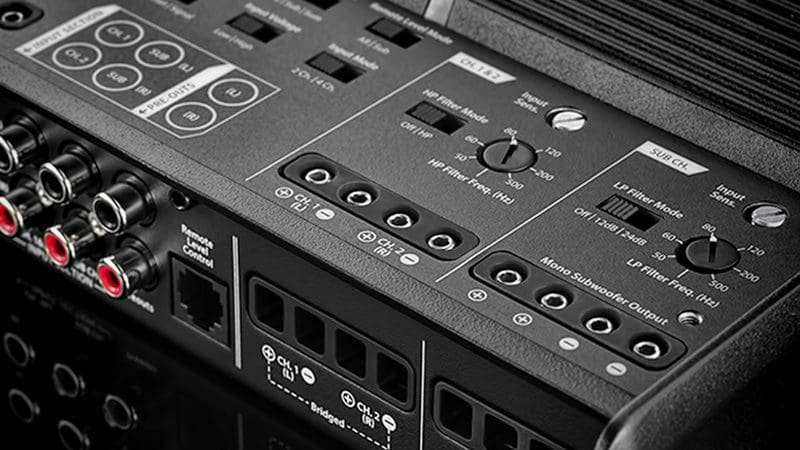
Upgrading a modern factory sound system can be tricky. In many applications, the source unit can’t be replaced. This means we need to connect to the radio or the amplifier. If you are planning on keeping your factory source unit in the system, then you will want to choose an amplifier that provides OEM integration features. First and foremost, the amplifier needs to be able to accept a speaker-level signal. Some amplifiers have dedicated connections for high-voltage signals. Other designs allow you to connect the factory speaker wires to the RCA inputs, then press a button to reduce the voltage to something that the amp can handle. A third popular option is amplifiers that include an RCA adapter that has circuitry built into it that reduces voltage.

The second feature you are going to want to look for is remote turn-on detection. Different companies have different names for this feature. In a nutshell, you want the amplifier to turn on when the factory stereo turns on. Amplifiers with automatic remote turn-on detection monitor the input connection for an audio signal or the presence of a DC voltage generated by BTL-type amplifiers in head units.

Remote Level Controls

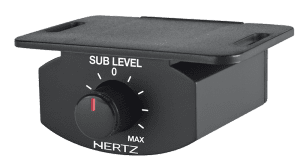
Car Audio Amplifier FeaturesIf you are going to use the amp you have chosen to drive a subwoofer, then choose something that includes or has the provision for a remote level control. A remote level control is typically a small metal or plastic box with a knob sticking out of it. You can turn this knob up or down to increase or decrease the level of the subwoofer relative to the rest of the speakers in your car.
The best designs are attenuators. This means that at the maximum position, the amp behaves as though the knob isn’t connected. You can turn down the bass level by turning the knob counterclockwise. The reason this design is best lies in the process of how systems are tuned.

Ideally, try to avoid bass boost controls. If you want more bass, then you should want more of ALL your bass, not just those frequencies around 50Hz. Deep bass (below 30Hz) is a lot of fun!

Amplifier Power

Car Audio Amplifier Features
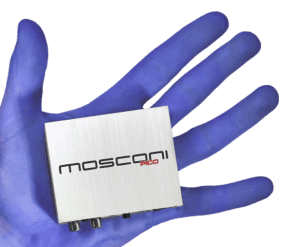
Ultra-small amps like the Mosconi Pico might be great for tight spaces, but could struggle with multiple subwoofers.

Here’s another tricky subject that requires balancing a lot criteria. First, you can never have too much power available. With that said, depending on your speakers, you may have more power than you’ll ever be able to use. In almost every case, maximum amplifier power determines the size of the amplifier, and vice versa. A 1,500-watt subwoofer amplifier that will operate reliably on a hot summer day isn’t going to fit in the palm of your hand. If you are hoping to upgrade your audio system while keeping the equipment out of sight, then you will need to choose an amplifier that will fit under a seat or in a storage compartment.

In terms of speaker longevity, choose an amplifier that is rated at the same (real) power ratings as your speakers. If the system is set up properly, you shouldn’t have any reliability problems.

Amplifier Installation Accessories

Car Audio Amplifier FeaturesThe second-to-last step in choosing an amplifier for your vehicle is to choose the right installation accessories for it. No, we aren’t talking about chrome shrouds or lighting kits. Your choice of power wire can have a dramatic effect on the performance and reliability of your amplifier. It might sound like a sales pitch, but don’t be stingy with the wiring you choose. A $40 amp kit with 1,000-watts printed on the package may look like a deal, but do you think it will supply power to your amp the same way a $100 kit will?

Think of your power wire like the tires on your car. Inexpensive skinny tires work fine when you are cruising through town on the way to get the groceries. When it’s time to crank up the excitement, these tires fail to provide premium performance. A high-quality tire simply sticks to the road better, and in many cases, lasts longer. Power wire is the same.

Quality Installation and Configuration

Car Audio Amplifier FeaturesLast and certainly not least is your choice of who will install your amplifier. Cars and trucks aren’t as simple as they used to be. Composite construction, aluminum, high-strength adhesives, computer data networks and BCM-controlled charging systems require that someone with extensive experience work on your vehicle. Assuming that your new car or truck is like every other vehicle they have worked on is a recipe for disaster.

A properly trained and qualified installation technician understands how to mount equipment safely and reliably. They understand the proper process to make electrical connections so that they are efficient and safe. Finally, they have a tried-and-true process that ensures every amplifier is configured to provide maximum performance and reliability. Choose whom you let work on your car very carefully.

Local Help With Car Audio Amplifier Features

When it comes time to upgrade your stereo system, drop into your local mobile enhancement retailer and ask about the latest car audio amplifier features. They will work with you to choose a solution that includes the features you want and provides the performance you desire.

This article is written and produced by the team at www.BestCarAudio.com. Reproduction or use of any kind is prohibited without the express written permission of 1sixty8 media.

Filed Under: ARTICLES, Car Audio, RESOURCE LIBRARY

Product Spotlight: DroneMobile X1-MAX

05/28/2020 By John Schwartz

Drone X1-MAX

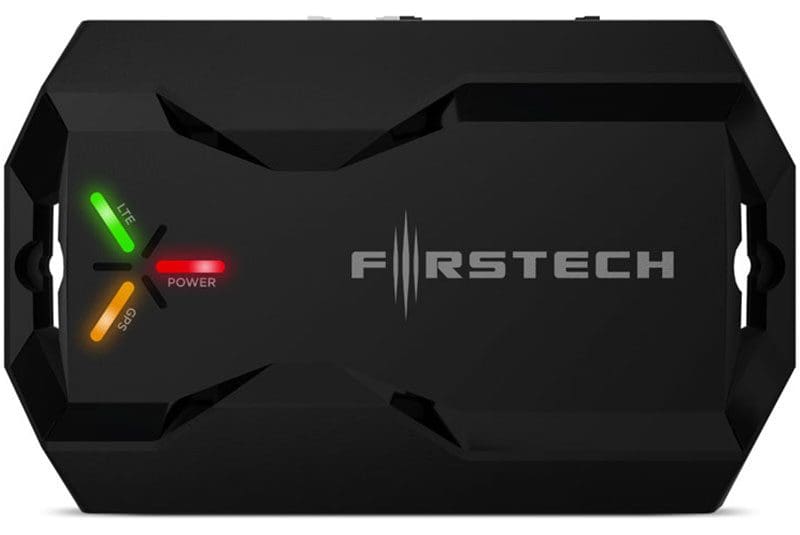
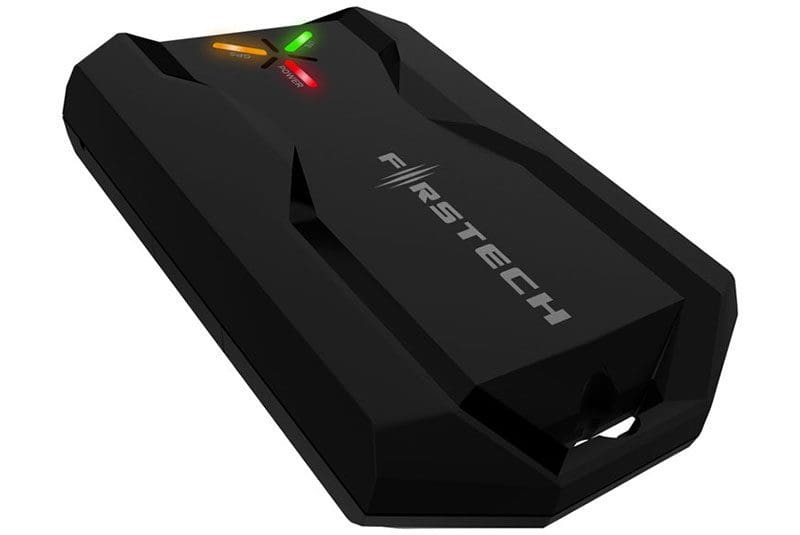
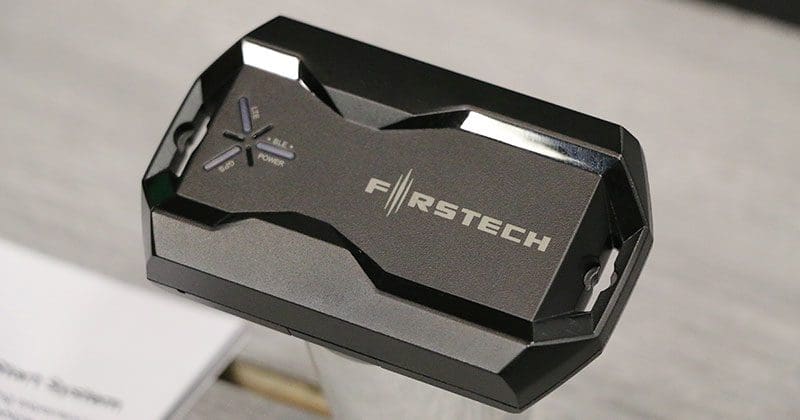
In the summer of 2019, Firstech introduced a new version of its Drone vehicle telematics module called the X1-MAX. This new module took everything great about Drone vehicle tracking and remote control and injected it with a healthy dose of new-feature steroids. The result is a smartphone control solution that is unparalleled in capabilities while remaining easy to use.

The Drone Telematics Platform

Just like the Drone X1-LTE interface included with such Compustar RF kits as the P2WR3, the X1-MAX includes a built-in LTE cellular radio that communicates directly with the DroneMobile servers. The DroneMobile app on your iPhone or Android-based smartphone can control door locking and unlocking, remote start functionality and several auxiliary outputs. Additionally, Drone modules can provide GPS tracking, driver monitoring, security alerts and vehicle health monitoring functions. The unit can also be integrated with a remote start controller like the CM7000 and CM7200 from Compustar for additional features or the inclusion of an RF remote option.

Drone X1-MAX
Complete control over your vehicle is as easy a few taps on the screen of your smartphone using the DroneMobile app.

Both systems include a GPS receiver that can be used with the DroneMobile smartphone app or the web interface to locate your vehicle and provide position-based geofencing alerts. Using the GPS features requires a subscription to the Premium, Premium Plus or Ultimate service plan instead of the Basic subscription.

Of course, both units will communicate directly with Compustar, Arctic Start, FTX, ADS iDatastart and Mid City Engineering car starters to control door locks and starting functionality. Control for optional auxiliary accessories like trunk release, sliding door or power windows may also be available.

Remote start, door locking and trunk release commands can be sent through Amazon Alexa or Google Assistant. You can also use the DroneMobile app with your Apple Watch or an Android Smartwatch. There’s also an iPhone Widget to make it easy to access commonly-used functions almost instantly.

The DroneMobile app includes provisions for controlling and monitoring multiple vehicles. The Family Sharing feature allows others to control the vehicle from their smartphones. Sharing is also great for businesses that use Drone. Finally, driver monitoring features like curfew alerts, geofencing, trip reporting and speeding alerts are also available.

Drone X1-MAX

New Drone Hardware Features

The X1-MAX separates itself from the X1-LTE with the inclusion of a built-in lithium-ion backup battery that will maintain location and control communication if the vehicle battery is disconnected or the wiring is cut. Once you get an alert that the battery is disconnected, you’ll have more than enough time to check the vehicle to see what’s going on or contact local law enforcement.

The X1-MAX includes CAN/OBD network connectivity hardware so that the module can communicate directly with the computer system in your vehicle. For example, should the ECM in the vehicle generate a Diagnostics Trouble Code (DTC), the Drone system will push that information through to your smartphone. Fuel level monitoring will also be available on many vehicles. These features are still in the final testing stages and, according to Firstech, should be available in the fall of 2020.

The X1-MAX system includes onboard security sensors for impact, glass breakage and tilt. If someone tries to jack the car up to steal your wheels, you’ll get a notification on your smartphone. Likewise, if a thief attempts to break a window, or if someone bumps into your vehicle, those conditions will also send an alert. Interestingly and conveniently, users can adjust the shock sensor sensitivity directly from the DroneMobile app. The tilt sensor also functions as an accelerometer so that warnings about abrupt acceleration or braking can be logged or sent to the phone application.

Finally, the X1-MAX includes a Bluetooth 4.2 radio. You can pair your smartphone directly to the system to control all the functions from the DroneMobile app. If you are traveling to a campsite or cottage outside of cellphone coverage range, Bluetooth ensures that you have complete control over the vehicle.

Drone X1-MAX

Control Your Vehicle from Almost Anywhere

Firstech recently upgraded the behind-the-scenes control system for Drone to use Amazon Web Services IoT for lightning-fast connectivity and fantastic reliability. Globally recognized companies like Formula 1, Volkswagen Group, and, of course, Amazon trust AWS IoT for their cloud-based services.

The X1-MAX is currently available for purchase exclusively in the United States.

Drone telematics systems have quickly become the industry reference for features and intuitive functionality. If you’re looking for a long-range remote control, vehicle tracking and maintenance logging solution for your car, truck or SUV, visit your local authorized Drone retailer. You can learn more about Drone by visiting their website, Facebook page, YouTube channel or Instagram. You can find a local retailer using their online dealer locator.

This article is written and produced by the team at www.BestCarAudio.com. Reproduction or use of any kind is prohibited without the express written permission of 1sixty8 media.

Filed Under: ARTICLES, PRODUCTS, Remote Car Starters, RESOURCE LIBRARY Tagged With: DroneMobile, Firstech

  • « Previous Page
  • 1
  • …
  • 26
  • 27
  • 28
  • 29
  • 30
  • …
  • 82
  • Next Page »

801 EAST 82ND AVE
ANCHORAGE ALASKA 99518
907-563-8112

Copyright © 2026 | Site design by award-winning creative agency D'zine Alaska , with site support by 1sixty8 Media and Modern Media Geeks.