Perfectionist Auto Sound and Security

Alaska's Most Award Winning Auto Customizer

  • About Us
    • Why Choose Us
    • Meet Our Team
    • Our Awards
    • Virtual Tour
    • Community Engagement
  • Signature Products
    • DroneMobile
    • SoundShield®
  • Services
    • Remote Car Starters
      • Vehicle Security
    • Car Audio
      • Sound Deadening
    • Custom Fabrication
    • Driver Safety
      • Bluetooth
      • Blind Spot Safety Systems
      • Camera Systems
      • Navigation Systems
    • Laser And Radar Detectors
    • Lighting
    • Offroad and Marine
      • Motorcycle Audio
    • Custom Interiors
    • Performance
      • Tires and Wheels
      • Suspensions / Lift & Lower
    • PRO Commercial Division
  • Gallery
    • Photos
    • Videos
    • Wallpaper Downloads
  • Contact Us
    • FAQ
    • Feedback
    • Join Our Team

Passive Vs Active Crossover Networks

11/27/2016 By John Schwartz

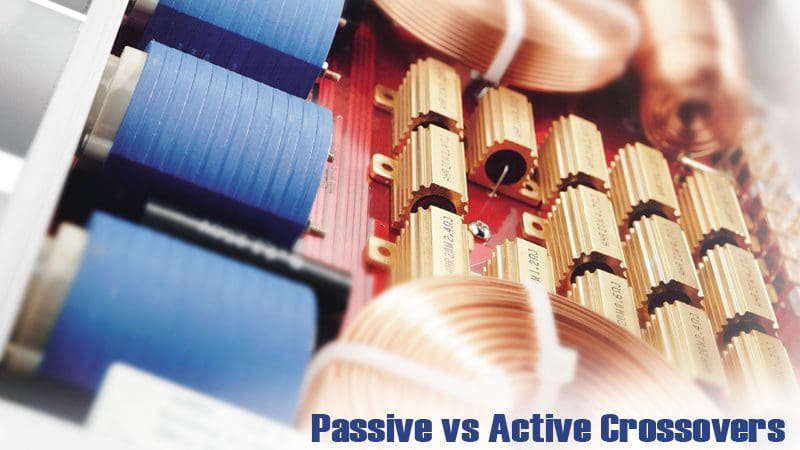
Crossover NetworksTo optimize the performance capabilities of a speaker, it should operate within the frequency range for which it was designed. A woofer or subwoofer won’t be able to reproduce high frequencies accurately. A tweeter will self-destruct if you ask it to try to play bass frequencies. For this reason, we use three- and four-way speaker systems in most vehicles. That means using crossover networks.

The purpose of a crossover is to split up the frequencies that pass through it. We are going to delve waist-deep into the benefits and drawbacks of the crossovers commonly used in car audio system component speaker sets.

How a Passive Crossover Network Works
Crossover Networks
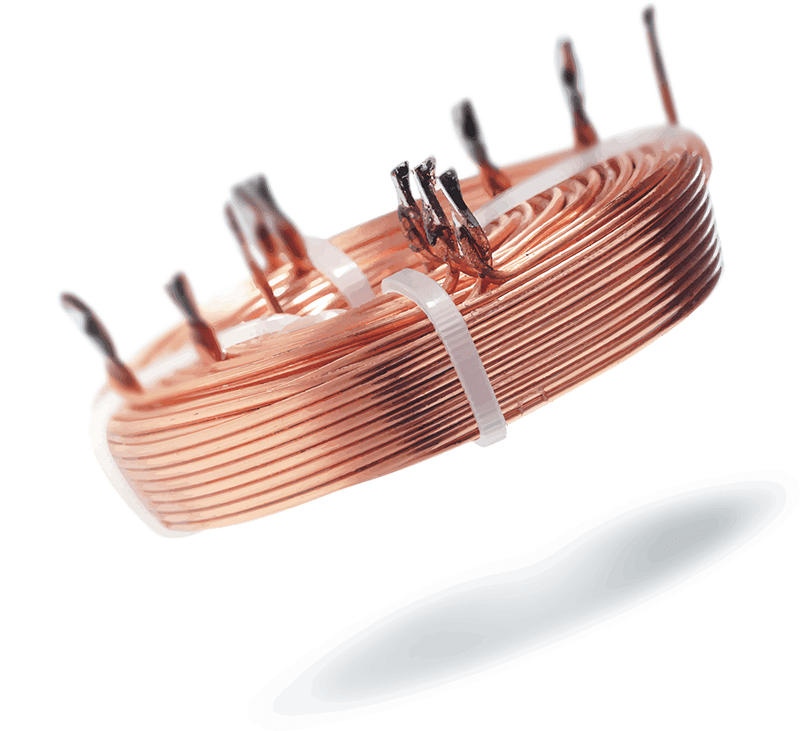
This inductor is one of the pieces used in a passive network

A passive crossover network is a component or group of components that is installed on the speaker wires between an amplifier and a speaker. The behavior of these components attenuates portions of the signal going to the speaker itself. Four components are commonly used in passive networks: capacitors, inductors, resistors and protection devices.

The combination and configuration of these components are used to create a low-pass, high-pass or band-pass filter network. Resistors are used to attenuate the output of devices, or sometimes used as part of a frequency-dependent impedance correction circuit called a Zobel network. Some manufacturers include light bulbs, diodes or some form of positive temperature resistors to limit how much voltage a tweeter receives. Completely passive active networks have been available (but that was a long time ago).

How an Active Crossover Functions

Crossover NetworksAn active crossover is a device that modifies an audio signal before the amplifier. It works on line-level or preamp signals only. Active crossovers combine op-amps, resistors and capacitors to alter different frequency ranges of the signal. Unlike passive networks, active crossovers can be designed to increase the level of the signal, but only in the case of powered filters. Active networks are often include other functions, such as remote level controls and bass boost circuits.

Benefits of Passive Crossovers
Crossover Networks
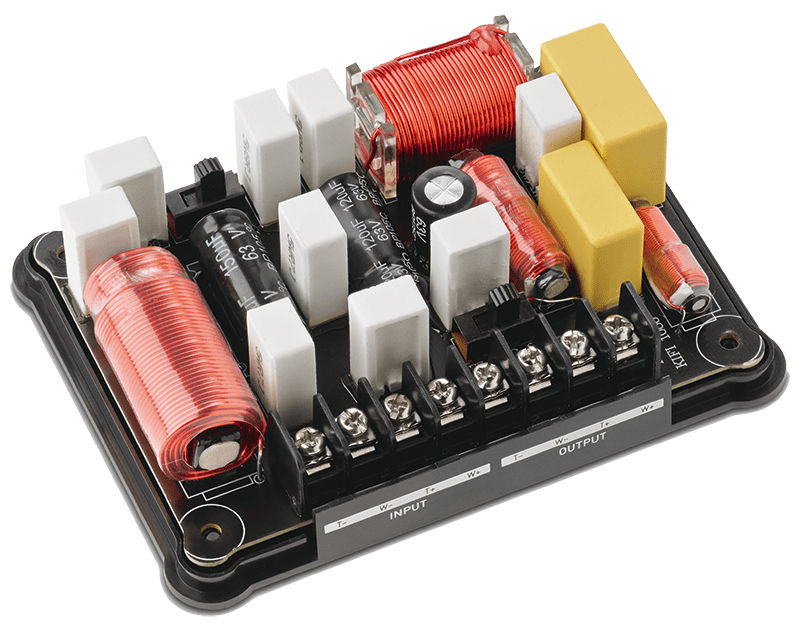
The switches on this passive crossover allow for attenuation.

It is worth noting that each passive network is designed to work at a specific frequency for a specific speaker. If you change the speaker, the filter will not respond in the same way. In some cases, if the impedance of the speaker is significantly different from the one the network was designed for, the speaker may be damaged, or portions of the network may become damaged.

Passive networks are easy to use. You run a wire from your amplifier to the input of the network, then connect each speaker to the output. Other than mounting the network in a dry location that is free from vibration, that’s about all you have to consider.

Some passive networks include some form of output level attenuation. Most use a two- or three-position switch. Some use jumpers. An extremely high-end network may include a variable L-pad or potentiometer for extreme fine-tuning capabilities.

Passive crossovers allow you to split the power of a single amplifier channel to drive two different speakers. Fewer amplifier channels can dramatically reduce the system cost, since you only need a pair of amplifier channels to run a full set of speakers.

Limitations of Passive Crossovers

Since a passive crossover network is designed for a specific frequency, once the parts are chosen and assembled, there is no way to change that frequency without introducing new or additional parts.

Designing a passive crossover can be somewhat complex. The simplest of networks rely on some basic assumptions about the impedance of each speaker at the crossover frequency. Designing a network that compensates for the complex reactive load that speakers create as they move is difficult. It requires computerized modeling software and a way to measure the impedance and frequency response of the speaker at varying drive levels.

High-quality passive crossovers are designed for a specific distance and angle between the woofer and the tweeter. If the network is designed for the speakers to be far apart, moving the speakers close together will cause the signals to sum incorrectly. Even changing the angle of a speaker can have a dramatic effect on the frequency response at the crossover point.

Passive crossover networks have limitations in how much power they can handle. The magnetic fields created in an inductor have a limit. The voltage applied to a capacitor also has a limit. Crossover networks can and do overheat and fail if too much power is sent to them.

Passive crossover networks consume energy. Using a speaker system with a passive network is not quite as efficient as one using an active filter network. The overall efficiency of the crossover network depends on its complexity and the quality of the components used in the network.

Passive crossover networks are somewhat susceptible to noise. If you run a wire with an AC signal on it past the inductor in a passive network, the network can easily pick up that signal and add it to the audio signal. Choosing a safe location to mount passive crossover networks is important.

Benefits of Active Crossovers
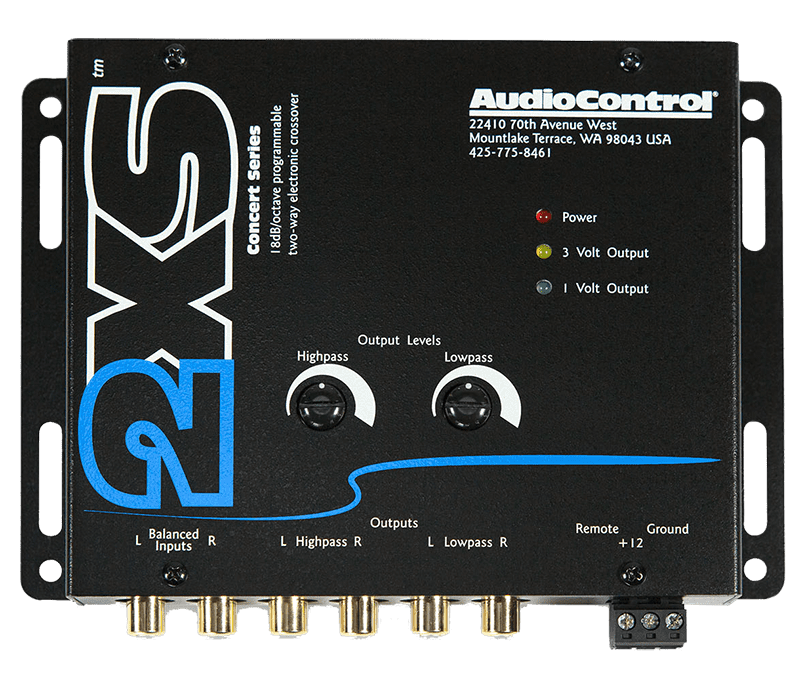
Crossover NetworksMost active crossover networks are adjustable. That means by turning a knob or moving a switch, you can change the crossover frequency. This flexibility makes active crossovers suitable for use with almost any speaker system. Most active crossovers also include level controls, so you can easily fine-tune the level of the midrange and tweeter to compensate for different mounting locations.

Active crossovers don’t care how powerful your amplifiers are because they process the signal before it enters the amplifier. Active crossovers are also not very sensitive to temperature variations, so they can be very accurate, all the time. If one of the amplifiers channels in an active crossover system clips, the distortion only affects that single channel.

Challenges of Active Crossovers

Because active crossovers are universal in design, being able to set crossover frequencies accurately can be challenging. Labels on potentiometers are notoriously inaccurate. Most active crossovers have fixed attenuation slopes. You can’t change these slopes to compensate for response characteristics or placement variations. Unless the speaker manufacturer provides it, or you have extensive experience in measuring the electro-mechanical and acoustic response of the set of speakers, knowing what frequency to cross speakers over at can be difficult. Too low and you risk damage to the tweeter. Too high and you get distortion from the midrange. Many speaker combinations also require the over- or under-lap of the crossover frequencies to produce a flat response.

An active crossover requires a dedicated amplifier channel for each speaker. These extra channel requirements can increase the cost of designing a system.

The Perfect Solution
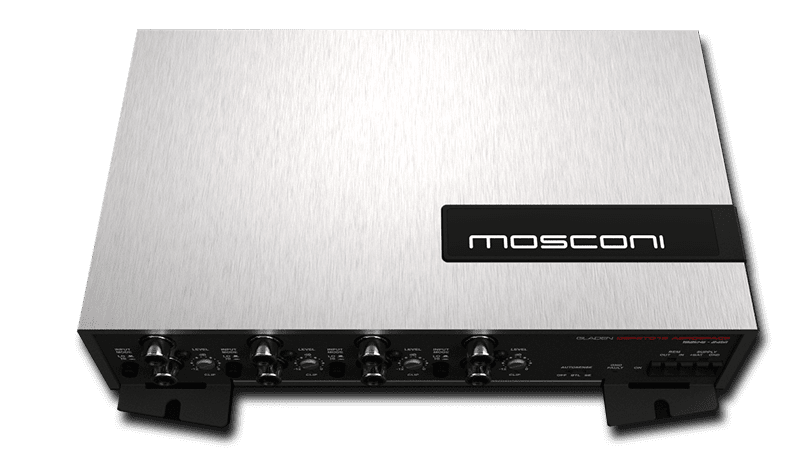
Crossover NetworksIf there is no limit to your budget, the ideal crossover solution for a set of speakers is an active crossover with a Digital Sound Processor performing the filtering. A DSP will offer adjustable crossover frequencies, and most offer adjustable crossover slopes and alignments.

No matter what you choose, it’s a good idea to spend some time with a high-resolution RTA to make sure your system is set up for the smoothest, flattest response possible at the crossover frequency.

This article is written and produced by the team at www.BestCarAudio.com. Reproduction or use of any kind is prohibited without the express written permission of 1sixty8 media.

Filed Under: ARTICLES, Car Audio, RESOURCE LIBRARY

What Are Parking Sensors, and Why Do I Need Them?

11/25/2016 By John Schwartz

Parking SensorsPerfectionist Auto Sound & Security in Anchorage has been installing parking sensors for a long time now. We have found, over the years, as backup cameras become better known, that this product often gets overlooked. That is too bad, because they are such a great driver safety product.

What exactly are parking sensors, and why do you need them?

Parking Sensors Add Depth Perception When You’re Backing Up

Have you ever backed out of a parking spot in a shopping center and wondered how close you were to the vehicle behind you? Wouldn’t it be great if you could know when you were approximately a foot away? Now you can.

The single biggest benefit to adding parking sensors to your vehicle is depth perception when you’re backing up. Here is how they work: When you place the vehicle in reverse, the sensors emit a single beep to alert you that they are working. As you slowly back toward an object, the audible alert goes from a slow beep to a fast beep, and finally a constant tone when you are very close. To make the sensors better, Perfectionist installs a visual display that helps you even more with depth perception.

Sensors Become an Integrated Part of Your Vehicle

Parking SensorsAnother great feature of parking sensors is the way they integrate with your vehicle. When Perfectionist Auto Sound & Security is done with your installation, you will think the sensors came factory-installed. We flush-mount four small black sensors into your vehicle’s rear bumper. They are about the size of a quarter, so they are barely noticeable. Inside the vehicle, we hide the speaker in a strategic location that lets you easily hear the audible prompts without seeing anything. We mount the visual display in a convenient spot upfront in easy view of the driver.

Weather Doesn’t Affect Sensor Performance

Have you ever used a backup camera at night and noticed it doesn’t work as well as during the day? How about when it is raining outside? Getting water on the camera affects the image quality, and wet ground makes it harder to see things behind you. Parking sensors are unaffected by weather or time of day since they use ultrasonic wave technology. Rain, shine or snow, they work great for you.

Add a Backup Camera for the Ultimate In Safety

For the safest backup experience, we suggest both a backup camera and parking sensors. This way, you can have a visual indication along with an audible alert to what is behind you. We consider this our ultimate package.

We invite you to stop by Perfectionist Auto Sound & Security and meet with one of our driver safety experts, who will work with you to find the best solution for your needs.

You can also contact us by clicking HERE.

Filed Under: ARTICLES, Backup Safety, Collision Avoidance Tagged With: Parking Sensors

Convenience System Accessories

11/20/2016 By John Schwartz

Convenience System Accessories

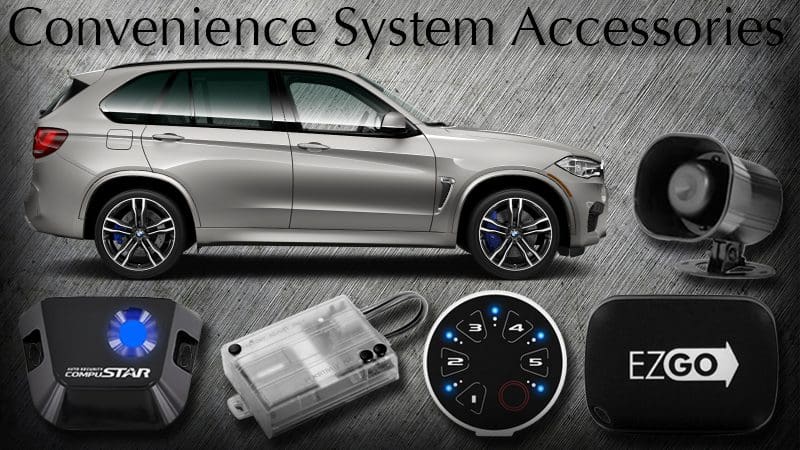
A remote starter, keyless entry or security system is a great way to enhance the functionality of your vehicle. A remote starter can make dealing with weather extremes much more comfortable. A properly installed security system can let you know if someone damages your vehicle or tries to steal it. If your car didn’t come with a remote control to unlock the doors, a keyless entry system can speed up the process of getting into your vehicle and locking it when you leave. An entire list of convenience options can be added to these systems to make them even more convenient and further improve the security of your vehicle.

Cellular Interface

ConvenienceMany companies sell smartphone interfaces for remote start and security systems. These systems work by interfacing between an app on your smartphone and the convenience system in your vehicle. Yes, you have to pay for a monthly (or yearly) service plan, so don’t be surprised by that aspect. These systems will allow you to lock and unlock your vehicle, start it remotely (if you have a remote starter installed), and pop the trunk if that is hooked up.

The best part is that if you have a security system, your phone will alert you with a message if your alarm goes off. Anywhere your car and your smartphone have access to a cellular connection, you can control the system.

Many smartphone interfaces include GPS receivers. Such a receiver can send the longitude and latitude of your vehicle to the app on your smartphone. This information will let you know exactly where your vehicle is and how fast it is traveling. The app also can let you know right away if the vehicle moves when it’s not supposed to.

Some of these systems include the ability to monitor battery voltage, advise you of vehicle diagnostic codes and tell you the temperature of the vehicle interior. A few of these systems include a built-in backup battery and will alert you if the unit is disconnected.

Power Window Control Interfaces

One of the “classic” convenience accessories is the power window interface. This module lets your convenience system roll your windows up and down with the press of a button on your remote. The system can be programmed to roll the windows up when the doors are locked. Many of these window control systems have the option of venting a window an inch or two with a short press of the button on your remote, then rolling the window down completely when you hold the button for a second or two.

Power window modules also can be used to control sliding doors or sun roofs.

Tilt and Motion Sensors

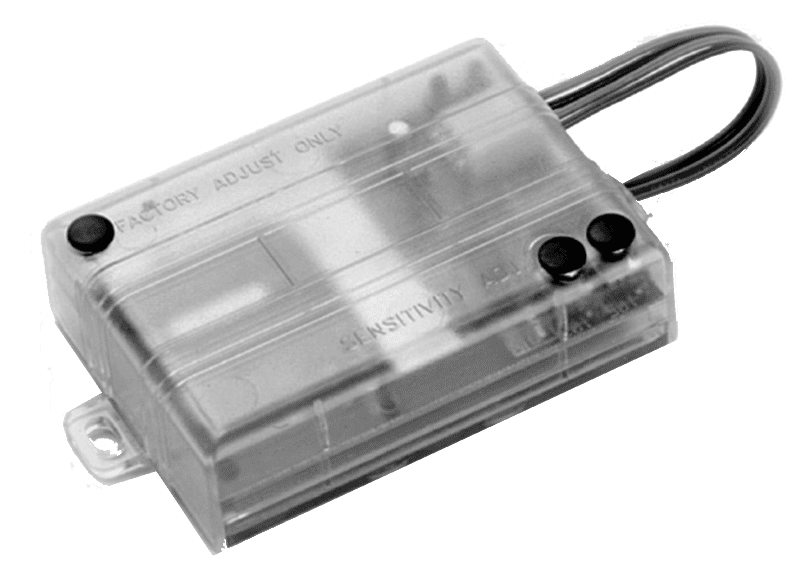
ConvenienceIf you are worried about someone stealing your wheels or towing your vehicle, then a tilt and motion sensor would be a great addition. These sensors calibrate themselves each time the alarm is armed, then trigger the system when the vehicle angle changes by more than a couple degrees. These sensors should not trigger the alarm under normal wind conditions, thanks to integrated software that recognizes when the vehicle is rocking.

Backup Battery Siren

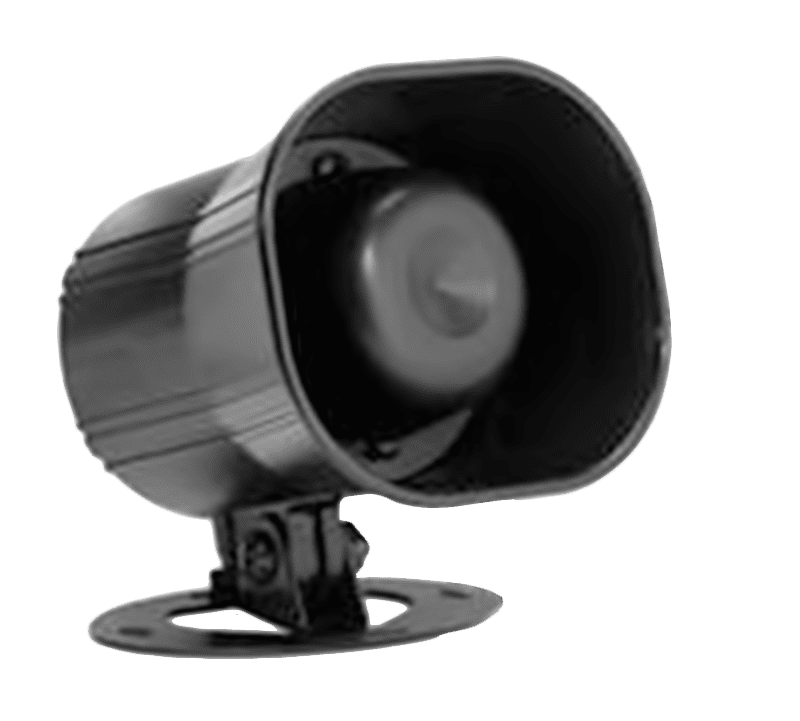
If you are concerned about someone cutting you the wire to your siren so they can work on bypassing the rest of a security system, ask your mobile electronics retailer about a battery backup siren. These sirens will go off if someone cuts the wiring to it. A key on the siren will turn it off.

Radar Sensors Boost Protection

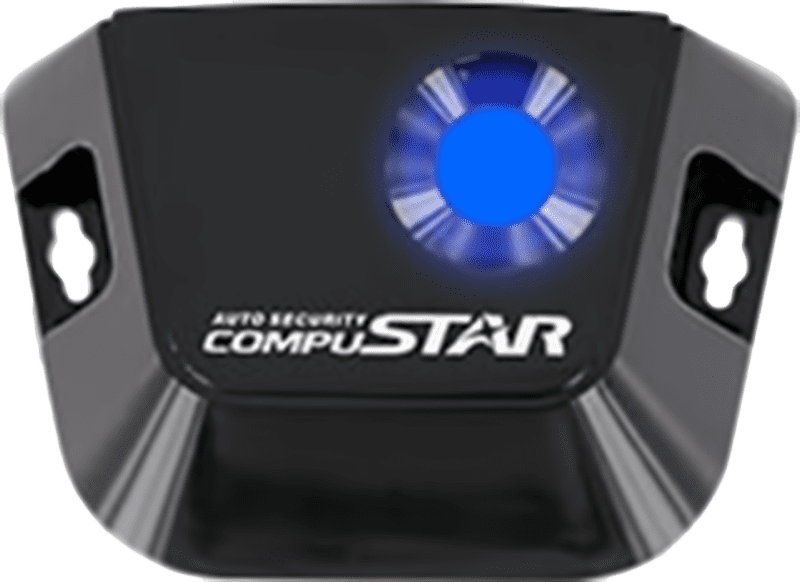
If you have a convertible-top vehicle or like to leave your windows down, a radar or field disturbance sensor is a great way to keep your vehicle protected. These sensors Convenienceusually have two stages of protection. The first will provide a warning to an intruder when something or someone enters the field. The second triggers the alarm right away. Your installer can fine-tune the size of the fields for a given sensor mounting location and vehicle type.

Keypads Add Convenience

Several companies offer convenience keypads that attach to the inside of your windshield. You can type in a code of your choice to arm or Conveniencedisarm the system.

Some keypads have the option of acting as a pager for an owner who has a two-way remote or smartphone interface. These systems use technology similar to what a smartphone uses with a glass screen uses to detect your finger presses.

Proximity Remote

Many new cars have proximity keys that unlock the doors when you walk up to the vehicle. Your installer can add similar technology to an aftermarket keyless entry system. You simply keep a fob in your pocket. When you walk up to the vehicle, it will disarm the alarm without your having to press a button.

High-output Sirens

ConvenienceIf you want to get people’s attention when your alarm goes off, then the addition of a high-output siren is just for you. Some of these sirens are extremely loud, while others offer a sound that is truly ear-piercing! These high-frequency sirens are often called pain generators and are typically installed in the vehicle.

Protecting your vehicle from theft or vandalism is an art. Some installers take great pride in their security system installations. They conceal wiring in the dash very carefully and use wire protection that matches the factory look and feel. Split-loom, flexible-conduit, Tesa tape and vinyl tape are just some of the wire protection options. Installers route wires with factory wiring to further conceal their work.

Adding features and functionality to a security or convenience system is a great way to enhance its performance and usefulness. These are just a few of the possible additions available. Be sure to ask your local mobile electronics specialist retailer about the options they have available.

This article is written and produced by the team at www.BestCarAudio.com. Reproduction or use of any kind is prohibited without the express written permission of 1sixty8 media.
Filed Under: ARTICLES, Remote Car Starters, RESOURCE LIBRARY, Vehicle Security

Backup Cameras Make a Thoughtful and Smart Gift

11/16/2016 By John Schwartz

Backup CamerasDid you know that a backup cameras from Perfectionist Auto Sound and Security in Anchorage makes a smart and thoughtful holiday gift? Every year, we see more and more clients opting for this great driver safety technology, but many times, it gets overlooked as a gift item. Here are some good reasons to consider buying one of these systems for anyone on your gift list.

Backup Cameras Can Save Lives

The sad reality is that every year, people die from accidents that could be avoided if the vehicle in question had a backup camera system installed. Small children behind your vehicle and people bending over can easily be in your blind spot. A backup camera would allow you to see them. Here is a link to a foundation called Kids and Cars that aims to bring awareness of these accidents.

Helps Prevent Damage to Your Vehicle and Others

When Perfectionist installs a backup camera on your car, truck or SUV, it makes you a safer driver. You will see that pole, tree, bicycle or anything else that is behind you, preventing you from damaging your vehicle. What makes things more interesting is when you back into another vehicle and have to pay for damage to two of them, not just one. Backup cameras can prevent these incidents as well.

Aids in Hooking Up Your Trailer or Camper

It can be frustrating to back up to a trailer. What if you could have a camera strategically placed in the back of your vehicle that would allow you to easily line up the ball on your hitch to the trailer? Do you own a fifth-wheel hitch? Perfectionist can add a camera that aims down at the hitch in your bed, making it a lot easier to connect. If your truck already has a backup camera on the rear of the vehicle, we can often add a second camera for your fifth-wheel hitch and give you an easy way to select between the two images.

A Great Resource When Parking

Backup CamerasMany people know the benefits of a rear camera, but did you know we can add a front camera as well? Remember the time you were trying to face-in park and scraped your front bumper on one of those concrete pylons? Or you tagged the corner of your bumper when parallel parking? A front view camera can help to eliminate these costly events. You can add just a front camera or it can be added along with a backup camera.

A Company You Can Trust

Perfectionist Auto Sound and Security is the most-awarded mobile electronics retailer in Alaska. We are known for the legendary quality of our work. Stop in today and let us show you why buying a backup camera system is a great holiday gift. You can also contact us by clicking HERE.

Filed Under: ARTICLES, Backup Safety Tagged With: Backup Cameras

Are Single or Dual Voice Coil Subwoofers Better?

11/13/2016 By John Schwartz

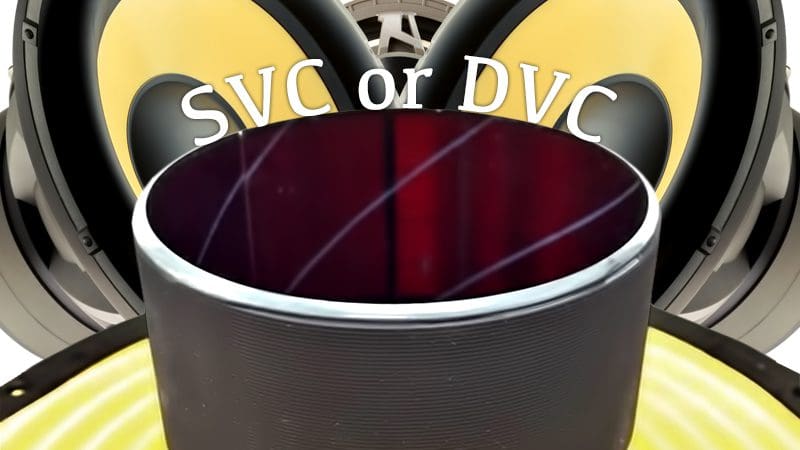
Voice CoilWhen it comes to buying subwoofers, a lot of people have questions or make assumptions about the benefits and drawbacks of single voice coil and dual voice coil versions. Understanding the differences between them requires a slightly enhanced understanding of how an amplifier works. We cover both topics in this article.

How an Amplifier Works

An amplifier is a simple device that takes an audio signal (from your radio, for example) and increases the voltage. That’s it.

You may (logically) be asking yourself, “Why do we call it a power amplifier?” We get an increase in power because the speakers we connect to the outputs of the amplifier have a low impedance. In car audio, we typically see loads between 1 and 4 ohms. This low impedance, combined with the increased voltage of the audio signal in the amplifier, causes relatively large amounts of current to flow through the voice coil of the speaker. This current flow causes a magnetic field and, subsequently, the voice coil moves toward or away from the magnetic field created by the stationary magnet on the speaker.

(OK, maybe this didn’t stay as simple as originally planned.)

Amplifier Load Determines Amplifier Power

Voice Coil
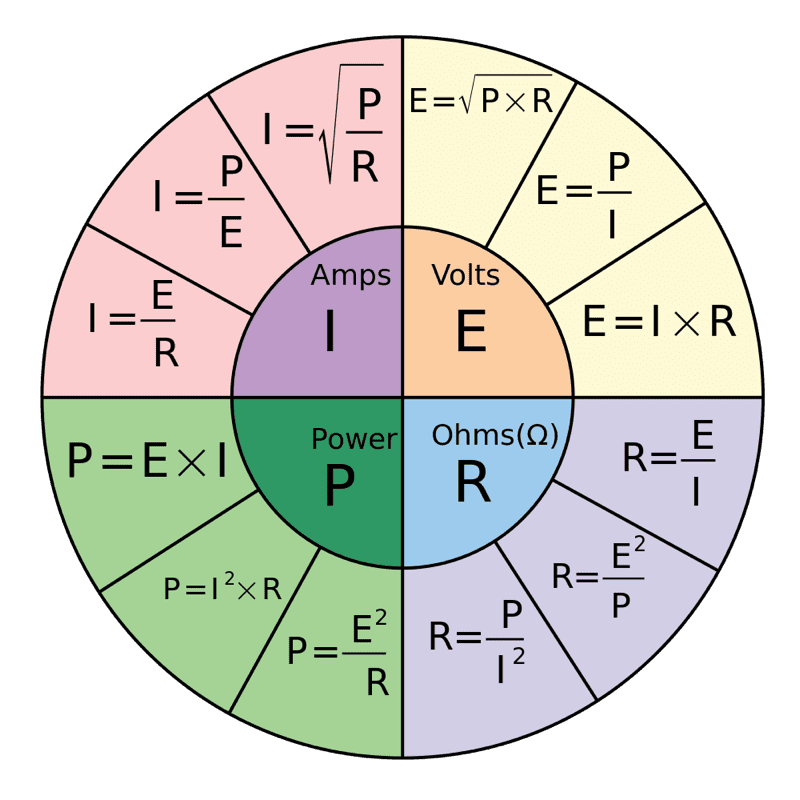
Ohm’s Law Pie Chart
Let’s use an example of an amplifier that has a peak output voltage of 20 V. We don’t need to worry about the fact that this is an alternating current signal – we will examine this at a single point in time. With 20 V applied to our voice coil, let’s say we have a 4 ohm impedance on this coil. Ohm’s law states that a potential of 20 volts applied across a resistance of 4 ohms will result in 5 amp of current to flow. Using the equation P (Power) = Voltage x Current, we get 20 x 5, or 100 watts of power. If we change the impedance of the load to 2 ohms, we double the current to 10 amps, for a resulting power level of 200 watts.

If you look at the specifications for an amplifier, especially a subwoofer amplifier, you will see power ratings at different load impedances. In most cases, unless the voltage of the power supply in the amplifier is adjustable, amplifiers will make more power as the load impedance decreases.

What About These Subs?

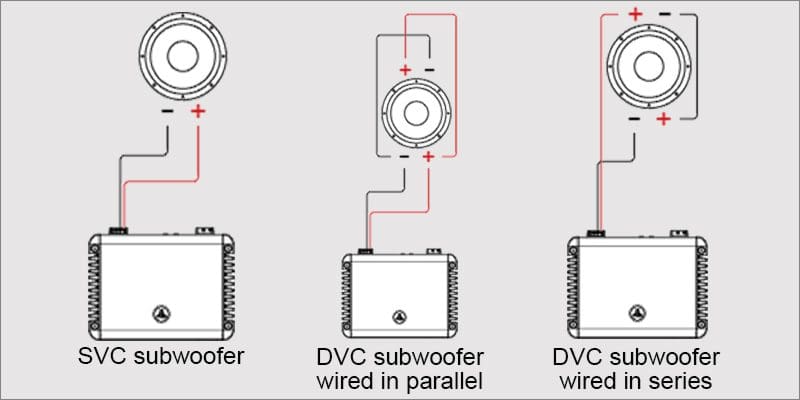
Deciding which subwoofers to buy depends on the amp you are using and the number of subwoofers you are going to use. You want to choose a combination of subwoofers that will let you wire the voice coils together to an impedance that will allow the amp to make the power you want. Let’s look at several examples.

Example 1

Voice Coil
Images courtesy of JL Audio

We have the option of two different fictional subwoofers, each rated for 750 watts of continuous power handling. One subwoofer has a single 4 ohm voice coil. The other subwoofer has dual 4 ohm voice coils.

The dual voice coil subwoofer can have its coils wired in series to produce an 8 ohm load, or in parallel to produce a 2 ohm load. To complete this fictional example, we have an amplifier that will produce 400 watts into a 4 ohm load and 700 watts into a 2 ohm load. We have a small car and want to use a single 12 inch subwoofer in a large vented enclosure to get maximum low-frequency output. What sub should we use?

If we use the single voice coil subwoofer, the amplifier will not make full power in the 4 ohm load. We should use the dual voice coil subwoofer and wire the voice coils in parallel to present the amp with a 2 ohm load.

Example 2

Voice Coil
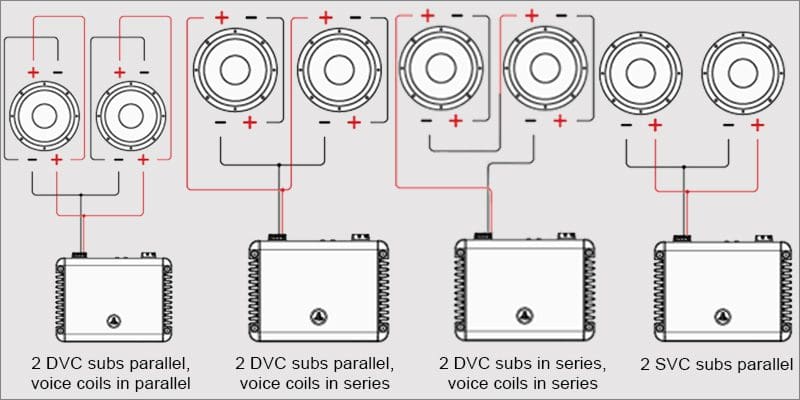
Images courtesy of JL Audio

In this example, we have the same electronic equipment, but the vehicle is a large SUV. There is a lot of room for subwoofers, and the owner wants to list to reggae, loudly. The owner has listened to a friend’s system and found out that a pair of subs matches his listening preferences perfectly. Which subs should we use?

If we use the dual voice coil subs, we have three options for wiring the four (two on each sub) voice coils together. We could wire all the coils in parallel. Parallel wiring will present the amp with a 1 ohm load. Most likely, the amp will go into protection because the load is too low. We could wire all the coils in series to present the amp with a 16 ohm load – but that’s not going to happen. We could wire the voice coils on each subwoofer in series, then parallel the pair of subwoofers to get a 4 ohm load. A 4 ohm load is not ideal.

If we use a pair of single voice coil subwoofers, however, and wire the subs in parallel, we get a 2 ohm load. Happy amp and happy customer!

Choosing and Wiring Subwoofers

  • Voice CoilYou can use as many subwoofers as you want on a single amplifier.
  • You must use all the voice coils on each sub. If you need a 4 ohm load but have a dual 4 ohm sub, using only one coil is going to cause issues. Bad issues.
  • Wire all the subwoofers you choose so the current going through each subwoofer is the same. In most cases, this means using pairs of subs. In the past, several companies offered dual 6 ohm voice coil subs that could be wired in groups of three to present amplifiers with standard load impedances of 1 or 4 ohms.

Do not wire one dual voice coil subs in series and one in parallel before connecting the subs together in parallel. You will get more current through the (parallel) low-impedance subwoofer. This imbalance will upset the performance of the enclosure and wreak havoc with the reliability and quality of your system. This is unrelated to the wiring of multiple subwoofers, but: Don’t mix and match different subwoofers. Each has its enclosure requirements and response characteristics. There is no way to guarantee that the output of two different subwoofers will sum positively at all frequencies.

So, Which Voice Coil Configuration Is Better?

The answer to the question “which is better” is neither. SVC and DVC subwoofers are simply two different options when buying. They are analogous to a tire manufacturer offering different-sized tires for different vehicles – there is an application for each.

Adding a subwoofer system should be one of the very first things you do to upgrade a factory audio system. When you are ready to make the leap into the realism, impact and dynamics that a great subwoofer can add, drop by your local car audio specialist retailer. They would be happy to work with you to design a system that meets your performance expectations.

This article is written and produced by the team at www.BestCarAudio.com. Reproduction or use of any kind is prohibited without the express written permission of 1sixty8 media.

Filed Under: ARTICLES, Car Audio, Remote Car Starters

  • « Previous Page
  • 1
  • …
  • 55
  • 56
  • 57
  • 58
  • 59
  • …
  • 82
  • Next Page »

801 EAST 82ND AVE
ANCHORAGE ALASKA 99518
907-563-8112

Copyright © 2026 | Site design by award-winning creative agency D'zine Alaska , with site support by 1sixty8 Media and Modern Media Geeks.