Perfectionist Auto Sound and Security

Alaska's Most Award Winning Auto Customizer

  • About Us
    • Why Choose Us
    • Meet Our Team
    • Our Awards
    • Virtual Tour
    • Community Engagement
  • Signature Products
    • DroneMobile
    • SoundShield®
  • Services
    • Remote Car Starters
      • Vehicle Security
    • Car Audio
      • Sound Deadening
    • Custom Fabrication
    • Driver Safety
      • Bluetooth
      • Blind Spot Safety Systems
      • Camera Systems
      • Navigation Systems
    • Laser And Radar Detectors
    • Lighting
    • Offroad and Marine
      • Motorcycle Audio
    • Custom Interiors
    • Performance
      • Tires and Wheels
      • Suspensions / Lift & Lower
    • PRO Commercial Division
  • Gallery
    • Photos
    • Videos
    • Wallpaper Downloads
  • Contact Us
    • FAQ
    • Feedback
    • Join Our Team

What Is A Soundstage And Where Can I Buy One?

12/25/2016 By John Schwartz

SoundstageWhen it comes to listening to music, there seem to be two kinds of listeners in the context of “where the sound comes from.” Some people want to be enveloped by the music. They want to feel like they are in the very middle of the performance, with sound all around them. This style is sort of like listening to a set of headphones. The other listener wants their music to come from in front of them. This “forward-facing soundstage” style is more like listening to a home audio system or a movie theater.

There is no right or wrong – everyone has their preference. But high-end mobile audio systems are, for the most part, designed for the latter – people who want to feel as if they are sitting in the middle of the audience at an amazing concert.

There is also that guy in the Monte Carlo with the 6x9s in open-backed boxes in the rear window. He, thankfully, is gone now. If you happen to see him, cut off his mullet and drag him to a car stereo shop, please, and thanks!

Imagining a Soundstage

This article talks about an imaginary soundstage. But what in the world is a soundstage?
Soundstage
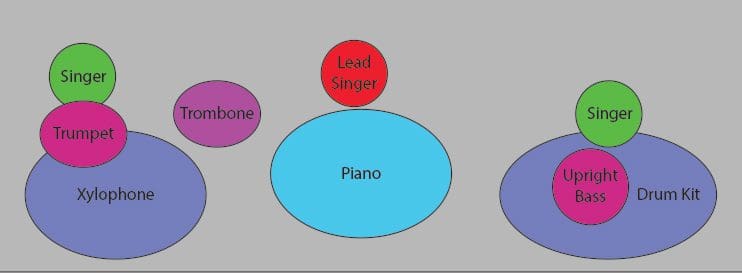
An overhead view of the described stage.

Imagine a band set up on a stage 20 feet in front of you. Let’s say there is a lead singer in the center of the stage, right at the forward edge. Behind him or her, someone is at a grand piano. To the right of the piano is a big drum kit with several cymbals all around the performer. In front of the drummer, to the right of the lead singer, is someone sitting on a stool with an upright bass. To the left of the singer is someone with a trombone. To the left of them is someone with a trumpet. Behind the trumpet player, to the left of the pianist, is a xylophone player. The xylophone player is also going to sing some backing vocals. So is the drummer.

Imagine those different positions for a second. They not only range laterally across the soundstage, but there is depth to their locations.

This unique and perhaps rare grouping of performers represents all the source aspects of your soundstage, but their locations don’t represent the limits of that stage. Let’s consider the venue in our analogy as well. A medium-size club of some sort. Wooden walls, a hard floor and a high ceiling. The room where we listen to our performance is a huge contributing factor to the sound of the performers. (If you ever have the chance to visit the Ryman Auditorium in Nashville, TN, do it! Even if you aren’t into country music, this venue is amazing.)

So, here we have our performers and our venue. We are going sit about 20 feet back from the center of the stage and let the show unfold for us. Our experience as the performers play defines the soundstage. We hear each instrument in its position on the soundstage. We also hear the sound of those instruments reflecting off the side walls of the club.

To reproduce the performance accurately, we need to reproduce those reflections as well. Capturing those reflections requires a specific recording style – so it may, or may not, happen. A recording of a live performance is much more likely to have that information than a studio recording.

Our Auditorium on the Road

SoundstageThere it is. The space in front of us, where the music is coming from, is our soundstage. If you get a chance to listen to your favorite recordings on a high-end home audio system, and you choose to sit equidistant from the speakers, then you probably have experienced a fairly accurate soundstage. The perceived location of where our music is coming from regarding height, width and depth is our soundstage.

Sadly, most mobile audio systems can’t or don’t recreate this very well. It’s a shame, because experiencing each performer in their correct location, including depth (one performer behind another) brings an amazing level of realism to your music. The good news: Recreating a soundstage in your car isn’t all that hard.

If you let the salesperson and installer at your local mobile electronics retailer know that you want a soundstage in your vehicle, they can design your system that way. Let’s assume we are building a whole new system from scratch, just to make this easier.

The first step will be to select a set of good-quality speakers for the front of your car. You mostly likely will want a component set unless you can fit a large (5-1/4” or larger) coaxial on the dash. Since most vehicles have the front speakers down low in the door, using a component set will let the shop you use install the tweeters up high and far forward. If the tweeters play low enough, say 2.5 kHz, then a skilled tuner can make the sound appear to come from the dash level, rather than the floor.
Soundstage
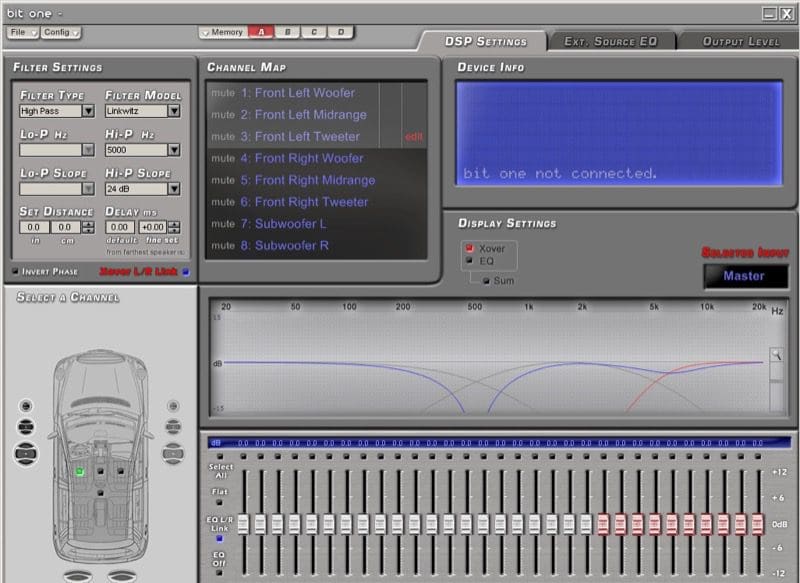
Tuning software such as this from Audison allows detailed control of the audio.

The next step to creating a soundstage is to have a way to tune those speakers. We aren’t talking about amplifier gain settings. We need control over equalization, output level and signal delay. Because the driver of the vehicle sits closer to the left speakers, those will appear to be louder, and we will hear the sound being reproduced by them sooner than the sound from the other side of the car. The simplest of systems with great soundstages will have either a source unit or external DSP unit with three-way crossovers, stereo equalizers and the ability to delay the signal going to each speaker.

With the above tools in place, your installer can set up the system so the sound coming from each speaker in the front of the car – from both midrange drivers and both tweeters – arrives at the listening position at the same time. Your installer will also tune the system so the left side of the car sounds the same as the right side. This tuning helps to eliminate frequency steering. Frequency steering causes the source location of a sound to move around the soundstage depending on frequency.

Next-level Performance

The above example offers a great two-way front stage. We would, of course, assume you are going to use a subwoofer in the system. A set of door speakers, even great ones, won’t be able to reproduce the bottom octave of the audio spectrum with any authority. With the sub in the system, it’s now called a three-way system. What if you want the system to sound even more realistic in terms of the placement of voices on the soundstage?

One way to improve your soundstage is to install a set of midrange drivers up high and far forward in the car. The A-pillars, dash speaker locations, and high and forward in the door are common midrange locations. If you can get a midrange that will play down to at least 300 Hz, the ability to solidify the dash as the source of the sound becomes much better. Rather than having deeper voices coming from lower in the door, now they will be focus better across the dash.

Another advantage of a three-way speaker set is that the woofer is often capable of producing slightly deeper midbass than an equivalent two-way speaker set.
Soundstage
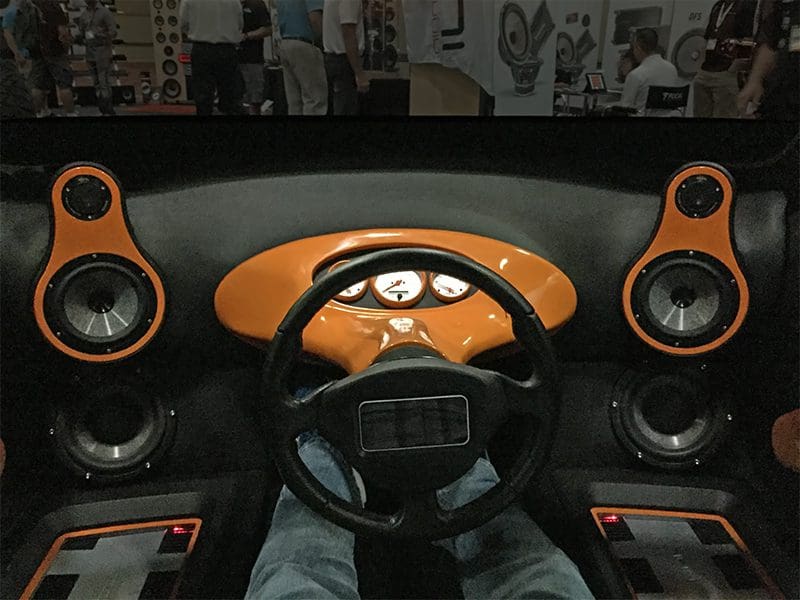
4-way systems, such as the one in this purpose-built Civic can sound incredible.

The four-way system is going to cost more. You need two more speakers, two more amplifier channels, somewhere to mount those new speakers and probably another 30 to 60 minutes worth of system tuning. But yes, it’s totally worth it.

In these systems, the focus of performance is tailored to the driver’s seat alone. The passenger isn’t going to enjoy the same experience. That said, if you and your co-pilot both want to enjoy equally amazing audio, there are solutions in the works. By the spring or summer of 2017, everyone in the car will be able to enjoy an amazingly realistic soundstage across the dash.

This article provides an overview of the system design requirements for creating a system with a good soundstage. There are a lot of variables and hundreds, if not thousands, of options regarding how to execute to fine-tune the concept.

This is where your experienced mobile electronics retailer comes in. Use their knowledge, skill and experience to help bring your desire for musical realism to reality. If you’re out cruising around, drop into your local mobile electronics specialist retailer and ask if they have a demo vehicle that produces a great soundstage. If you have never experienced one, you will be blown away! Best Car Audio will not be held responsible for the ensuing audio addiction.

This article is written and produced by the team at www.BestCarAudio.com. Reproduction or use of any kind is prohibited without the express written permission of 1sixty8 media.

Filed Under: ARTICLES, Car Audio, RESOURCE LIBRARY

Product Spotlight: Sony XAV-AX100

12/20/2016 By John Schwartz

Sony XAV-AX100Here at Perfectionist Auto Sound and Security in Anchorage, we take pride in offering cutting-edge mobile electronics products to our loyal clients. The Sony XAV-AX100 in-dash stereo and multimedia system is one of the most exciting products to come down the pike in a long time.

Apple CarPlay and Android Auto on Tap

Sony XAV-AX100If you own an iPhone or an Android phone, you are holding lots of technology in your hand. Unfortunately, there hasn’t been a good way for you to use that technology in your vehicle in a safe manner. But now, Apple CarPlay and Android Auto change all that for you! All you have to do is go out to your vehicle and plug your smartphone into the Sony XAV-AX100 using the appropriate cable. You instantly gain voice control over many popular functions including phone calls, texting, turn by turn GPS navigation, music, and reminders. In short, many of the popular functions you use on a daily basis can now be done safely while driving.  All being controlled with a simple touch on the screen and the sound of your voice. How cool is that?

It Can Integrate with Your Existing Controls and Features

One of the specialties here at Perfectionist is our ability to integrate new technology into your vehicle without losing any of the existing ones. Do you have steering wheel mounted audio controls? They will work beautifully when we are done. Do you have an existing backup camera? We can integrate it with the Sony 6.4” color screen. And if you don’t have a backup camera, now may be the perfect time to add one.

Sony Quality and Sound Comes Standard

Sony XAV-AX100Sony is legendary for their quality, and the XAV-AX100 will continue that trend. You can be confident that when you buy this unit for your car, truck, or SUV, it will give you years of reliable service. The integrated processor makes the response time lightning fast. The beautiful 6.4” display is crystal clear and bright as day so you can easily use it while driving. And remember, we are a car stereo specialist, so sound quality is important to us. It includes three sets of preamp outputs, giving you lots of expandability options. The sound control options include time alignment, plus multiple equalization settings designed to restore the musical quality of your compressed audio files.

Come See The Sony XAV-AX100 for Yourself

The best way to experience the Sony XAV-AX100 is in person at Perfectionist Auto Sound and Security. You will enjoy it live and in action.  You can hook up your iPhone or Android phone and see how easy it is to operate. Feel free to contact us HERE for more information on any of our products and services.

Filed Under: PRODUCTS, Smartphone Integration Tagged With: Backup Cameras, Radios, Sony

Product Spotlight: Optix RVCLPMB And RVM430NBTG Backup System

12/19/2016 By John Schwartz

Optix Backup SystemA lot of clients come to Perfectionist Auto Sound and Security in search of backup camera systems for their cars and trucks. Adding this technology not only can make parking easier and faster, it dramatically increases the safety of everyone around your vehicle. We have several options for cameras and displays, but our most popular package is from a company called Accele. The Optix RVCLPMB low-profile camera and the RVM430NBTG replacement rearview mirror with monitor comprise our backup system that works well in most vehicles.

Premium License Plate Camera

Optix Backup SystemThe Accele RVCLPMB is an adjustable-angle 1/3-inch CCD camera in a metal mounting bracket. The camera has a resolution of 528 pixels horizontally and 492 pixels vertically. The wide-aperture design allows the camera to capture images in light levels as low as 0.1 Lux. This light sensitivity measurement ensures that your reverse lights are more than enough to illuminate anything behind you safely, even in the darkest situations. The camera has built-in parking guide/grid lines to help you navigate into a parking spot.

Universal Rearview Mirror with Monitor

In some vehicles, we can integrate the image from a backup camera into a factory display. While this looks neat and tidy, those video interfaces are costly. Enter the Accele RVM430NBTG. This replacement rearview mirror mounts in place of your factory mirror, using the factory mounting hardware. When the camera system is not in use, the RVM430NBTG looks like a normal 10-inch mirror. As soon as you put your transmission in reverse, a 4.3-inch LCD on the right side of the screen shows the image from the camera.

The RVM430NBTG isn’t just a one-trick pony. The mirror also includes Bluetooth interface for hands-free operation of your cellphone. A speaker and built-in microphone ensure you can hear the caller clearly, and that they can hear you. The 4.3” LCD screen displays phone numbers for incoming calls, so you know who is calling.

Stop By To Learn More About Our Optix Backup System Options

If you are looking to enhance the safety of your car or truck, then drop into Perfectionist Auto Sound and Security in Anchorage, Alaska. A member of our sales team would be happy to develop a custom solution to meet your needs.

For more information about any of our products or services, contact us by e-mail by clicking here.

Filed Under: Backup Safety, PRODUCTS Tagged With: Accele, Backup Cameras, Optix

How Car Audio Has Changed Through The Years

12/18/2016 By John Schwartz

Car AudioIf you have been around the mobile electronics industry for more than a decade, then you may have noticed some significant changes. New technologies make our time behind the wheel safer, more entertaining and more productive. Many products offer better performance and efficiency compared to their originals. Innovations and technological advancements let us do things that simply were not feasible decades ago. This article looks at some of the most significant changes that have taken place in the car audio industry over the past few decades.

The Mighty Head Unit

Car Audio
By CZmarlin (Own work) [CC BY-SA 3.0], via Wikimedia Commons
Let’s see how far you want to go back. Mono FM radio? The 8-track? Perhaps a turntable under the dash of your 1960 Chrysler? Things have come a long way in source units and their features. We saw cassette players, the mini-disc (if only for a year) and even CD players come and go. We introduced digital media with MP3 files, then added WMA, WAV and – most recently – FLAC file playback. Soon, Master Quality Authenticated (MQA) will join the ranks.

The introduction and popularity of the Apple iPod signaled a massive change in the philosophy of music lovers. While this handy device could be considered the “nail in the coffin” for the record store industry, it launched new levels of convenience for music accessibility. The mobile electronics industry embraced the iPod, and now, support for it is standard on all mid- to high-level source units. Similar support for Android-based smartphones has also become almost a standard feature in the last few years.

Miniaturization and the advancement of computer processing have given us full-color touchscreen interfaces with fancy animated graphics. We can watch a DVD or digital media movie while having lunch in the car. Portable navigation systems have replaced paper maps to help us travel safely and more efficiently.

Car AudioRecently, we have introduced connected technology solutions. Internet connectivity is a feature in many new car radios, most often via your personal smartphone. Access to the Internet allows you to stream music from online resources like Google Play or iTunes Radio. Apple and Android have developed interfaces for their smartphones to enable drivers to send and receive text messages, make phone calls, select navigation destinations, and choose the music they want to listen to by just talking to the radio. CarPlay and Android Auto are the current “big thing” in multimedia source units.

Those Oh-so-fun Subwoofers!

Car Audio
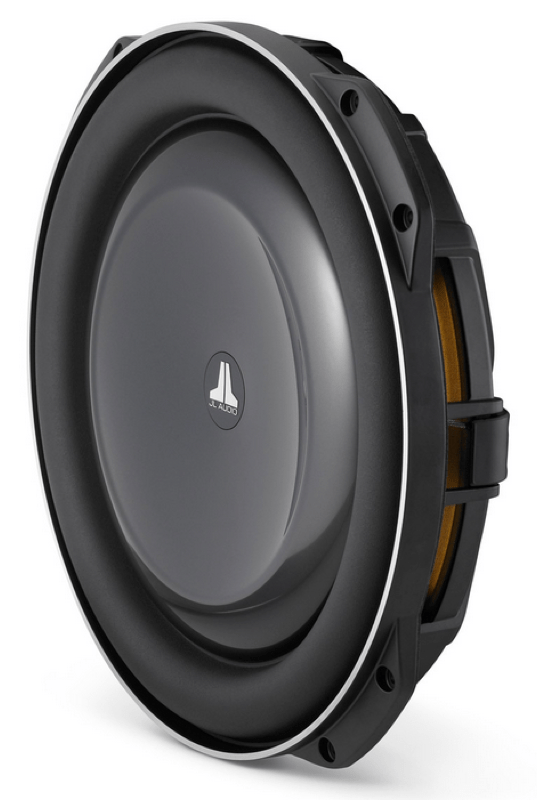
The JL Audio TW5 is an example of advancements in subwoofer design.

What could you change when it comes to the design of a speaker? Materials for cones, suspensions, surrounds and motors haven’t advanced all that much, and because a subwoofer reproduces only low frequencies, things like cone materials don’t have a dramatic effect on performance. What has changed is our ability to model the behavior of the magnetic field within the speaker. Being able to optimize the geometry of the magnetic field allows designers to create subwoofers that are more efficient and that offer better performance with less distortion at high excursion levels.

The size and location of the subwoofer enclosures we use in our vehicles have become and more important. Back in the “good old days,” if you wanted big bass, you had to give up your trunk. Now, many subwoofers are designed to play nice and low in a very small and shallow enclosure. Using these subwoofers allows your installer to create compact solutions that will fit in a spare-tire well, the corner of your trunk or even in the footwell of some vehicles. We should be clear; there is a trade-off with these subs – they often require more power to produce the same output as a “conventional” subwoofer, but power is inexpensive these days.

Amplifiers, Smaller, More Power

Car Audio
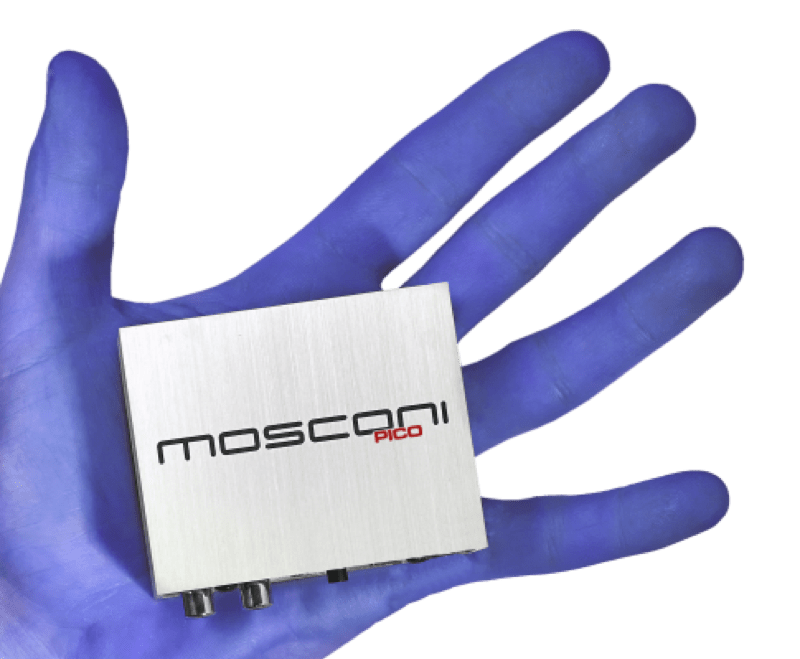
200 watts that fits in the palm of your hand was unheard of in the past.

Power is cheap. You can buy a great-quality 1,000 watt subwoofer amplifier for around $500. Decades ago, a 1,000 watt amp was among the biggest amps available, and it cost several thousand dollars. That amp was also the size of a skateboard and consumed a lot of power. Modern amplifiers are much smaller and much more efficient, sound better and consume less power. A lot of people credit the increase in efficiency to Class D designs. While switching to Class D for many applications makes sense, there have been efficiency improvements thanks to being able to use small microcontrollers and high-tolerance components in a Class AB amp.

In the past few years, more and more companies have been offering amplifiers with built-in advanced signal processing. On the most basic of amplifiers, we have crossovers and bass boost circuits. More advanced amplifiers offer both high- and low-pass filters on the same channel for midbass and midrange applications. Some amplifiers even provide low-frequency signal restoration processing. A whole other class of amplifiers on the market has built-in DSP processing. Some are so advanced that they don’t have a single analog adjustment on them.

Signal Processing Moves To Digital

Years ago, signal processing meant you had an EQ and a crossover in your car. These in-dash processors were made popular by the 1/2-DIN equalizer – a 1×7-inch EQ that would mount in the dash above or below your radio. These little EQs offered as many as 11 bands of graphic equalization to let you “tune” your system. Some had subwoofer level controls and crossovers built in.

Car AudioThe next step in processing was the stand-alone processor – usually either an equalizer or a crossover, sometimes both. These were the size of a medium-sized hardcover book and gave installers much more precise control over system tuning. The drawback was their physical size. They took up a lot of room.

Almost all of these are gone now, replaced by stand-alone DSP processors. These seemingly magic black boxes replace those old stand-alone equalizers and crossovers, and include options like signal delay and the ability to switch between different settings at the flick of a switch.

Modern signal processing has allowed installers to use signal delays to optimize seemingly unconventional mounting locations for speakers to produce an amazingly accurate soundstage.

Speaker Placement Becomes Less Critical

In the past, if you wanted a great soundstage in your car, then you had to work with placement to equalize the difference in path lengths between the front speakers. Autosound competitors would go to great lengths to move seats as far back into the vehicle as possible, and some even built vehicles with a single seat located in the center. It was all somewhat silly because that effort never translated into value or performance for the consumer. All consumers could get were kick-panel–mounted speakers or a compression horn under the dash to aid in equalizing distances.

Car Audio
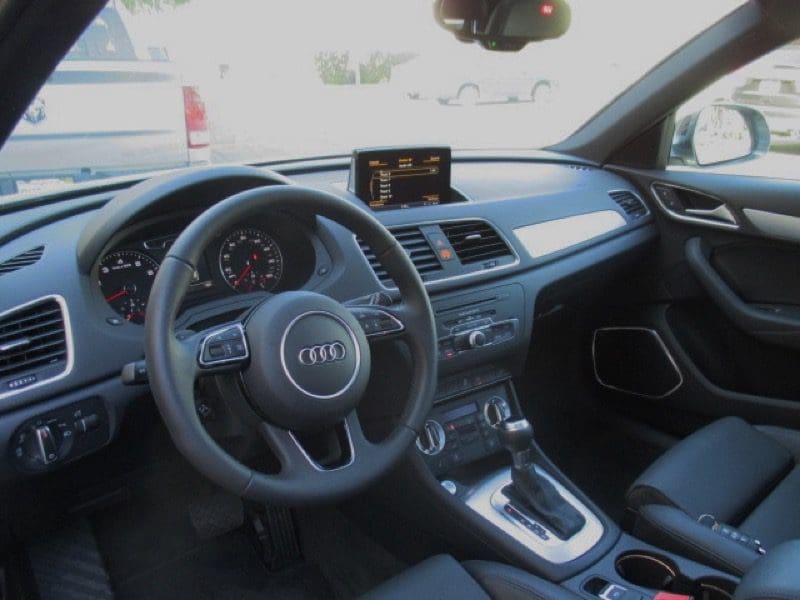
The factory speaker locations in this Audi can be utilized for great sound.

With the assistance of modern signal processing, installers can use factory locations, then delay the signal going to the closest speakers to put you in the center of them.

Another speaker location that has become popular is the A-pillar speaker pod. A nice midrange and tweeter up high and far forward in the vehicle can help create a deep and wide soundstage. The drawback with this approach is that it only works for one seat. If it is set up for the driver’s seat, the soundstage for the passenger seat is compressed into the right-side speaker location.

Very soon, the newest of processors will offer provisions to make every seat in the car sound great using an up-mixer and a center channel, just like the one in your home theater. Now, both front seats and even passengers in the rear can experience an even and focused soundstage across the dash of the vehicle.

Modern Speakers Refined

Like subwoofers, speakers haven’t changed dramatically since the first fixed-magnet, moving-coil speaker was created in 1925. Speakers have improved in efficiency and accuracy thanks to better materials for surrounds, better adhesives and dramatically better processes that help speaker manufacturers build more-consistent products. The real performance upgrades have come in the optimization of a speaker’s motor assembly with respect to the interaction between the voice coil and the magnetic field.

As a speaker cone moves in and out, the magnetic field strength varies. This causes distortion. The same goes for the suspension system: Being able to model the behavior of different surrounds and spiders allows designers to produce transducers that are more linear and, thus, create less distortion.

The Incredible Car Audio Evolution

Overall, the latest innovations and technologies have moved the mobile electronics industry to a point where the modern in-vehicle infotainment system performs at a level that could not be conceived of even a decade ago. If you want to find out about the latest technologies or products, drop into your local mobile electronics specialist. They would be happy to show you the latest and greatest offerings for your vehicle.

This article is written and produced by the team at www.BestCarAudio.com. Reproduction or use of any kind is prohibited without the express written permission of 1sixty8 media.

Filed Under: ARTICLES, Car Audio, RESOURCE LIBRARY

Product Spotlight: Metra IBHS1 Seat Heaters

12/17/2016 By John Schwartz

Metra IBHS1We are installing a lot of remote car starters here at Perfectionist Auto Sound and Security now that the weather is cold. We offer several options with our Compustar remote starters – you can add security features, and we can activate functions like your rear window defroster or heated seats automatically. If your vehicle doesn’t already have heated seats, then we offer the Metra IBHS1 seat heaters to solve that.

Metra IBHS1 Carbon Fiber Seat Kits

Metra IBHS1We can install aftermarket seat heaters in most vehicles. We use the IBHS1 seat heater kits from Metra. Each kit includes a pair of 9×18-inch heating pads, an illuminated three-position switch and a wiring harness. The heating elements use flexible carbon fiber threads to allow the pads to conform to the seat cushion perfectly. The pads are thick enough to be undetectable once installed.

Illuminated Control Switch

Each seat heating kit has an illuminated two-position control switch. The mechanical switch has high, low and off positions with an LED that illuminates when the system is on. The beauty of a mechanical switch is that you can leave it turned on when you get out of your car and when you remote start the car, the seats start to warm up right away.

Fast Warm-up Time

Each heating pad is rated to produce about 25 watts of heat. The pads have a built-in thermostat that keeps the temperature between 115 and 135 degrees. This power level allows the seat heater kit to warm up quickly.

Quality Perfectionist Installation

To properly install a seat heating kit, we remove the seats from your vehicle and carefully disassemble them on our bench. Then we remove the upholstery and secure the heating pad in place. We solder every electrical connection in the vehicle to ensure maximum reliability and conductivity. We protect and conceal the wiring with Tesa cloth tape. Once we have installed the heating elements in your seat and reassembled it, you can’t even tell we worked on it.

Tired of getting into a cold vehicle? Drop into Perfectionist Auto Sound and Security in Anchorage, Alaska, today. We will look over your car or truck and provide you with a quote to install seat heaters and a remote car starter.

For more information about any of our products or services, contact us here.

Filed Under: PRODUCTS, Remote Car Starters Tagged With: Heated Seats, Metra

  • « Previous Page
  • 1
  • …
  • 53
  • 54
  • 55
  • 56
  • 57
  • …
  • 82
  • Next Page »

801 EAST 82ND AVE
ANCHORAGE ALASKA 99518
907-563-8112

Copyright © 2026 | Site design by award-winning creative agency D'zine Alaska , with site support by 1sixty8 Media and Modern Media Geeks.