Perfectionist Auto Sound and Security

Alaska's Most Award Winning Auto Customizer

  • About Us
    • Why Choose Us
    • Meet Our Team
    • Our Awards
    • Virtual Tour
    • Community Engagement
  • Signature Products
    • DroneMobile
    • SoundShield®
  • Services
    • Remote Car Starters
      • Vehicle Security
    • Car Audio
      • Sound Deadening
    • Custom Fabrication
    • Driver Safety
      • Bluetooth
      • Blind Spot Safety Systems
      • Camera Systems
      • Navigation Systems
    • Laser And Radar Detectors
    • Lighting
    • Offroad and Marine
      • Motorcycle Audio
    • Custom Interiors
    • Performance
      • Tires and Wheels
      • Suspensions / Lift & Lower
    • PRO Commercial Division
  • Gallery
    • Photos
    • Videos
    • Wallpaper Downloads
  • Contact Us
    • FAQ
    • Feedback
    • Join Our Team

Understanding Specifications: Car Audio Amplifier Distortion

05/30/2021 By John Schwartz

Amplifier Distortion

As we slowly approach the end of our latest Understanding Specifications series, we want to take a look at car audio amplifier distortion ratings and explain what they mean. We should make it clear: No matter how or good or bad a piece of audio equipment is, every audio component adds some amount of distortion to the signal. The amount and type of distortion those audio products add matters a great deal. Let’s explain distortion, so you know what we’re talking about.

What is Harmonic Distortion?

Before we talk about distortion, let’s talk about harmonics. By definition, a harmonic is an overtone or multiple of a frequency or sound. For example. If you were to play a 1 kHz test tone through an amplifier and a speaker, harmonics of 1 kHz would be 2 kHz, 3 kHz, 4 kHz and so on until the information becomes inaudible because the amplitude is reduced or you have reached the limit of the recording medium.
Amplifier Distortion
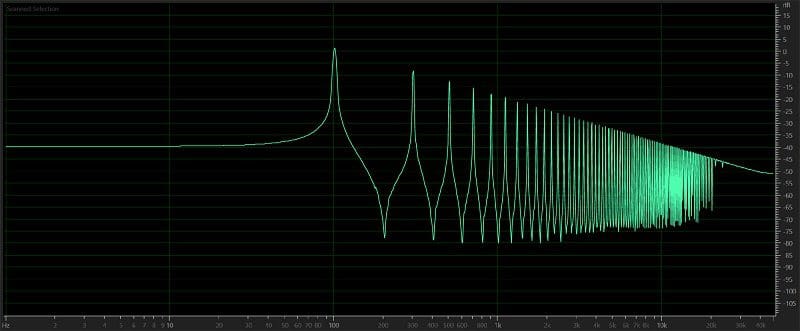
The frequency content of a 100 Hz square wave showing odd-ordered harmonics at 300 Hz, 500 Hz, 700 Hz, 900 Hz and so on.

Visual Representation of Harmonic Distortion
Amplifier Distortion
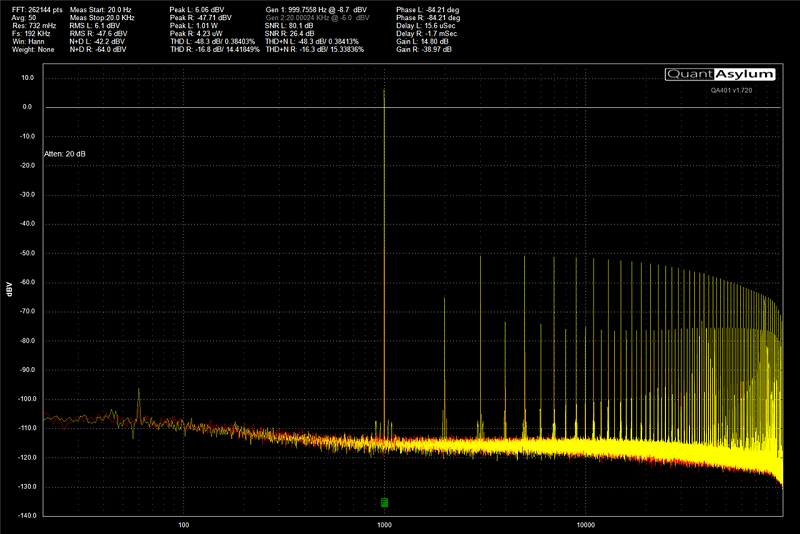
Here is an image of the output of an inexpensive amplifier playing a 1 kHz test tone at an output level of 1-watt into a 4-ohm load. As you can see, additional audio information has been added to the output signal at almost every conceivable harmonic, right out to 20 kHz. The level of the distortion is significant at -48.3 dB or 0.384 percent.


Amplifier Distortion
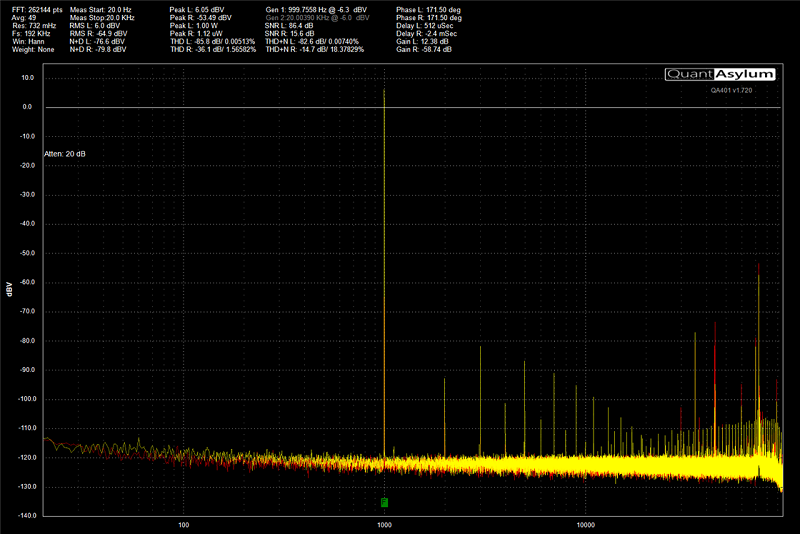
Here is a high-quality amplifier playing the same 1 kHz test tone at the same 2.0 Vrms level. There is significantly less harmonic distortion added to the output signal. The peak is at a level of -85.4 dB or 0.00513 percent.

Intermodulation Distortion Explained

Another common distortion is intermodulation distortion (IMD). From a mathematical standpoint, where harmonic distortion results in multiples of a specific frequency, intermodulation distortion manifests itself as audible signals that are the difference between two frequencies.

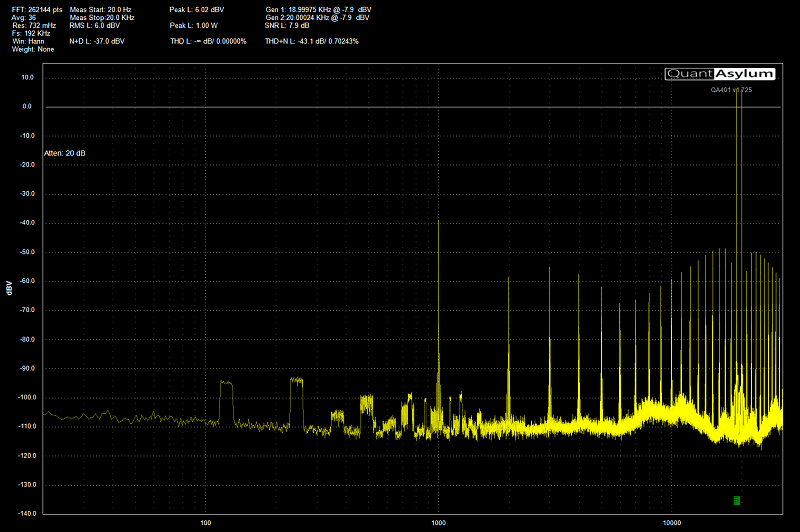
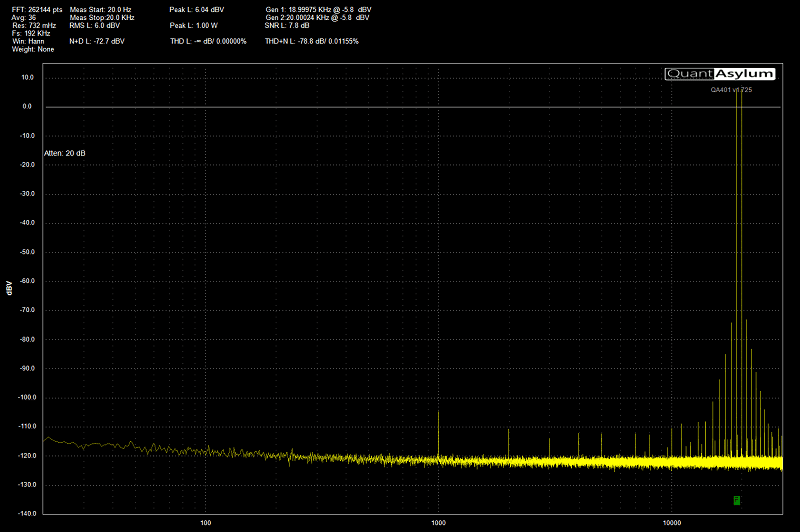
The most common lab test for intermodulation distortion involves playing two test tones at the same time and looking at the resulting output. In most cases, 19 kHz and 20 kHz tones are used and the resulting distortion typically manifests itself as unwanted output at 1 kHz. This 1 kHz content is the difference between 19 kHz and 20 kHz (20-19=1). You will also see harmonic distortion present in the output signal on either side of the 19 and 20 kHz tones.
Amplifier Distortion
Here are the IMD measurements of our inexpensive amplifier. As you can see, the output level is set to 1 watt or around +6 dBv. The difference product at 1 kHz is at a level of -45.06 dB (0.558 percent distortion) and the higher ordered harmonic distortion products are at or below -54.7 dB (0.183 percent distortion).


Amplifier Distortion
Our good amplifier is set up for the same test as above and as you can see, the results are significantly different. The product at 1 kHz is at an astonishing -110.78 (0.000289 percent distortion) and the highest sideband is at an impressive -80.22 dB (0.00975 percent distortion). This is several orders of magnitude better performance.

How Do We Perceive Car Audio Amplifier Distortion?

Amplifier DistortionIn the case of harmonic distortion, this typically manifests itself as adding an amount of “brightness” or “harshness” to the amplifier since it creates high-frequency content where none originally existed. Harmonic distortion reduces the clarity and realism of the music you are enjoying.

Intermodulation distortion, on the other hand, is responsible for adding unwanted low-frequency content to your music. In most cases, when someone describes an amplifier (or source unit or processor) as sounding “warm,” that is a result of the presence of audible intermodulation distortion.

Choosing the Right Amp for Your Car Stereo System

Of course, you will want to choose an amplifier that offers the lowest possible distortion numbers for your given budget. In the case of the three amplifiers we used in our good, better and best comparisons, you are looking at a dramatic difference in cost, with the cheap amp coming in under $100, the middle amp costing around $600 and the great amp having an MSRP around $1,500. With that said, the fact that an amplifier is expensive doesn’t automatically make it good. Your local mobile electronics specialist retailer can help you choose the right amp for your system and budget to ensure that your music will sound great!

This article is written and produced by the team at www.BestCarAudio.com. Reproduction or use of any kind is prohibited without the express written permission of 1sixty8 media.

Filed Under: ARTICLES, Car Audio, RESOURCE LIBRARY

High-Output Air Horn System for Anchorage Jeep Grand Cherokee

05/26/2021 By John Schwartz

Air HornA client from here in Anchorage recently contacted the team at Perfectionist Auto Sound and Security to inquire about having us install a high-output air horn system on his 2016 Jeep Grand Cherokee. The system that the client wanted wasn’t the sort of thing you’d find at Walmart or an auto parts store. This HornBlasters Conductor’s Special kit includes a high-performance compressor and four hand-tuned Shocker XL horns that deliver real train-horn performance.

Grand Cherokee Air Horn System

Air Horn
Our technicians carefully secured the lines and wiring.
Air Horn
Our team had their hands full with the necessary parts to complete the air horn system.
Air Horn
The compressor and tank were securely mounted for safety.

The project started with us creating a mounting panel that fits into the storage area in the back of the Jeep. With a layer of black carpet in place for a neat and tidy look, we mounted the Viair 444C compressor and the two-gallon, six-port air tank to the panel. We plumbed the compressor into the tank and installed the pressure gauge to be visible from the rear of the vehicle. Using our CNC laser, our team fabricated a 2-inch acrylic plastic spacer that fits under the spare tire hold-down nut to secure everything in place.

The Viair compressor is rated for 100% duty cycle and can fill the tank back to full pressure in about one minute. The horn system has enough air to blast at full output for at least four seconds. That’s well more than enough to get anyone’s attention.

Train Horn Installation

Air Horn
The horns and solenoid were secured underneath the vehicle.

Next, we set to work mounting the quartet of Shocker XL horns and the brass-body solenoid valve under the vehicle. The valve features a 16 mm orifice to ensure maximum airflow to the horns. The horns themselves are tucked up close to the floor and are aimed rearward so that they won’t fill with dirt, water, snow or slush. The solenoid is bolted securely to the truck’s floor, and all the wiring is protected from damage and moisture using automotive-grade cloth tape before being routed with existing wiring under the vehicle.

With everything installed, it was time to test the system. Of course, we warned everyone in the shop about our intentions before giving this the first blast. Sweet-mother-of-pearl, this system is insanely loud! Even with the bay doors closed, we bet they could hear us up the street at the gas station. Our apologies to our neighbors.

The client was absolutely thrilled with the installation and loved how loud the air horn system is. He was excited to get the truck back on the road and give his friends a demonstration. If you’re interested in upgrading your vehicle, drop by Perfectionist Auto Sound and Security and speak with one of our experts. If you can’t get to the store during regular business hours, give us a call or send our team an e-mail.

Filed Under: Custom Fabrication, FEATURED INSTALLATIONS, Truck Accessories Tagged With: 2016, Air Horns, Cherokee, HornBlasters, Jeep, Viair

Why Car Audio System Setup and Tuning Are Important

05/23/2021 By John Schwartz

Car Audio System TuningUnlike buying and setting up a basic home audio system, having a new amplifier and speakers installed in your car or truck requires proper setup and tuning. At home, you can adjust the placement of the speakers and how much they are toed in to affect the focus of the soundstage and the bass response. In a car, your installer needs to mount the amplifier, wire it, then adjust the crossover and sensitivity controls to work with your source unit and the design of the system. Getting these settings wrong can have an audibly detrimental effect on the performance of your mobile audio system. Let’s look at why proper amplifier setup and tuning are so important.

Basic Car Audio Amplifier Setup

Car Audio System TuningOnce the power, ground and remote turn-on connections are made, and new speaker wires have been run to each location in the car, the last step is to connect your amplifier to the source unit in the system. Depending on the design of your audio system, you may have a very basic CD player with low-voltage preamp outputs, a premium multimedia receiver with 5-volt preamp outputs or you might be using a factory radio with or without an amplifier. The sensitivity (gain) control on your amplifier exists to ensure that your new amp can reach its full potential from any of these sources. Many shops use an oscilloscope or a distortion detecting device to ensure that the system is configured accurately and efficiently.

Car Audio System TuningIf you are adding a subwoofer to your vehicle, the basic process is the same, but your installer now has to balance the output of the sub to the other speakers in the car. He or she will also have to set the crossovers on the amp so that the output of the sub blends with the output of the smaller speakers. Many high-end shops use a real-time analyzer (RTA) to perform this task to ensure the output of the speakers blends perfectly. Setting up crossovers also needs to take into account the physical capabilities of a speaker. A small 4-inch midrange certainly can’t produce the same amount of low-frequency information as a 6.5-inch woofer and needs to be adjusted accordingly.

What if Things Aren’t Set Up Properly?

Car Audio System TuningIf the sensitivity setting is wrong, you may experience a lot of background noise or hiss in your system. At the opposite end of the scale, you may not be able to reach full volume. If the crossovers aren’t right, you run the risk of damage to small speakers or experience unwanted dips and peaks in the frequency response of the system around the crossover point.

Setting Up a Digital Signal Processor

The goal of adding a digital signal processor (DSP) to a mobile audio system is to produce accurate imaging and realistic frequency response at the listening position. Setting up a DSP properly requires training and an investment in tools. Beyond that, your installer needs to use a real-time analyzer to measure the acoustic performance of the system. While there are a variety of processes used to set parameters like signal delay and different theories on whether to boost or cut EQ bands, the person tuning the system needs to have a full and detailed understanding of how the adjustments he or she makes affect the amplifiers, the speakers and the resulting acoustic performance of the system.

What if Your DSP Isn’t Set Up Properly?

In the simplest of scenarios, your audio system may not be as optimized as it could be. There may still be frequency response, imaging or staging issues. If the settings are really far off, you run the risk of damaging speakers permanently, or the performance of your sound system might have been better off with no processing at all.

Choosing the Right Retailer to Setup Your Mobile Audio System

Car Audio System TuningThe easiest way to choose a shop to set up your mobile audio system is to ask to listen to one of their demo vehicles. If you like the sound of the system, it offers excellent imaging and staging and plays at a volume level that suits your listening preferences, they should be qualified to recreate something very similar in your vehicle. If you aren’t happy with the way the vehicle sounds, ask to listen to a client vehicle. If you still aren’t satisfied, look for another shop to work on your car or truck.

When a car audio system is set up and tuned properly, it can rival some of the best home audio and studio reference systems on the planet. Don’t short yourself on getting the most performance possible from your upgrade – make sure it’s installed and configured properly.

This article is written and produced by the team at www.BestCarAudio.com. Reproduction or use of any kind is prohibited without the express written permission of 1sixty8 media.

Filed Under: ARTICLES, Car Audio, RESOURCE LIBRARY

Upgrade Your Truck or SUV with a Grille Guard or Heavy-Duty Bumper

05/20/2021 By John Schwartz

Truck Grille GuardWhether you’re searching for protection, functionality or style, Perfectionist Auto Sound and Security in Anchorage can help you find the perfect bumper, grille guard or front grille insert for your truck or SUV. We offer class-leading brands like Ranch Hand, Hammerhead Armor, Rigid, Iron Cross and Royalty Core that provide durable construction and perfect fitment to make your vehicle look and function better. Best of all, our team of vehicle enhancement technicians can install your upgrade and integrate a winch or auxiliary lighting with precision and expertise to deliver reliable performance.

Front Grille Inserts Add Style

Truck Grille GuardThe grille on the front of your truck or SUV is one of your vehicle’s most prominent styling components. We offer upgraded grille inserts from Royalty Core and Rigid Industries. Royalty Core grilles are fabricated from premium T304 stainless steel and include a variety of color matching options along with custom made-to-order solutions. Rigid Industries is best known for its top-quality LED lighting. Their stainless-steel grille inserts include provisions for 20-inch E-Series or Radiance Plus light bars to ensure that you can see safely once the sun sets.

Fabricated Bumpers Increase Functionality

If you’re looking for rugged styling for your truck, then a set of fabricated bumpers might be the perfect upgrade. We have solutions with provisions for winches, upgraded lighting and heavy-duty towing applications. The bumpers mount securely to the vehicle frame and are available in durable or ready-to-paint finishes. Many options from Iron Cross Automotive, Hammerhead Armor and Ranch Hand work perfectly with original equipment parking sensors and forward-facing cameras. We can add these safety technologies to your truck if they didn’t come with the vehicle.

Protect Yourself with a Grille Guard

Whether for work or play, the front of your truck, SUV or Jeep is exposed to a variety of extreme challenges. Boulders, trees and stumps on a trail or wildlife jumping out in front of your vehicle on the freeway could be a recipe for disaster. The high-strength grille guards from Ranch Hand and Hammerhead Armor are designed to protect you from injury and help prevent damage to your vehicle. Just like our bumper upgrades, many solutions work with the factory-installed collision avoidance technologies on your vehicle.

Enhance and Protect Your Truck, SUV or Jeep at Perfectionist

Drop by Perfectionist Auto Sound and Security in Anchorage to learn about the grille insert, bumper and grill guard upgrades available to enhance and protect your vehicle. A team member will help you choose a solution that fulfills your criteria for functionality and styling, and then our outstanding technicians can complete the installation for you. If you can’t visit our store, give us a call or send us an e-mail using our online contact form.

Filed Under: ARTICLES, Truck Accessories Tagged With: Bumpers, Grille Guards, Rigid Industries, Royalty Core

Product Spotlight: AMP Research PowerStep Motorized Running Boards

05/20/2021 By John Schwartz

AMP Research PowerStepIf you have a tall truck, SUV or van and are shopping for a side step or running board, drop by Perfectionist Auto Sound and Security in Anchorage and ask about the AMP Research PowerSteps. These motorized steps offer the convenience and safety benefits of a running board for getting in and out of your vehicle, then fold up tight against the rocker panel as you drive.

Truck Step Convenience and Style

AMP Research PowerStepPowerStep running boards mount directly to the chassis of your vehicle to provide a solid platform. The steps are constructed from a durable 6063 marine-grade aluminum extrusion that’s powder-coated with a corrosion- and wear-resistant PTFE finish. The motor and idler linkage assemblies are cast from an aluminum alloy and include precision-machined stainless steel pivot pins for excellent longevity and stability. AMP Research includes LED illumination on all models of PowerSteps to help you see around the product in the dark.

How Do AMP Research PowerStep Truck Steps Work?

When you drive, the step platform is tucked up tight against the rocker panel of your pickup truck, van or SUV. This retracted location offers good ground clearance and minimal aerodynamic drag compared to a fixed step or board. As soon as you open a door, the steps motorize down into place without the need for you to press any buttons. Once the last door is closed, the steps retract automatically after 3 seconds. Again, you don’t have to press any buttons — it’s all automatic.

PowerStep Options for Every Application

AMP Research PowerStepAMP Research offers the PowerSteps in three models to suit your vehicle and needs. The classic PowerStep features a single high-torque motor and extends 6 to 7 inches below the pinch weld on the bottom of the cab. This height is more than twice the distance offered by most other fixed steps and boards. The PowerStep XL is an extended design that’s optimized for extreme duty and lifted truck applications. The XL series adds an additional 3 inches to the extension length. For those who need the most-durable step available, the PowerStep Extreme is the right choice. These steps include dual motors to help you power through mud, ice and snow that may build up on the system while you’re driving. Best of all, all models are backed by a comprehensive, hassle-free, five-year, 60,000-mile warranty to the original owner.

Upgrade Your Safety and Convenience at Perfectionist

Whether you’re looking for a way to climb into a pickup truck with a 4-inch lift kit and tall tires or want to help the kids get in and out of the family SUV with increased safety, a set of AMP Research PowerSteps from Perfectionist Auto Sound and Security in Anchorage would be a perfect choice. Drop by our store today to find out what’s available for your vehicle.

Filed Under: PRODUCTS, Truck Accessories Tagged With: AMP Research, Truck Steps

  • « Previous Page
  • 1
  • …
  • 8
  • 9
  • 10
  • 11
  • 12
  • …
  • 82
  • Next Page »

801 EAST 82ND AVE
ANCHORAGE ALASKA 99518
907-563-8112

Copyright © 2026 | Site design by award-winning creative agency D'zine Alaska , with site support by 1sixty8 Media and Modern Media Geeks.