Perfectionist Auto Sound and Security

Alaska's Most Award Winning Auto Customizer

  • About Us
    • Why Choose Us
    • Meet Our Team
    • Our Awards
    • Virtual Tour
    • Community Engagement
  • Signature Products
    • DroneMobile
    • SoundShield®
  • Services
    • Remote Car Starters
      • Vehicle Security
    • Car Audio
      • Sound Deadening
    • Custom Fabrication
    • Driver Safety
      • Bluetooth
      • Blind Spot Safety Systems
      • Camera Systems
      • Navigation Systems
    • Laser And Radar Detectors
    • Lighting
    • Offroad and Marine
      • Motorcycle Audio
    • Custom Interiors
    • Performance
      • Tires and Wheels
      • Suspensions / Lift & Lower
    • PRO Commercial Division
  • Gallery
    • Photos
    • Videos
    • Wallpaper Downloads
  • Contact Us
    • FAQ
    • Feedback
    • Join Our Team

Guide to Choosing Car Audio Speakers

07/24/2016 By John Schwartz

Car Audio SpeakersThere is no component more important to the sonic performance of your vehicle’s sound system than the car audio speakers you chose to install. You may own the best radio and amplifier in the world, but without great speakers, none of that great sound can get to your ears. Let’s look at why speakers are so important and a few suggestions on how to pick the best ones for your system.

Different Designs of Car Audio Speakers

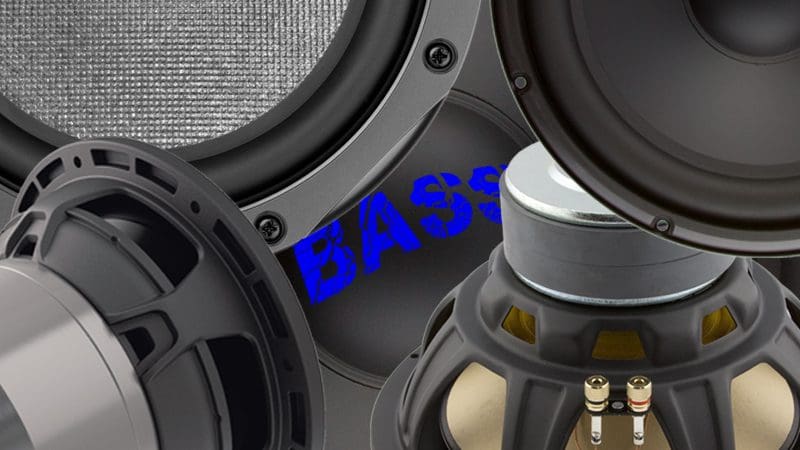
Every car audio speaker is engineered to operate well within a specific range of frequencies. As a generalization, subwoofers are best at playing those frequencies below 80 Hz. Most midrange speakers can play from 80 Hz to 4 kHz, and tweeters typically play from 4 kHz and up. The size and weight of the speaker cone or diaphragm and the stiffness of the speaker’s suspension components (the spider and the surround) all affect the frequency response of the speaker. We need different-sized speakers to cover the entire audible range of audio.
Car Audio Speakers

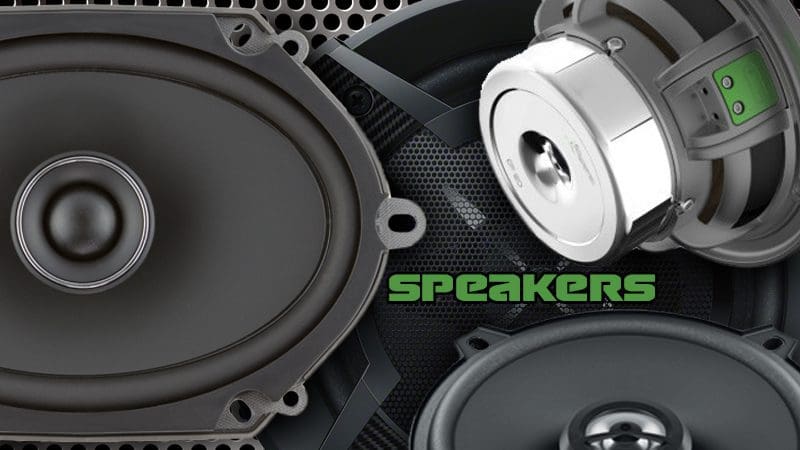
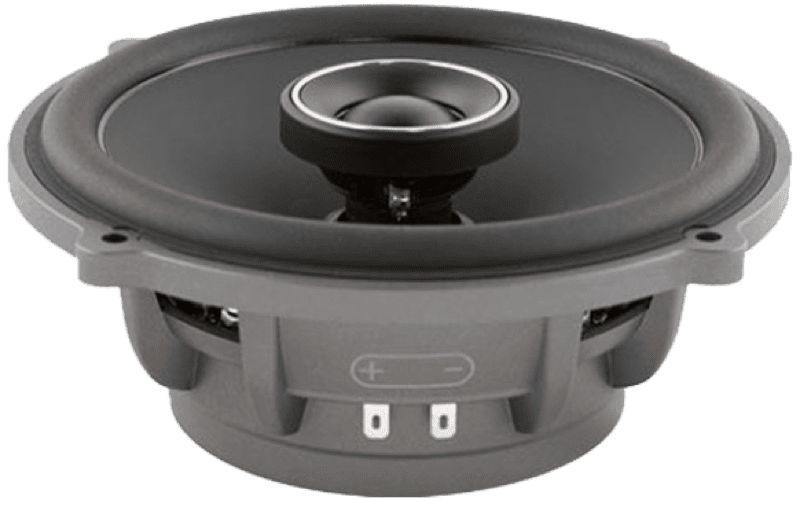
For the speakers in your vehicle, you have two design choices – component or coaxial speakers. In a component speaker set, the midrange and tweeters are separate pieces. The midrange is often installed in the factory door or dash speaker location, while the tweeter is mounted high in the door, on the dash or in the A-pillars. This higher location helps make the sound appear to come from in front of you rather than from down by your legs. Coaxial car audio speakers still have two separate drivers. The tweeter is physically mounted to the midrange – typically, on a post that extends up through the center of the speaker. Coaxial speakers are easier to install, because there are only two pieces, not four. Both designs can sound very good, but typically, the best of the best speakers are designed as components.

A common trait among high-quality car audio speakers is high-quality passive crossover networks. Every tweeter needs some method of limiting what frequencies are being sent to it. In better systems, the output of the midrange that would normally overlap where the tweeter was playing is also filtered out. Passive crossovers can include tweeter level controls to help provide some basic system tuning.

Listen To This
Car Audio Speakers
Image Courtesy Of Cartronix

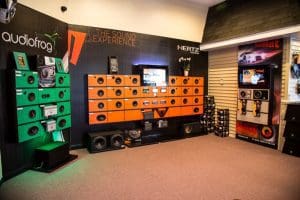
Listening to speakers has been described as “personal preference” for decades. That being said, a speaker that is very accurate and free from distortion will always stand out from a speaker that has design issues. The best way to audition speakers is in a vehicle. Some companies put extra effort into the design of their speaker systems to make them sound better in a vehicle as compared to on a display board. Retail display boards have the benefit of letting you quickly compare the performance of several different models. Listening to both a demo vehicle and display can be the best solution for helping you pick a great set of speakers.

Car Audio Speakers
Bring your favorite music and take some time to listen.

When you go to listen to speakers, bring your favorite music. It should be something that you have listened to many times on as many different sources as possible. Pick out and listen to different portions of the performance one at a time. If you are comparing speakers on a display, you can switch back and forth as you listen to different pieces of the performance.

Listen for vocals to sound natural. If there is too much high-frequency information, then S, T and P sounds will be over-emphasized. If there is an unwanted resonance in the midbass region (a very common problem with lower-quality speakers), then M and B sounds may be pronounced and sound unnatural. Some speakers sound nasally, some sound harsh. Either can be a sign of a distortion caused by the speaker design. Keep looking if you hear that.

Listen to high-frequency sounds like the ring of a cymbal or high-hat. It should have clarity and detail. Listen for the speed of transients – drums are a great test of a speaker’s ability to reproduce a wide range of frequencies while demonstrating smooth frequency response and lack of distortion. Drums should sound tight and controlled, with great definition.

Size Matters

When it comes to reproducing music, the size of your speakers has a dramatic effect on what you hear. A speaker with more area can move more air for a given amount of power – we refer to this as efficiency. The design of the speaker’s voice coil and the magnet structure also affects efficiency. In most cases, a larger speaker also produces more bass than a small speaker. This has to do with the weight of the speaker cone and the flexibility of the speaker’s suspension components.

Finally, how far the speaker cone can move will determine how loud the speaker can play. Don’t forget; you need amplifier power to move the speaker cone – don’t skimp on power.

Choosing Car Audio Speakers By The Numbers
Car Audio Speakers
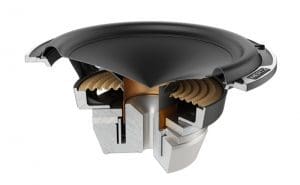
A peek inside a aftermarket speaker to see what makes it tick.

One thing that an experienced car audio retailer rarely talks about is power handling. While this is important if you are looking for sheer system volume, power handling is in no way a quantifier of the quality of a speaker. There are speakers rated at 50 watts that sound exponentially better than speakers rated at 200 watts. Just as with amplifiers, manufacturers play many games when it comes to speaker power ratings. The only number that matters is the continuous power handling, sometimes referred to as RMS power handling. If you see a speaker with a CEA-2031 Power Rating, that is the best number to use. Max and peak power numbers start to make assumptions about the energy content of music, and it’s best to avoid assumptions. But don’t forget, power handling does not relate to sound quality in any way.

Drop in at your local specialist and have a listen to a few different car audio speakers in the appropriate size for your application and your price range. It may even help to make some notes as you listen. Your installer can offer suggestions like new wiring and sound deadening that can further improve the performance of your speakers once they are installed in your car. Don’t be afraid to ask questions and most importantly – have fun listening to your music! That’s what a great car audio system is all about!

This article is written and produced by the team at www.BestCarAudio.com. Reproduction or use of any kind is prohibited without the express written permission of 1sixty8 media.

Filed Under: ARTICLES, Car Audio, RESOURCE LIBRARY

App Radio 4 Installation in 2013 Volkswagen Jetta of Anchorage

07/21/2016 By John Schwartz

2013 Volkswagen Jetta App Radio 4

Our customer came in looking for the new Pioneer App Radio 4 to be installed in a 2013 Volkswagen Jetta. We familiarized our client with the different functions and perks of the App Radio 4. We then looked up the required parts, such as the dash kit, module and antenna adapter. We agreed on a spot to mount the USB and scheduled an appointment for our client. Less than a week later, we performed our install.

As with every install we do, we started with a vehicle check-in using an iPad, which includes taking photos of the exterior, checking the functions of the vehicle and performing a battery test. We then put a battery charger on the vehicle with a fender cover to protect the vehicle’s paint from any scratches. Our tech prepped the install by soldering every connection, electrical-taping each connection and using Tesa tape to clean up the install.

After the install, again as is our routine, our technician vacuumed the vehicle and wiped down the dash, and then another tech checked out the vehicle. We delivered the vehicle and our sales team taught our client how to use the new App Radio.

When you are ready to upgrade your radio, or need more information, come on in or give us a call. You can Contact Us Here.

Filed Under: Bluetooth, Car Audio, INSTALLATIONS, Mobile Video, Smartphone Integration Tagged With: 2013, Android, App Radio, Apple, Bluetooth, In-Dash Video, iPhone, Jetta, Pioneer, Volkswagen

Product Spotlight: Pioneer AVH-5800BHS

07/18/2016 By John Schwartz

Pioneer AVH-5800BHSIf you’re looking for a new radio for your vehicle, Perfectionist Auto Sound and Security has everything you’ll need. We offer some of the best products, and we’re thrilled to tell you about the Pioneer AVH-5800BHS. This unit is a touchscreen DVD receiver with a 7” motorized display. It’s easy to use, yet has many hi-tech functions.

Smartphone Integrated

Pioneer AVH-5800BHSIf you have a smartphone, the Pioneer AVH-5800BHS just might become your new best friend. Featuring the Pioneer NEX user interface, designed specifically for smartphone users, this unit is extremely customizable. You’ll also be able to access your music in any way, shape or form. With the included Bluetooth capability, not only will you be able to safely make hands-free phone calls, you can even stream your audio wirelessly. This unit also supports two phones at once, so there’s no need to continually connect and disconnect multiple phones. The built-in HD radio and optional SiriusXM satellite radio give you even more options when it comes to listening to your tunes.

Apps!

If you have an iPhone or Android, you can have control over content on Spotify and Pandora right from your phone. With a simple cable, you can also control music that is stored on your phone. Using the AppRadio One feature (compatible with iPhone 5 or newer and certain Androids), you can get access to apps such as maps, weather and calendars directly from your radio unit.

Great Sounding Audio

Pioneer AVH-5800BHSThe Pioneer AVH-5800BHS has a MOSFET 50W x 4-channel built-in amplifier that gives increased power with less distortion. There are three sets of 4.0-volt outputs, so you can grow your system if you’d like to add some amplifiers. The subwoofer preamp output is completely adjustable, so you can have the perfect amount of bass. The 13-band customizable graphic equalizer is yet another built-in feature that allows you to tune your music to your liking.

Expandability

The Pioneer AVH-5800BHS gives you the option of an add-on navigation system, and the dual-camera input allows for installing two cameras (one being a backup camera).

Stop By And See The Pioneer AVH-5800BHS Today!

Stop by Perfectionist Auto Sound and Security in Anchorage, Alaska, and let one of our team members assist you in finding the perfect system for your vehicle.

Filed Under: Bluetooth, Car Audio, Mobile Video, PRODUCTS, Satellite Radio Tagged With: Pioneer

Product Spotlight: Pioneer AVH-4200NEX

07/06/2016 By John Schwartz

Pioneer AVH-4200NEXAt Perfectionist Auto Sound & Security, we strive to offer our clients the latest and greatest products on the market. In today’s world, most drivers own smartphones and many of them rely on these devices for multiple reasons. Pioneer had you in mind when they created their 2-DIN Flagship Multimedia Receiver, the AVH-4200NEX.

The Pioneer AVH-4200NEX features a 7” detachable touchscreen with multi-angle adjustments. With a built-in HD radio and Bluetooth hands-free calling and audio streaming, this unit will meet all of your desires. It also has five customizable display colors to choose from.

Numerous Audio Sources

Pioneer AVH-4200NEXNot only will you be able to listen to your favorite tunes through your HD radio and Bluetooth streaming – this unit also has iPod, iPhone and iPad control. On top of that, you’ll even gain control of Pandora and Aha Radio with your iPhone or Android. Sirius XM satellite radio and a navigation module are additional options that you can add on.

Apple CarPlay And Android Auto

One of the greatest features of this receiver is compatibility with Apple CarPlay and Google’s Android Auto. These technologies work with most iPhone and Android devices and give you access to many of your phone’s apps while you drive. Some of these apps include phone calls, Messenger, maps, music, weather and more. All of it is done through voice control so your eyes stay on the road and your hands remain on the wheel.

Great Sounding And Flexible Audio Features

Pioneer AVH-4200NEXThe Pioneer AVH-4200NEX also features a MOSFET 50Wx4 channel built-in amplifier. The 13-band customizable graphic equalizer is another great aspect that let’s you shape the sound to perfection. Because this unit plays audio and video from CDs, DVDs, SD cards and USB thumb drives, you’ll have entertainment in every way, shape and form. The preamp has three great-sounding sets of 4.0-volt outputs in case you want to add amplifiers to your system.  Plan on adding some bass?  The subwoofer preamp output is full adjustable, so you can have finger-tip control of your subwoofer level from your radio.

Pioneer AVH-4200NEX Is A Must-Have, Stop By Today To Check It Out!

If the Pioneer AVH-4200NEX sounds intriguing to you, stop by Perfectionist Auto Sound & Security in Anchorage, Alaska, to talk with one of our team members about your next radio upgrade.

Filed Under: Bluetooth, Car Audio, Mobile Video, Navigation, PRODUCTS, Smartphone Integration Tagged With: Pioneer

How to Buy a Car Audio Subwoofer

07/03/2016 By John Schwartz

Car Audio SubwooferAdding a subwoofer to a car audio system is the best bang for the buck regarding audio performance upgrades. You can instantly hear the difference, and it dramatically improves the realism and enjoyment of your system. Let’s look at how to pick a car audio subwoofer for your vehicle.

Factory Audio System Limitations

Subwoofer SystemBefore we get into how to choose a car audio subwoofer system for your vehicle, let’s examine why a subwoofer is such a great upgrade. In a nutshell, factory audio systems are designed around a budget – both monetary and weight-related. When automakers start looking at car audio products, price is often their primary concern. Automakers also work hard to reduce vehicle weight as much as possible, thereby reducing fuel consumption and, subsequently, environment emissions from the vehicle. This means that the performance of even these so-called “premium” factory audio systems is mediocre at best, and typically can be quantified as disappointing.

A factory audio systems that does happen to include a subwoofer is often limited in the amount of power available for the sub. The subs themselves are typically small, and the speaker cones can’t move very far to produce sound. Finally, the enclosures are often extremely compact, further limiting low-frequency sound reproduction. These limitations combine to produce bass that, if it seems to exist at all, won’t play very loud, doesn’t play very deep, and lacks clarity and definition.

Retail To The Rescue!

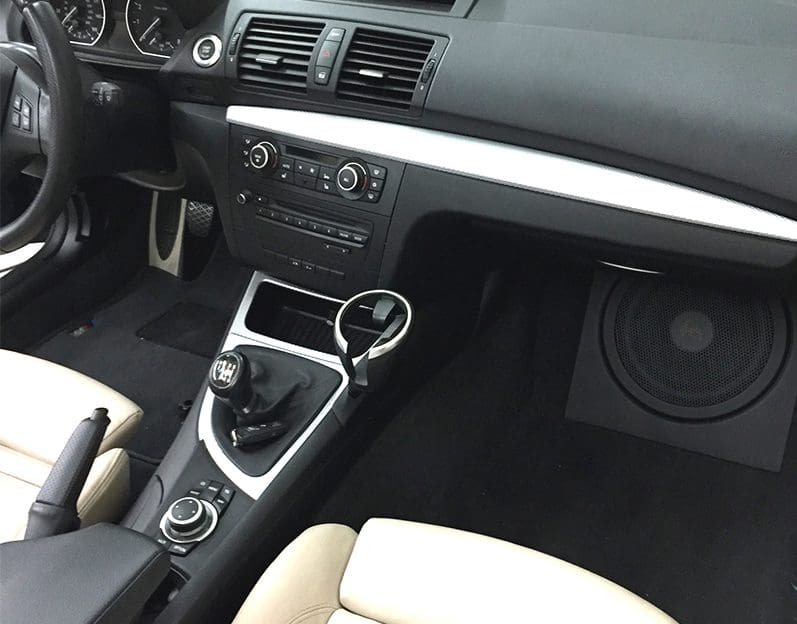
Subwoofer SystemA specialist car audio retailer can work with you to design a subwoofer system that can offer an octave or two more low-frequency output. With the availability of subwoofers designed specifically to fit into small enclosure volumes, these subwoofers can be hidden inside storage compartments, inside your spare tire or in the footwell of almost any vehicle. Gone are the days when all your storage space has to be sacrificed for great sub-bass.

Before we delve into how to pick a sub, don’t let the stereotype of “booming bass” sway you from adding a subwoofer. Just as every home theater system includes a subwoofer to accurately reproduce low frequencies, the addition of a subwoofer to your vehicle will add accuracy and realism. Subwoofers make your music sound bigger and more lifelike by letting you hear and feel frequencies as low as 20 Hz. A sub also takes the load off the smaller door and dash speakers that aren’t capable of making accurate or deep bass.

Starting The Process

Car Audio SubwooferBefore you head out to your local car audio specialist to inquire about a subwoofer system, there are a few things you should do. Accurately quantify your goals for the subwoofer – are you looking to “warm up” the system, are you trying to rattle your fillings loose or something in between? It’s important that you know what you want. A properly designed system with adequate speaker cone area and power will sound dramatically better than an undersized system pushed to its limits.

As with any purchase, have a rough idea of your budget ahead of time. Consider that there will be some installation cost and additional expenses for wiring for the amplifier and vehicle integration.

Finally, have a look at your vehicle and consider how much space you want to dedicate to the subwoofer system. As mentioned, it doesn’t need to be much these days, but every subwoofer needs a proper-size, properly built enclosure.

Auditioning Car Audio Subwoofers

Listening to a subwoofer in a vehicle is highly useful. The small space inside the vehicle boosts low frequencies more than a larger listening room. Once you have established a reference for how a specific subwoofer in a specific enclosure sounds in the vehicle, then you can listen to different options in the showroom for changes compared to that reference.

As with any listening session, you will want to use music you are familiar with, preferably something you have listened to dozens, if not hundreds, of times. In the case of a subwoofer, the performance of the speakers that are playing with it can affect the perception of its quality, so choose something similar to what you will be using. You will want to focus on three aspects of the subwoofers performance: frequency response, how loud it will play and how accurate it is.

Regarding frequency response, you will want to listen to how loud different frequencies are. Some subwoofers produce a lot of energy in the 50–70 Hz range, some between 30 and 50 Hz, and some play well below 20 Hz. You need a find a balance that accurately reproduces your music and meets your performance goals. High-quality subwoofers can be very musical, accurately defining subtle nuances between each different frequency. A pipe organ, piano, harp, bass guitar, contrabassoon and even a tuba all play into the range of a common car audio subwoofer. In fact, some male voices extend down to 65 Hz or lower. The best subwoofers offer smooth and extended frequency response while remaining tight and dynamic.

Quantifying how loud a subwoofer will play has a great deal to do with what type of enclosure it is installed in, and how much power you have to drive it. The limiting factor on output is cone area and how far the speaker cone can move – we call this excursion. Without accurate measurement equipment, all you can do is decide if the combination of the subwoofer, amplifier and enclosure you have chosen meets your needs.

A Word On Car Audio Subwoofer Enclosures

Subwoofer System
Image Courtesy Of Adrenaline Autosound

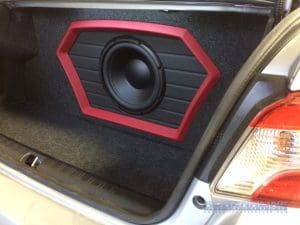
There are four common ways of installing a subwoofer in a vehicle. If you have a trunk, you can have your installer create a baffle that separates the trunk from the interior of the vehicle, and install the subwoofer in that baffle. That is known as an infinite baffle installation. You need a subwoofer that was designed specifically for that kind of application.

More common is a sealed enclosure, known formally as an acoustic suspension enclosure. These are forgiving regarding their volume requirements and can offer very smooth frequency response when combined with the output gain that most vehicles offer.

Perhaps the “most fun” of all subwoofer enclosures is the ported design, known as a bass reflex enclosure. In these, which are larger than a sealed enclosure, there is a vent of a specific area and length that uses the back-wave (sound coming off the back of the subwoofer cone) to help reinforce the output. You get more bass output for the same size subwoofer.

Finally, the most complex of enclosures commonly used is the bandpass design. In these, the enclosure acts to filter out high-frequency information. These enclosures sound the best when you have great-quality midbass drivers in the system.

An entire article could be dedicated to the benefits of one enclosure design over another, but your car audio retailer can help steer you toward the correct one for your application.

If you are thinking of upgrading your car audio system and you do not already have a subwoofer, drop in at your local car audio specialist right away! There are enclosures not much larger than a shoe box that can make a dramatic difference in the way your system sounds. If you want something more significant, that is easily arranged. Take along your favorite music and have a listen. Adding a subwoofer not only makes a huge improvement, but can be a lot of fun!

This article is written and produced by the team at www.BestCarAudio.com. Reproduction or use of any kind is prohibited without the express written permission of 1sixty8 media.

Filed Under: ARTICLES, Car Audio, RESOURCE LIBRARY Tagged With: Subwoofers

  • « Previous Page
  • 1
  • …
  • 64
  • 65
  • 66
  • 67
  • 68
  • …
  • 82
  • Next Page »

801 EAST 82ND AVE
ANCHORAGE ALASKA 99518
907-563-8112

Copyright © 2026 | Site design by award-winning creative agency D'zine Alaska , with site support by 1sixty8 Media and Modern Media Geeks.