Perfectionist Auto Sound and Security

Alaska's Most Award Winning Auto Customizer

  • About Us
    • Why Choose Us
    • Meet Our Team
    • Our Awards
    • Virtual Tour
    • Community Engagement
  • Signature Products
    • DroneMobile
    • SoundShield®
  • Services
    • Remote Car Starters
      • Vehicle Security
    • Car Audio
      • Sound Deadening
    • Custom Fabrication
    • Driver Safety
      • Bluetooth
      • Blind Spot Safety Systems
      • Camera Systems
      • Navigation Systems
    • Laser And Radar Detectors
    • Lighting
    • Offroad and Marine
      • Motorcycle Audio
    • Custom Interiors
    • Performance
      • Tires and Wheels
      • Suspensions / Lift & Lower
    • PRO Commercial Division
  • Gallery
    • Photos
    • Videos
    • Wallpaper Downloads
  • Contact Us
    • FAQ
    • Feedback
    • Join Our Team

What Is An MP3 File?

03/19/2017 By John Schwartz

MP3

You cannot have talked about audio and computers any time in the last 15 years and not have heard of an MP3 file. MP3 audio files and websites, like the original Napster, started a shift in where, how and when people acquired music. If you are on the older end of the spectrum, like many of us in the mobile electronics industry, then you bought your CDs, cassettes and maybe even your vinyl at a record store. Computers and the Internet changed that. You could go online after dinner and download an illegal copy of a song in a few minutes. It was wrong, but people acquired tens of millions of songs this way.

In the 1990s and early 2000s, accessing the Internet was slow. We started connecting to the Internet using phone lines and modems. Each byte of information took time to transfer to your computer, so anything that would speed up the process was a treat. Downloading (stealing) music using the Internet is where the popularity of the MP3 audio file met its calling.

A Primer on Digital Audio

MP3We could write 10 articles about digital audio – and we just might. For now, we are going to look at the basics and use the compact disc (CD) as our reference. CDs store digital audio sampled at 44.1 kHz with a resolution of 16 bits. These numbers mean each sample can have an amplitude that is a single value within a range of 65,536 different levels (2 to the power of 16). The information is sampled 44,100 times a second. Sampling at what is known as 44.1/16 allows capturing the audible range of audio (considered 20 Hz to 20 kHz) with good detail and accuracy.

To store 1 second of audio at this resolution, we need to store 1,411,200 bits of information. Anyone who has played with audio transcoding software may recognize 1,411 kbps as a standard data rate. This number is calculated by multiplying the number bits per sample (16) times the number of samples per second (44,100) times 2. The times-2 factor is because we record in stereo – which is two channels. So, a 3-minute long song is 254,016,000 bits or 31,752,000 bytes.

Let’s round it off to 31 megabytes of information. Can you imagine how long it takes to download that with a dial-up modem running at 14,400 baud? The answer is at least 3.5 minutes – without error checking, line noise and other factors that slow the real download time to about 5.5 minutes.

Data Compression

What if someone found a way to shrink the size of the audio file to speed up download time and reduce bandwidth usage? The caveat is that the audio still sounds essentially the same on most basic audio systems, such as a TV, computer speakers or a 1990s factory car radio. In 1991, a group of companies, including the Fraunhofer Institute, France Telecom, Philips, TDF and IRT, started working on a way to reduce file size while maintaining relevant information. That is the key to how file size is reduced using MP3 compression.

The MP3 file format is a “lossy compression” algorithm. Lossy compression means that information is thrown away to reduce file size. The development team worked on a compression method called perceptual encoding to decide what information to remove. Perceptual encoding is based on how we hear sounds relative to other information, and the limits of our hearing.

What MP3 Files Throw Out

We are going to analyze the information that MP3 files remove to reduce file size. One of the easiest ways to cut back on information storage is to reduce the highest frequency that will be reproduced. If we analyze a 128 kbps MP3 file, we see that the highest reproduced frequency is just below 16 kHz. If that were the only information that was removed, our new bitrate with 16-bit samples in stereo would be about 1,004,800 kbps instead of 1,411,200 kbps for 20.05 kHz.
MP3The next part of the compression process analyzes content that is common to both channels. It is common for some parts of a recording to be virtually in mono. The encoding process removes duplicated information from the file and adds code to copy the opposite channel. If the audio track were purely mono, the file size would be divided in two. Few tracks are completely mono, but we can see more space saving from this process.

Subsequent processing looks at low-level information during high-amplitude passages. Let’s use the example of a song with a lot of bass in it and some very quiet harmonic midrange information. Perceptual encoding processes like MP3 will remove this low-level information from the audio track. This process is called audio masking. There is enough audio information at other frequencies to distract you from hearing what is removed.

Can You Hear the Difference?

Dozens – nay, hundreds – of tests have compared MP3 files to full CD-quality audio tracks. Are there differences? There most certainly are. One thing became apparent during our research: How an MP3 file is created is crucial to its subjective sound quality. Different encoders work in different ways with different results.

Perhaps the best way to describe the difference between a CD-quality recording and an MP3 file is to look at the difference between the two. I wish we could share some samples here for you to listen to, but that would break copyright laws. What we can do is visually show you the difference.

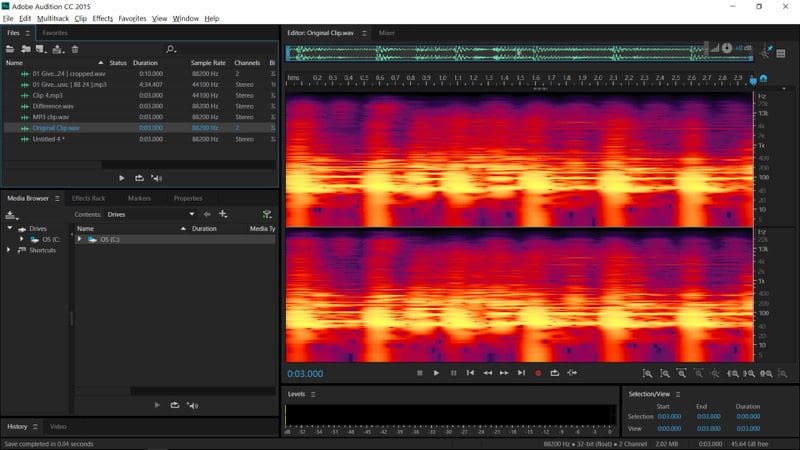
We took a 3-second sample from Daft Punk’s “Give Life Back to Music.” We chose this track because of Daft Punk’s clear and conscious effort to make a high-resolution version of the album commercially available. We want to thank them for that! The sample is from 31.5 seconds to 34.5 seconds into the song.

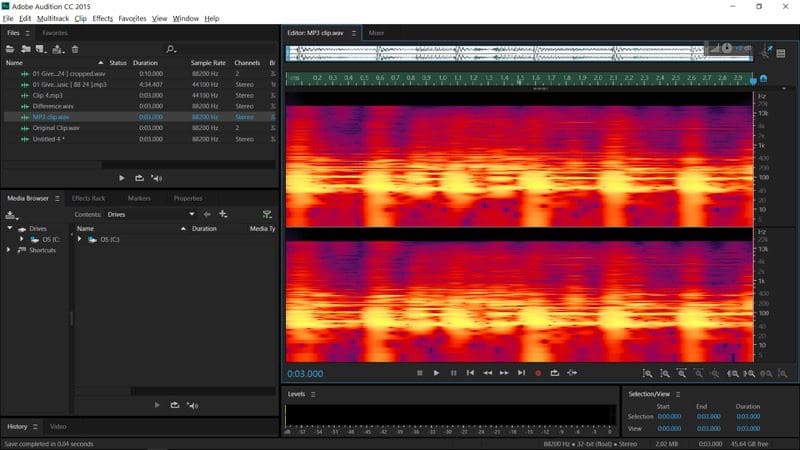
This Spectrogram shows the frequency content of the sample. The horizontal scale is time. The vertical scale is frequency. Finally, the color intensity shows the amplitude.
MP3
This is the original sample.

You can see that there is frequency content up to 30 kHz, clearly demonstrating the high-resolution nature of this track. Each vertical color band represents a drum machine beat – more or less.

128 kbs MP3 File Analyzation
MP3
This is the sample converted to a 128 kbps MP3 file.

It is clear that audio information above 16 kHz has been removed. Infrasonic frequency content is clearly different as well. There is more information in the MP3 file below 30 Hz compared to the original. This increase in information will, however, present itself as less-dynamic range.

MP3 Vs Original File
MP3
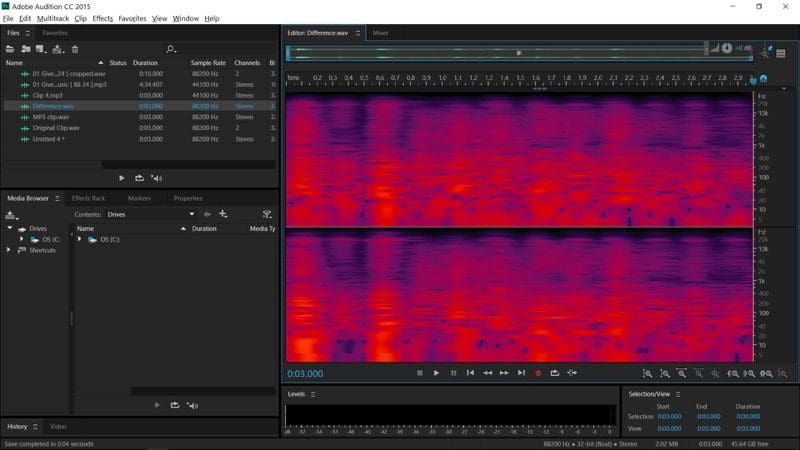
This is the difference between the Original sample and the MP3 Sample.

We inverted the MP3 file and added it to the original sample to make the image you see here. The net result is the difference between the two tracks. You can see the high-frequency content that was removed above 16 kHz. In fact, information was removed at all frequencies, and that information follows the intensity pattern of the audio file.

The original file has a peak amplitude of -0.1 dB for both channels and an average amplitude of about -14.2 dB. The removed information has a peak level of -10.9 dB and an average amplitude of -37.01. The removed information is buried deep below the peak amplitude information.

MP3What does the removed audio sound like? We would describe the clip as the sound of a distant marching band. The audio is mostly high-frequency information. The track has a decidedly warbled texture to it as well: The drum machine beats are clear and present, but they sound like distorted cymbal hits.

Even with a high-end headphone preamp and studio grade headphones, the difference is hard to perceive when switching between the original track and the MP3 file. In a listening environment with a larger soundstage, it may be more apparent.

Conclusions about MP3 Files

Purists will tell you that you should have the highest-quality recordings available. There is no fault to this logic. Why skimp when you can have it all? High bitrate MP3 files, like those at 320 kbps, for example, are excellent in quality. Repeated testing has shown that when created with quality compression algorithms, the sound difference between a CD-quality recording and a 320 kbps MP3 file is almost impossible to detect. Lower bitrate MP3 files start to dispose of more information, and the differences become bigger.

The latest source units on the market are capable of playing WAV and FLAC audio files of great resolution and bit depth. Shortly, we will see units that will play MQA files over digital connections. Almost every source will handle MP3 and WMA files.

Drop into your local mobile electronics specialist retailer today, and bring along some music to enjoy. We think you will be impressed – no matter what format you choose.

This article is written and produced by the team at www.BestCarAudio.com. Reproduction or use of any kind is prohibited without the express written permission of 1sixty8 media.

Filed Under: ARTICLES, Car Audio, RESOURCE LIBRARY

History of Perfectionist Auto Sound and Security

03/17/2017 By John Schwartz

History of PerfectionistFollow along as we share some of the unique history of Perfectionist Auto Sound and Security.  We have been around for quite some time, but the store you see today is nothing like what you would have seen 20 years ago. Over the last several years, we’ve learned a lot from the good times and the hard times, and grown even more.

Way Back When …

John Schwartz, the current owner of our store, has worked for Perfectionist for the past 18 years and has been the owner since 2008. He grew up in North Carolina “where bass was invented.” When he was 14 years old, he worked at a sandwich joint next door to a stereo shop. One day, a guy pulled up in his car with his bass booming so loud that the windows shook. John had never heard anything like it. That day, he decided that he wanted to work on cars, and specifically learn all about stereo systems. The next day, he walked in the stereo shop and begged for a job. They offered to let him come around and help out with cleaning and sweeping. But over time, John learned quite a bit about car audio and electronics.

When John was 16 years old, he moved to Alaska, where right away he was considered the “stereo guy.” During his high school years, he even opened up a shop called the Sound Doctor in his mom’s yard. It was common to see three or four cars in their driveway at a time, having their radios and sound systems worked on. Then at the age of 18, he was hired at the biggest shop in town, called Safe and Sound, where he grew his knowledge and skills even more. He worked there until he got a job with Compustar in September of 1999.

A New Beginning for Perfectionist

At one point, our shop was called Perfectionist Car Care. We did everything from car detailing to running a limousine service. However, there wasn’t much vision for the business and it showed through. At that time, it was owned by Jason Lee, the founder of Compustar. With Compustar growing so rapidly, Perfectionist was in the backseat. John Schwartz joined the Compustar team in ’99 as head technician. Shortly after, Jason sent John over to Perfectionist to check things out and see – in a sense, spy on the employees – what was going on in their store. What he found wasn’t very good. Things were constantly being broken and inventory was being stolen, among other problems.

John and Jason met up for dinner and began talking about Perfectionist and where it was headed. It didn’t look like the store was going to make it much longer. That day, Jason decided to fire all of the employees and hand the store over to John. This was the beginning of a new chapter for Perfectionist.

Learning Through Experience is the History of Perfectionist

History of PerfectionistJohn, a 23-year-old with no business experience, was now running a store. It didn’t take long for him to realize what needed to change to see this business have more success. Over the next 10 years, he built up his team and made a new name for himself. He put a lot of effort into making sure each client was treated with excellent care every time they stopped by our shop. This was a new thing for Perfectionist, but over time, our town realized we had really stepped up our game.

There were a lot of headaches and lessons learned in those first years. It took time to hire a team that carried the same vision for Perfectionist that John did. Through a lot of trial and error, a great team was developed and our name began to grow.

Exponential Growth and Celebrating Goals Met

Now called Perfectionist Auto Sound and Security, we put our focus on three main things: car audio, remote starters and lighting. We decided to stick with what we were good at, and it’s definitely paid off.

We eventually began to outgrow the location we were in, so when the landowner offered us the lot across the street, we couldn’t resist the offer. We began the building of the 6,000-square-foot shop that we have today. On October 6, 2006, we celebrated moving into the shop we used to dream of, which had now become a reality.

Things were going better than we could have ever imagined until the economy crashed in 2009. This may have been the hardest year Perfectionist had ever seen. The summer months dragged on and the credit cards were maxed out as a last resort. Thankfully, when winter rolled around again, there was also a turning of a page for our store and business began to pick back up.

The Perfectionist Auto Sound and Security You See Today

History of PerfectionistToday, Perfectionist Auto Sound and Security is one of the best-known car audio shops in the nation. Remaining humble and willing to learn from our mistakes has gotten us where we are today. We have received many incredible awards for our service and work. In 2011 and 2015, we were named Retailer of the Year, one of the most sought-after awards in our industry. We also won Top Retailer for Compustar this year and every year since 2005.
One of the biggest things we are known for now is our incredible service. Each and every client who comes in our store is greeted with a smile, given a tour of our facility and handed a Perfectionist water bottle. If we have the pleasure of working on your vehicle, we are always sure to give it back in better condition than we received it and you’ll even get a hand-written thank-you card in the mail from our team.

Stop by Our Store

From one of the worst to becoming one of the best, we are proud of what we’ve built over the years. We have learned a lot throughout the history of Perfectionist Auto Sound and Security. Contact us HERE, or stop by our store in Anchorage, Alaska, today!

Filed Under: Car Audio, Lighting, OUR FACILITY, Remote Car Starters Tagged With: Compustar

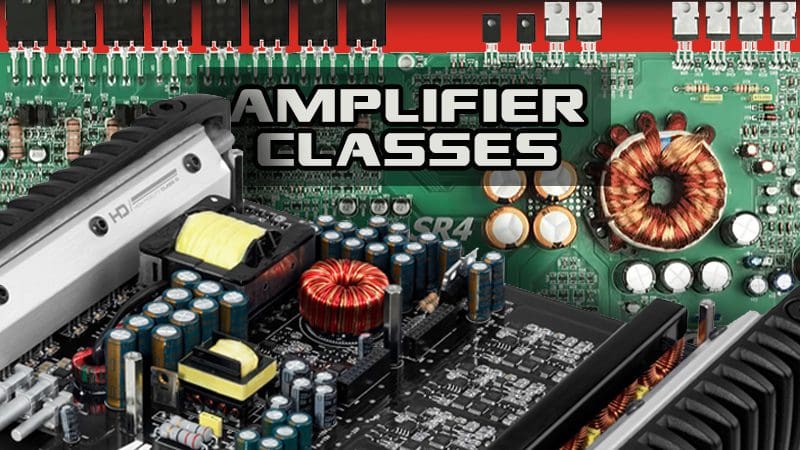
Amplifier Classes: Making Sense Out of Class AB and Class D Amps

03/12/2017 By John Schwartz

Amplifier ClassesAmplifiers have a very tough job. They have to take a very low voltage signal and increase it in amplitude so it can drive a speaker. In this transformation, we expect the signal to remain pure – no distortion or no noise should be added. We also want significant amounts of power to drive our speakers, even though we only feed our amplifiers with a measly 12 to 14 volts of electricity. The laws of physics seem to want to work against us at every turn – but we prevail! Modern car audio amplifiers are amazing feats of engineering and design. This article looks at the two main types of amplifier classes used in the car audio industry and the benefits and drawbacks of each. Welcome to Class AB vs. Class D.

The Math behind how Amplifiers Make Power

No matter how we configure the components inside an amplifier, the goal is the same: Increase the voltage of the preamp audio signal so it can drive a speaker. Because the speakers we use are low in impedance (2 or 4 ohms for most midrange speakers), we need to be able to provide a significant amount of current to the speaker as well. This delivery of current to the speaker is the second task an amplifier has to undertake.

By way of some quick math, if a 4 ohm speaker is getting a 12V RMS signal, we can make a few calculations. To calculate the current flowing through the speaker, we divide the supplied voltage by the impedance of the speaker. In this example, we have 12 divided by 4, so 3 amps of current are flowing through the speaker wires and the voice coil. An easy way to calculate the power going to the speaker is to multiply the supplied voltage times the supplied current. The product of 12 times 3 is 36. This speaker is receiving 36 watts of power.

Let’s look at the same example as though this were a subwoofer amplifier. In this second example, we will assume we have a Dual 2 Ohm voice coil subwoofer with both coils wired in parallel to produce a 1 ohm load. If we supply this speaker with 12 Vrms of signal, then 12 amps of current flow through the speaker wire and the subwoofer. To calculate power, we multiply 12 times 12 to get 144 watts. 144 watts is a lot more power and current for the same amount of voltage.

General Amplifier Function Overview

Most amplifiers are composed of three or four key sections (or stages), depending on their design and complexity. The input stage is the portion of the amp where the low-level preamp audio signal enters the amp and receives any processing in the form of equalization or filtering.

An amplifier has a power supply. The power supply converts the supplied 12 to 14 V of direct current to positive and negative rail voltages. Let’s say, for example, a theoretical amplifier has +25 and -25V rails, relative to our ground reference. Depending on the size of the amp, there will be a driver stage. The driver stage is responsible for increasing the low-level audio signal to a higher voltage. How much the driver stage increases the voltage depends on how much power the amp will be making.

Amplifier Classes
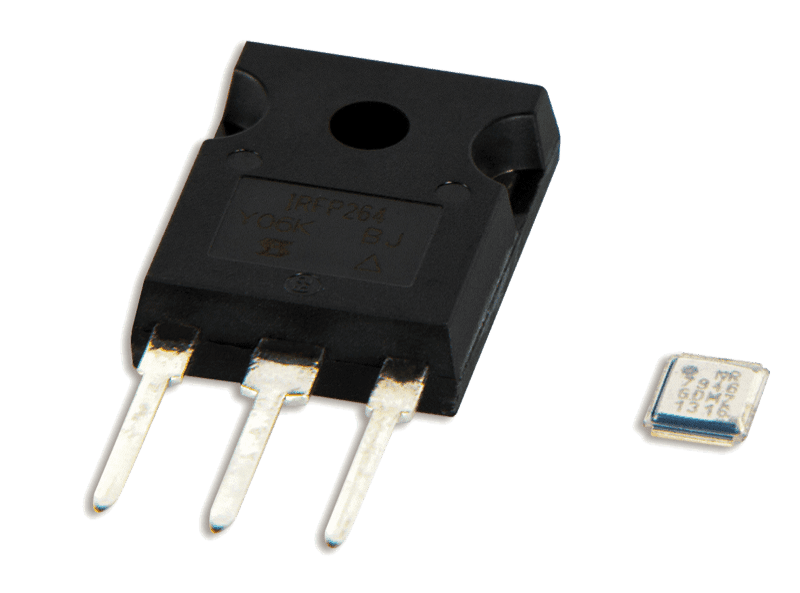
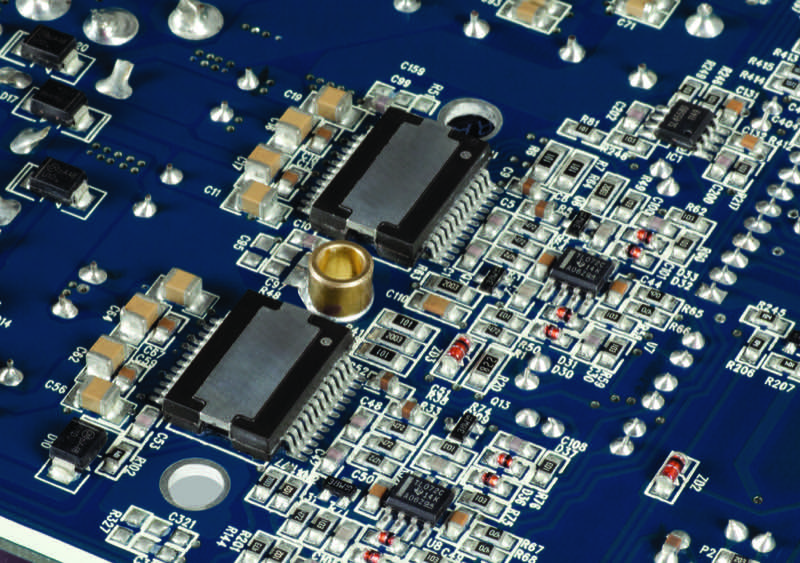
Mosfets have shrunken in size over the years to the minuscule size now available (right).

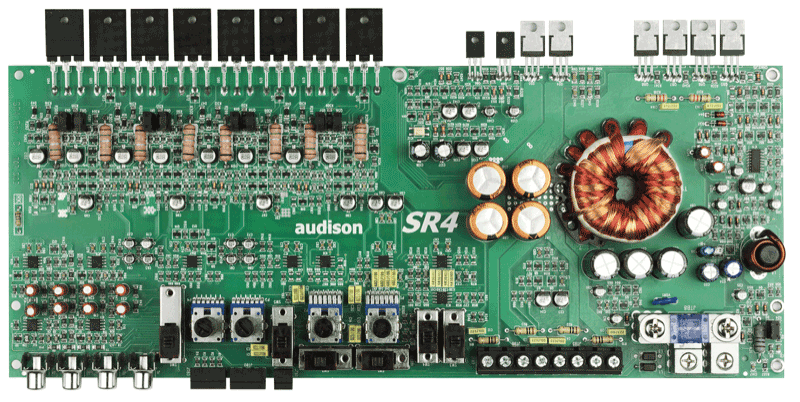
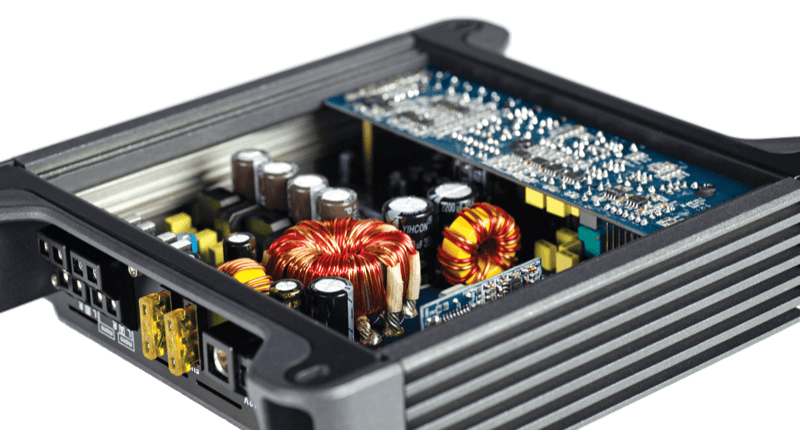
Finally, we have the output stage. The output stage is relatively simple – it does not significantly alter the signal coming from the driver stage, but the devices (MOSFETs or transistors) used to provide the output signal with the current the load requires. The power supply and the output stage are the two portions of the amp that do the most “hard work.” That is to say, they are the stages that pass a lot of current.

In almost all amps on the market, we use dedicated devices for the positive half of the waveform and separate devices for the negative half of the waveform. To clarify , if we measure the output signal of the amplifier about the vehicle ground, we will see that it swings back and forth above and below 0V. Think back to our +25 V and -25 V power rails. Speakers don’t care about the value of the signal being sent to them; all they care about is the difference in voltage from one end of the voice coil to the other end.

Class AB Amplifiers

Amplifier ClassesFor this article, we are going to generalize Class AB amps into an Analog, Amplifier model. In our analog amplifier, we have large transistors in the output stage of the amp. When we want half of the positive rail voltage at the output, we feed half the voltage to the positive output device. When the signal goes negative, we turn off the positive device and start using the negative device only. Looked at a different way, the audio signal from the driver stage controls the resistance of the output devices and, subsequently, how much current can flow to the speaker.

In an Analog Amplifier, the output devices can be “turned on” in varying amounts about the audio signal. This means the output devices are often acting as resistors. Power is wasted as heat when we pass current through a resistor. Keep this in mind as part of our comparison later in the article.

Class D Amplifiers

Amplifier ClassesIn a Class D amp, the output devices receive a control from a Controller Integrated Circuit (IC). This controller sends out a variable duty cycle square wave. The square wave amplitude is high enough that it turns the output devices all the way on or off. The output devices spend very little time operating as resistors and act more like switches.

The logical question is, how in the world do we get music out of a square wave? If you thought that, good for you! The frequency of the square wave is much higher than the maximum frequency of our music. In fact, some modern Class D amplifiers switch the output devices at frequencies as high as 600 kHz.

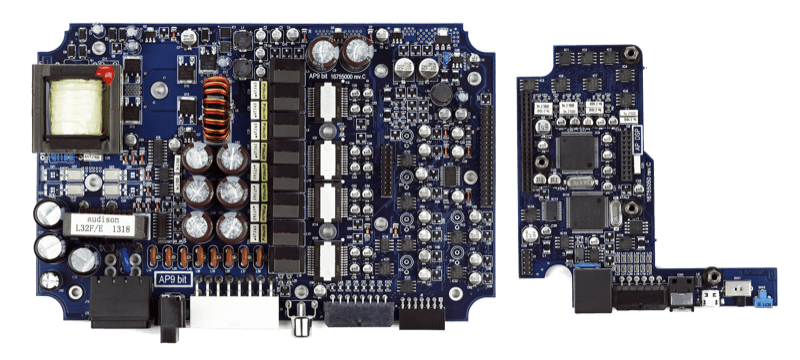
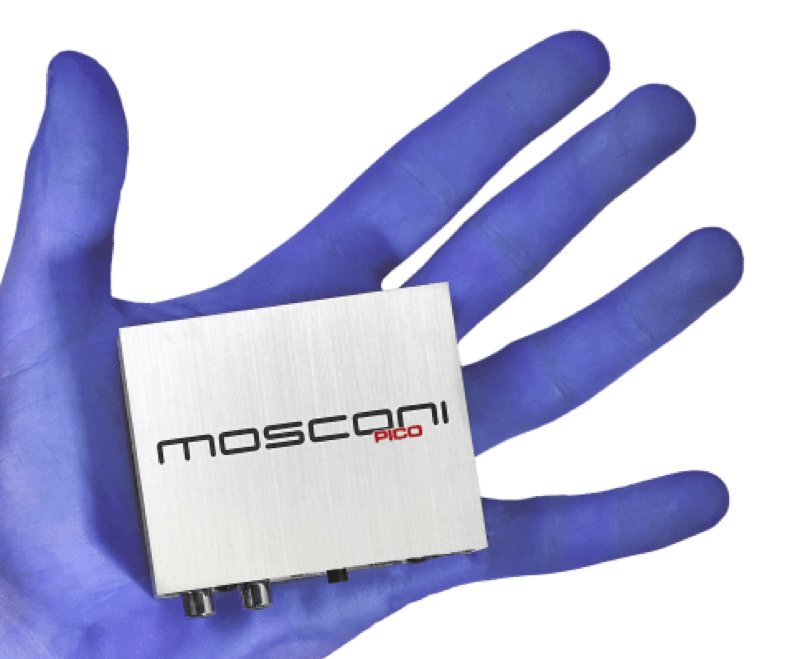
Amplifier Classes
An additional benefit of class D amplifiers is the potential for extremely compact size.

To recreate music, the Class D controller sends out a signal that is Pulse Width Modulated. The amount of “on” time about the “off” time determines the output level of the signal. As a very general analogy, if the positive output devices were sent a square wave with a 50% duty cycle (on for as much time as it was off), then the average of the output would be 50% of the positive rail voltage. If the square wave is on for 75% of the time, then off for 25%, then we would get 75% of the rail voltage at the output.

As you can imagine, the signal from the Class D controller is quite complex. It has to modulate the duty cycle of the square wave going to the positive and negative devices fast enough to accurately recreate the audio signal. It also has to control both the positive and the negative output devices separately.

Benefits and Drawbacks of Analog Amplifiers

Because the audio signal in an analog amplifier is never chopped up into tiny pieces, analog amplifiers can remain faithful to the original signal. The best-sounding amplifiers in the mobile electronics industry are analog. Analog amplifiers are, historically, given a reputation for accurate high-frequency response.

The drawback of an analog amplifier is its efficiency. Efficiency describes how much energy is wasted as heat as compared to the energy sent to the speaker. Because of the output devices in an analog amplifier work as variable resistors, they get hot. Typical analog amplifiers operate in the 70-80% efficiency range regarding total efficiency, while operating at full power. That missing 20-30% is released as heat. At lower output level, the efficiency drops even more.

Benefits and Drawbacks of Digital Amplifiers

Amplifier Classes
The integrated circuit of the class D amplifier controls the switching.

Modern digital amplifiers switch at extremely high frequencies. We see amps capable of audio frequency response beyond 50 kHz, and some that exceed 70 kHz. This performance is a long way from the first Class D amps that were only for subwoofers and struggled to produce audio above 5 kHz. That said, because digital amplifiers require filter networks at the end of the output stage, they still cannot quite match the performance of a premium analog amp. With this information in mind, consider that there are some good digital amplifiers that sound better than many poorly designed analog amplifiers.

Because the output devices of a digital amplifier rarely operate in their resistive range, these amplifiers can be very efficient. A well-designed Class D amp can have an efficiency around 92%.

Another problem with Class D amplifiers is noise. Because the output devices are driven by a square wave, there is a lot of high-frequency energy in the output signal. The filter network we talked about removes much of that from the output signal, but that energy can still have detrimental effects on other systems in the vehicle. An unfortunately common trait for many Class D amps is that they cause interference with radio reception when in operation.

Choosing Between Amplifier Classes

Amplifier ClassesIt would be nice if we could formulate a set of hard-and-fast rules for choosing the right amplifier for your system. With so many variations on each kind of amp at so many different price points, that is truly impossible. We strongly suggest that the only way to pick an amp is to compare one to another under controlled conditions: Use the same music and the same speakers, and listen at the same volume. You will hear differences in frequency response and dramatic differences in imaging and staging capabilities.

Is one kind of amp better than the other? For an installation dedicated purely to sound quality, the choice is clear. For an installation where power delivery is limited or massive amounts of power are required, the choice is clear there as well. In the middle, it depends on your application and budget.

Drop in at your local mobile electronics specialist retailer to find out about the latest amplifiers on the market. They would be happy to help you choose one that meets your application and works with your budget.

This article is written and produced by the team at www.BestCarAudio.com. Reproduction or use of any kind is prohibited without the express written permission of 1sixty8 media.

Filed Under: ARTICLES, Car Audio, RESOURCE LIBRARY

Acoustic Suspension Subwoofer Enclosures Explained

03/05/2017 By John Schwartz

Acoustic SuspensionEnclosure, box or cabinet: Whatever you want to call them, where you install your speaker or subwoofer is critically important to their resulting performance. In this article, we focus on the simplest and most forgiving of enclosures to design and construct – the acoustic suspension or sealed enclosure.

The Laws of Physics

There are a few characteristics to keep in mind about every speaker. The first is that as frequency decreases, cone excursion increases. In fact, to produce the same acoustic output, a speaker must move four times as far for every halving of frequency. As an example, if your subwoofer were moving 1 mm at 80 Hz, it would have to move 4 mm to produce the same output at 40 Hz. To produce the same output at 20 Hz, it would have to move 16 mm.

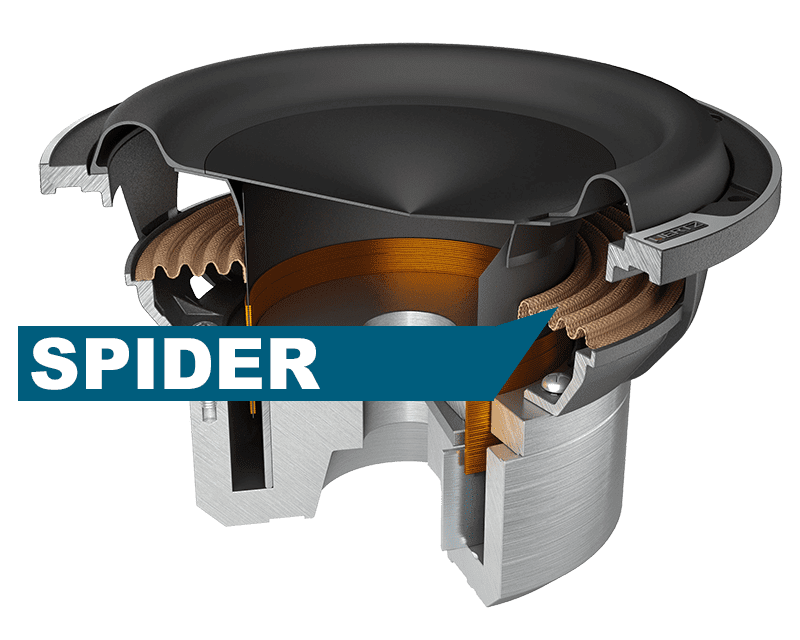
Acoustic SuspensionA speaker includes an element called a spider. The spider stores energy when the voice coil of a speaker moves the cone forward or rearward from its resting position. When the cone reaches the end of its travel and comes to a stop, the stored potential energy in the spider wants to be released. This stored energy pulls the cone in the opposite direction. Each transfer of energy includes some losses, and eventually, the cone comes to rest.

Think of the cone motion like a swing at the park. You exert a force on the swing to get it started, and it continues to swing back and forth with a decreasing amplitude until it comes to a stop. Thankfully, a speaker stops moving a lot faster than the swing at the park.

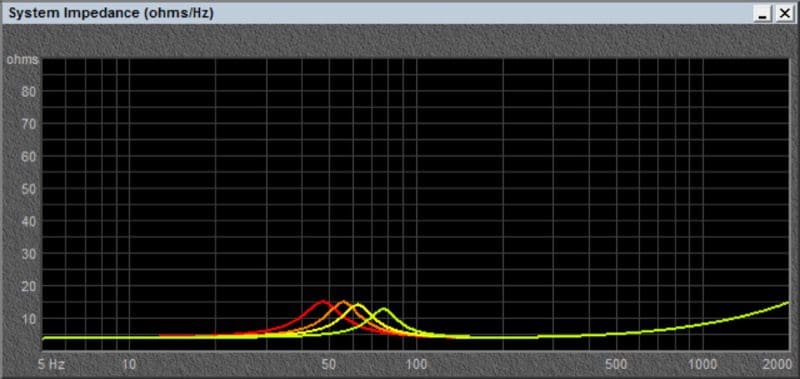
In a speaker, this transfer of energy from the cone to the spider and back is most efficient at a specific frequency. We call this the resonant frequency of the speaker. At the resonant frequency, there is a dramatic increase in impedance because the spider stores a great deal of energy. This energy storage causes the cone to want to continue to move. The movement of the voice coil moving through the magnetic field generates a voltage. This voltage generates a flow of current in the opposite direction to the current flowing from the amp. We represent this opposition to current flow as an increase in impedance.

Acoustic Suspension
This graph shows the impedance rise around the resonant frequency of a 12-inch subwoofer in enclosures with a Qtc of 0.85, 1.0, 1.1 or 1.25.

We also have to consider that every speaker is limited in how far the cone can move. Once we exceed the excursion limitations of the speaker, bad things happen. The voice coil former can hit the back plate. The suspension components may be compromised and start to fail. As a by-product of the cone, dust cap, surround, spider and motor geometry, harmonic distortion also increases as excursion increases.

Our goal in designing any audio system should be to keep distortion as low as possible. Most of the distortion at low frequencies is resonance. These resonances decrease as we move above the resonant frequency of the speaker. The spider and the changing motor force, as the coil moves past the edge of the gap, are the biggest contributors to distortion.

Why Do We Need an Enclosure?

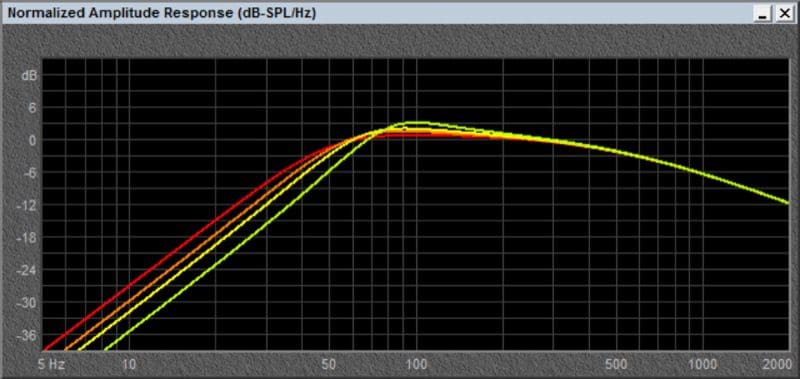
Let’s consider a few additional characteristics. The low-frequency roll-off of a speaker is a high-pass filter. The spider in the speaker is like a capacitor—a spring stores energy and so does a capacitor. The air inside the box is also a spring, and it is in parallel with the spider. The air spring and the spider work together at the same time to do the same thing. The combination of the air spring and the spider increases the high-pass filter frequency. Yes: Contrary to our efforts to produce as much low-frequency information as possible, an enclosure limits low-frequency reproduction.

If that is the case, why do we want to limit cone motion? Consider what we’ve said about how much excursion is required to reproduce low frequencies and about distortion. Limiting low-frequency output from our speaker is not an ideal goal, but limiting some of the really low frequencies to get the right amount of bass at higher frequencies is worthwhile.

Acoustic Suspension
This graph shows the increase in energy output as the Q-factor of the enclosure for this 12-inch subwoofer increases. The volume of the enclosure decreases and the Q-factor increases.

There is a benefit to increasing the resonant frequency of the speaker and enclosure system. Let us say we have a subwoofer with a Q of 0.5 and it is our goal to have a total system Q of 0.707. We choose an enclosure air volume that increases the Q, which then increases the system output at the new resonant frequency. Yes, we sacrifice output at lower frequencies, but we gain output around the new system resonant frequency.

I Want More Bass!

Acoustic Suspension
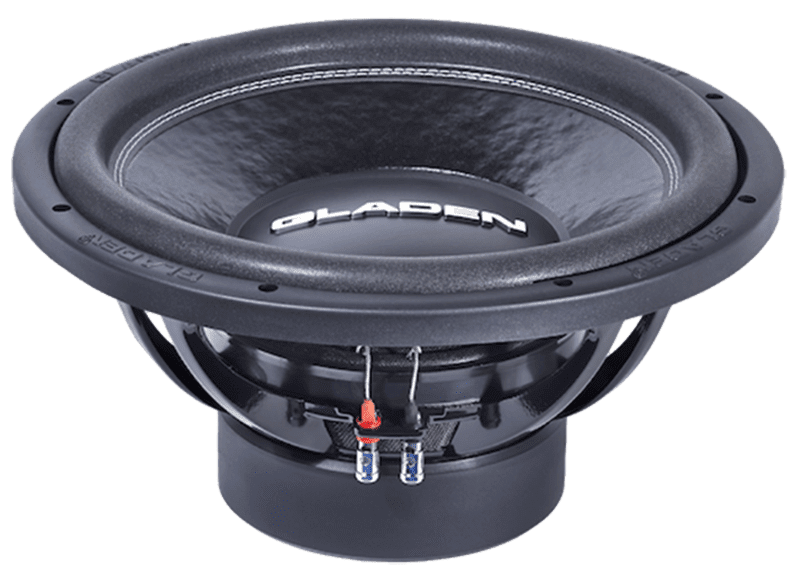
The King of the Hill is the 15″ subwoofer.

Modern speaker designs continue to reduce distortion through computer simulation and modeling of material behavior. Qualified and properly equipped speaker designers can simulate spider, cone and surround behavior to analyze individual resonance and distortion behaviors. They also can model the interaction between the voice coil and the motor structure to predict changes in magnetic field strength and inductance that can further affect how a speaker will sound at moderate to high excursion levels.

These advancements have resulted in speakers that produce less distortion at higher excursion levels. This improvement in performance allows enclosure designers to build speaker systems that will play lower and louder.

Some basic principles govern low-frequency sound reproduction. Cone area is critical. An old article published by the Audio Engineering Society called “The Problem with Low-Frequency Reproduction,” by Saul J. White, included a graph that compared cone excursion vs. frequency vs. system output for a 12- and 15-inch loudspeaker. In the chart, it shows that a 15-inch driver cone only has to move half as much as a 12-inch driver to produce the same output.

To produce sound, we need to displace air. Displacement is calculated by the product of speaker cone area times the distance the cone can travel. In other words, bore times stroke. For the same displacement, more bore requires less stroke.

What is the punch line? If you want it louder, buy more speakers or subwoofers.

Driver Behavior in an Enclosure

The increase in the system Q caused by the addition of air stiffness in the enclosure can cause distortion if the Q is increased excessively. This increase in Q works against our desire for a low-distortion system. Making the enclosure too small increases the Q too much, and we wind up with a system that produces a great deal of output in a narrow frequency range. These undersized enclosures are often referred to as a “one-note-wonders.”

What causes this behavior? The one-note quality is a result of the increased energy storage and transference in the resonant system. The bass just keeps going and going – like our swing at the park.

Power Handling

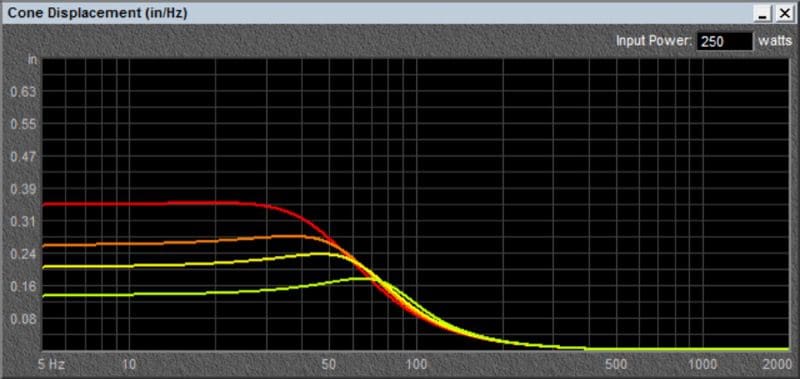
In an acoustic suspension enclosure, cone excursion increases as frequency decreases. This increase in excursion continues down to the frequency at which the force of the spider and the box exceeds the force of the motor. At that point, the excursion level is limited, and we will not see the increase in excursion . The result: We protect the speaker from physical damage due to cone excursion beyond the design characteristics of the speaker.

Predicting the limits of cone excursion relative to frequency and power is relatively simple for a sealed enclosure. The volume of the enclosure is inversely proportional to the amount of power the speaker can handle when perceived from the standpoint of excursion. A small enclosure limits cone excursion a great deal at very low frequencies, but the system does not produce a lot of deep bass. A large enclosure allows the speaker to move further and produce more low-frequency output, but we cannot drive the speaker with as much power for fear of damaging it.

Acoustic SuspensionAs we increase the volume of the subwoofer enclosure, the air inside has less “spring effect” on the subwoofer’s motion. This graph shows the increase in driver excursion as air volume increases in four different enclosures.

Acoustic Suspension Overview

An acoustic suspension speaker enclosure reduces bass output at a rate of -12 dB per octave below the resonant frequency. When you combine this roll-off with the cabin gain associated with most vehicles, you can get excellent and linear low-frequency extension well into the infrasonic region. Acoustic suspension enclosures are easy to calculate and to construct. They are very forgiving of minor errors in volume calculation.

Finally, it is worth remembering that acoustic suspension enclosures are not the lowest-distortion enclosure designs available.

When it comes time to design a subwoofer enclosure for your car or truck, visit your local mobile electronics retailer and discuss your requirements. They can help you choose a subwoofer and enclosure design that will give you a solid foundation on which to build your audio system.

This article is written and produced by the team at www.BestCarAudio.com. Reproduction or use of any kind is prohibited without the express written permission of 1sixty8 media.

Filed Under: ARTICLES, Car Audio, RESOURCE LIBRARY

Product Spotlight: Momento M5 Full HD Dual Dash Cam

02/28/2017 By John Schwartz

Momento M5Perfectionist Auto Sound and Security in Anchorage is pleased to be an authorized dealer for the Momento M5 Full HD dual dash camera. These days, driving can be more and more of a challenge. Distracted driving has resulted in ever-more senseless accidents. Unfortunately, getting to the bottom of what really happened is getting harder for an insurance company and the authorities. The good news is you now can have a video recording of an accident or someone tampering with your vehicle.

Full HD-quality Sony Camera

Momento M5First and foremost, if you are going to buy a dash camera, you want one with great picture quality. The Momento M5 uses a Sony camera and sensor that give you full HD picture quality.

Momento M5 Has Dual Cameras

For the ultimate in protection, the M5 offers a front and rear camera, giving you protection from things that happen in front of you and behind you.

Touchscreen Monitor

Momento M5For the ultimate in convenience, you get a full-color touchscreen monitor that lets you see what is being recorded in both directions at the same time. It also lets you make changes in a quick and easy fashion. You can use it to review footage of previous recordings. In the event of an accident, this feature may be helpful in instantly proving your innocence to the authorities.

Event-recording Options

The onboard motion detector and impact sensor give you many options for when the M5 will record and safely store video. Imagine your vehicle is parked and someone hits it when you aren’t around. The M5 will lock that video into memory, preventing it from being overwritten.

Removable Micro SD Card & Integrated GPS Technology

The removable Micro SD card allows you to easily move any video needed to your computer. When you add in the GPS technology option, you can now add a location and time stamp to your recording, for even more proof of where you were and at what time.

Come See It in Action

We invite you to stop by Perfectionist Auto Sound and Security and see the Momento M5 Dual HD dash cam live and in action. Once you see the incredible feature set, you will probably want one of these units in every car, truck or SUV you drive.

You can also get more information about any of our products and services by clicking HERE.

Filed Under: Collision Avoidance, PRODUCTS Tagged With: Dash Camera, Momento

  • « Previous Page
  • 1
  • …
  • 49
  • 50
  • 51
  • 52
  • 53
  • …
  • 82
  • Next Page »

801 EAST 82ND AVE
ANCHORAGE ALASKA 99518
907-563-8112

Copyright © 2026 | Site design by award-winning creative agency D'zine Alaska , with site support by 1sixty8 Media and Modern Media Geeks.