Perfectionist Auto Sound and Security

Alaska's Most Award Winning Auto Customizer

  • About Us
    • Why Choose Us
    • Meet Our Team
    • Our Awards
    • Virtual Tour
    • Community Engagement
  • Signature Products
    • DroneMobile
    • SoundShield®
  • Services
    • Remote Car Starters
      • Vehicle Security
    • Car Audio
      • Sound Deadening
    • Custom Fabrication
    • Driver Safety
      • Bluetooth
      • Blind Spot Safety Systems
      • Camera Systems
      • Navigation Systems
    • Laser And Radar Detectors
    • Lighting
    • Offroad and Marine
      • Motorcycle Audio
    • Custom Interiors
    • Performance
      • Tires and Wheels
      • Suspensions / Lift & Lower
    • PRO Commercial Division
  • Gallery
    • Photos
    • Videos
    • Wallpaper Downloads
  • Contact Us
    • FAQ
    • Feedback
    • Join Our Team

Product Spotlight: Momento M4

06/22/2017 By John Schwartz

Momento M4Firstech, the well-known manufacturer of the Compustar brand of remote vehicle starters and security systems, recently introduced the new Momento series of dash cameras. Having a dash cam in your vehicle is an inexpensive way to protect yourself against fraud because it can assist in settling disputes in the event of an accident. Read on to delve into the features and functions of the Momento M4.

Platform and Application

The M4 is a high-resolution dash cam system designed to be installed at the top of your windshield, using the included adhesive-backed mounting bracket. The M4 includes a 1 megapixel CMOS image sensor that records at a resolution of 1,280×720 pixels at 30 frames per second. The M4 kit includes a second camera that is suitable for installation on the rear window to monitor driver behavior behind your vehicle, or on the windshield to record movement within the vehicle. Recording the driver if there is an incident can provide evidence to verify you were not talking on the phone, texting or adjusting the radio at the time. The rear camera features a 0.3 megapixel sensor that records at 720×480 resolution at up to 30 fps.

Momento M4On the rear panel of the M4 is a 3.5-inch TFT LCD touchscreen that displays the camera image and provides an easy interface to set up and configuration the system. The right side of the unit is home to a mechanical on/off switch, a speaker and the microSD card slot. On the top are connections for power, the rear camera and an optional GPS receiver. A microphone on the bottom of the chassis records audio whenever the system is capturing video.

Momento packages the M4 as a complete recording solution. They include both front and rear cameras, all the cables and mounting hardware, and even a 16 GB microSD card. Some companies sell their dash camera systems a la carte. Momento believes that what happens behind the vehicle is as important as what happens in front of it.

Features and Functions

Momento M4A hard-wire kit that your installer can connect to your choice of constant or switch power points powers the camera system. If connected to a switched power source, the M4 wakes up and starts recording right away when you start your car. When connected to a constant power source and with the parking function activated, the M4 monitors motion within the camera image and only stores information when it senses action. The onboard three-axis accelerometer can also trigger the recording function.

The M4 stores video while you’re driving in a folder on the provided 16 GB microSD card called Driving. It stores motion detected while in parking mode in a folder called Motion. The onboard accelerometer can trigger the M4 to store a video file in the Event folder if motion exceeds a user-selectable threshold. Finally, pressing an icon in the bottom-right corner of the screen will trigger the manual recording mode and store those images in a separate folder. Once the Motion folder is full, the system will overwrite old files.

The M4 stores recordings from 10–15 seconds before any trigger. Even if something has already happened, you can trigger the M4 to store a video of the event. The M4 includes a feature called Forward Vehicle Movement Alert that uses advanced image processing to alert you when the car in front of you drives away.

Parking Mode

As mentioned, the M4 can monitor activity around your vehicle after you stop driving. Once the system detects a lack of activity for about 10 minutes, it stops storing video. Motion within the camera’s field of vision or activity detected by the accelerometer will trigger the system to record video. Parking mode can capture vandalism and the behavior of people or pets around your vehicle. The M4 can be set to turn off parking mode after a preset amount of time, or if the vehicle battery voltage decreases past an adjustable level. The automatic shut-down system will prevent the M4 from killing your battery.

Why You Need a Momento M4

A video recording system like the M4 is inexpensive insurance against someone taking advantage of you. It is not at all uncommon for people to jump on the hoods of cars and fake injuries. Likewise, many scammers will back into stopped vehicles and claim they were rear-ended. The M4 is your indisputable witness to their behavior and can help prevent dramatic insurance rate hikes. Visit your local Momento dealer for more information.

This article is written and produced by the team at www.BestCarAudio.com. Reproduction or use of any kind is prohibited without the express written permission of 1sixty8 media.

Filed Under: PRODUCTS, RESOURCE LIBRARY, Vehicle Security Tagged With: Firstech

Trust the Motorcycle Audio Experts at Perfectionist

06/21/2017 By John Schwartz

Motorcycle Audio ExpertsWhen it’s time to upgrade the audio system on your Harley-Davidson, the team at Perfectionist Auto Sound and Security in Anchorage is your motorcycle audio experts. No matter what you ride, we can install or upgrade an audio system that will sound better, play louder and last longer than anything you can buy online or at a bike show. We have decades of experience in designing and installing motorcycle audio systems. When you want the best sound possible for your investment, visit the motorcycle sound system experts at Perfectionist.

Mobile Audio Installation Experts

We don’t do oil changes, sell chrome foot pegs or overhaul motors. We are mobile electronics specialists. Our team understands the unique acoustic challenges and installation obstacles that a dealership or repair shop doesn’t.

Designing an entertainment system for your motorcycle is more involved than picking a package out of a catalog. We work with you to understand how loud you want the system to be, the kind of music you listen to and your expectations for sound quality. Armed with this information and more, we will develop a unique solution that provides the performance you expect, as well as incredible reliability.

The Best Equipment in the Industry

Motorcycle Audio ExpertsChoosing the right speakers, amplifiers and source units for each client starts with our supplier partnership. The companies behind the products we offer have invested thousands of hours in the design and engineering of premium audio solutions. Audio is not a hobby for them; it is everything they do.

We offer products designed specifically for the motorcycle environment. UV- and water-resistant speakers that sound great and compact amplifiers that can handle vibration while remaining efficient are just the tip of the iceberg.

System Integration, Not Just Installation

Motorcycle Audio ExpertsWe prefer to call our team of motorcycle audio experts integrators, not installers. Professional installation is much more involved than simply turning a screwdriver. We start every project with a thorough inspection of your motorcycle. We confirm that all of the electrical systems are functioning properly and document everything on our tablet-based tracking system.

We protect your motorcycle while it is in our care. We have a large installation area, so other staff members and vehicles stay away from the bike. We prevent nicks and scratches by protecting panels and painted surfaces before we start work. We have safe locations to store seats, tanks and fairings while we work on the chassis of your bike.

We solder all of our electrical connections, then protect them with premium Tesa cloth tape. We secure wiring harnesses in place to prevent vibrations and damage. Once an installation is complete, a second member of our team inspects the project and signs off before the bike rolls out the door. A flawless experience is our mandate, every time!

Proper Tools and Training

Without accurate measurements, troubleshooting a system that isn’t performing as expected is simply guesswork. We have invested in the tools and experience required to make electrical and acoustic measurements of any audio system. We use these tools to confirm that each installation is performing to the best of its ability before it leaves our shop, and we can track down and repair problems with existing systems. A motorcycle dealer simply can’t offer these services.

Alaska’s Motorcycle Audio Experts

When it’s time to upgrade the sound system on your motorcycle, visit Perfectionist Auto Sound and Security. A member of our sales team would be happy to develop a solution that exceeds your expectations for performance and reliability. For more information, send us an e-mail using our contact FORM.

Filed Under: ARTICLES, Motorcycle Audio Tagged With: Amplifiers, Harley Davidson, Integration, MotorCycle, Speakers, Subwoofers

RCA Y-Cables

06/18/2017 By John Schwartz

RCA Y-CablesIf you spend any time reading car audio discussions on Facebook or in forums, then you will have undoubtedly come across comments involving the supposed drawbacks of using RCA Y-cables. There seems to be a lot of misconception or misunderstanding about how preamp signals works, and this misinformation leads to comments that aren’t always accurate. Let’s take (more than) a few minutes to clear things up.

Understanding Preamp Level Audio Signals

RCA Y-CablesThe audio signal that connects your source unit to your amplifier is both very weak and quite small. The voltage of the preamp signal is rarely above 10% of the maximum voltage capability of your source unit for several reasons. Firstly, the signal level is directly proportional to the output of the system. When the volume is low, the signal is low in amplitude.

The second factor that contributes to the microscopic amplitude of the preamp signal is known as the Crest Factor. By way of a formal definition, the Crest Factor is the ratio between the peak signal amplitude and the RMS value of a waveform. For a pure sine wave, this value would be 1.414. For music, the Crest Factor value is much larger.

We analyzed a few different songs to come up with some relatable numbers. The new song Run by the Foo Fighters has a maximum amplitude of +0.15 dB and an RMS amplitude of -12.7 dB over the entire track. To keep the math simple, let’s call it 13 dB, which is a ratio just shy of 20:1. We also analyzed Heathens by Twenty One Pilots and found that it has a Crest Factor of 10.5 dB, or just about 11.25:1.

If we think about the highest voltage possible on our preamp signal as being 4 volts, then the average voltage for the above track would be 200 millivolts and 355 millivolts respectively. The peak of 4 V only happens when the volume is at maximum. Don’t forget that.

Scotty, We Have No Power!

Another characteristic of our preamp signal is that it contains almost no current flow. As with any electrical circuit, the amount of current flowing through the circuit is determined by the voltage in the circuit and how much resistance there is. The output impedance of most head units is between 300 and 500 ohms. The input impedance on most amplifiers is about 10,000 ohms.

Using our maximum voltage of 4 volts, and a resistance of 10,500 ohms, the maximum current in our circuit will be 0.381 milliamps. If we consider that the average signal amplitude is about 275 millivolts, then we have an average current flow of 0.0275 milliamps. That is nothing.

What does an RCA Y-cable Do?

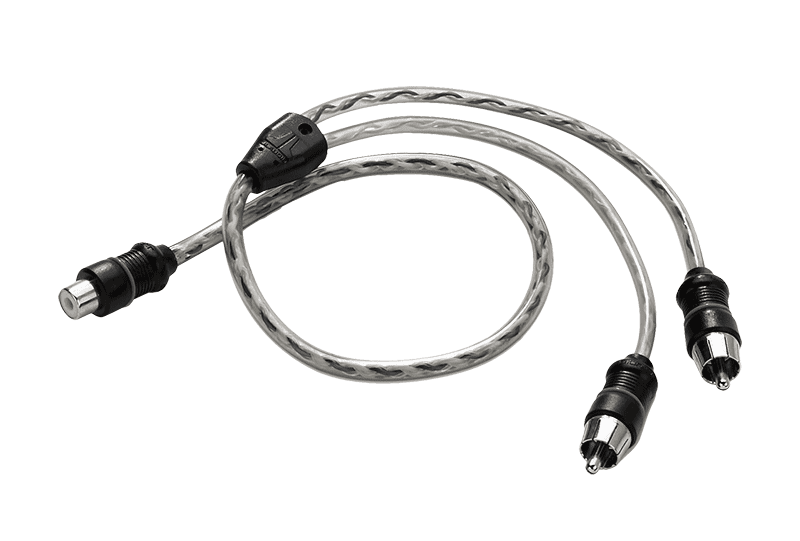
RCA Y-CablesAn RCA Y-cable allows you to connect a single RCA output to two RCA inputs. Typical applications for Y-cables are a single subwoofer output RCA on a source unit or processor and the need to feed a pair of inputs on a subwoofer amp. Another common application is a source unit with only a single left and right RCA output; you want to use a four-channel amp that doesn’t include a two-input/four-input switch.

Please Don’t Believe the Hype

The biggest myth about the use of Y-cables is that they dramatically reduce the signal going to each input. To prove why this is not true, we need to understand how a voltage divider circuit works. Yes, it is time for a little physics and math.

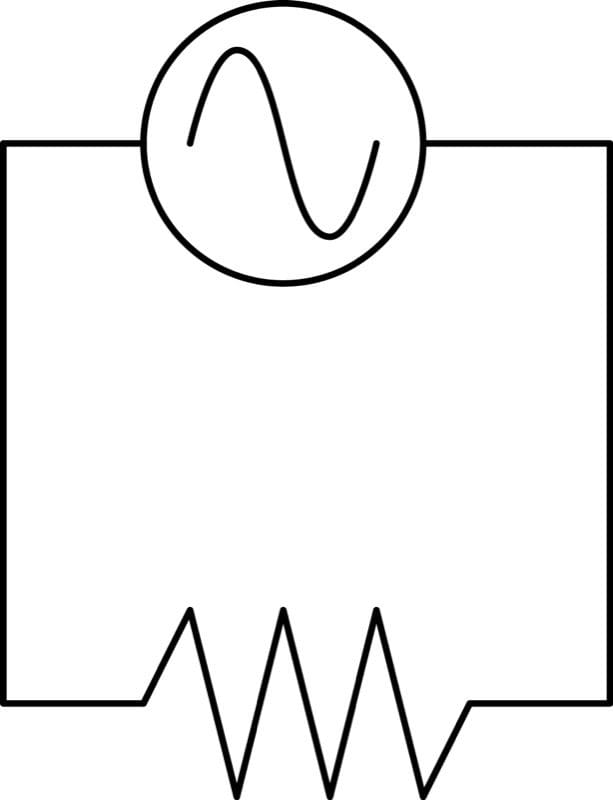
In an ideal situation, when we have a signal source and a single load, all the voltage developed by the source appears across the load.

RCA Y-Cables

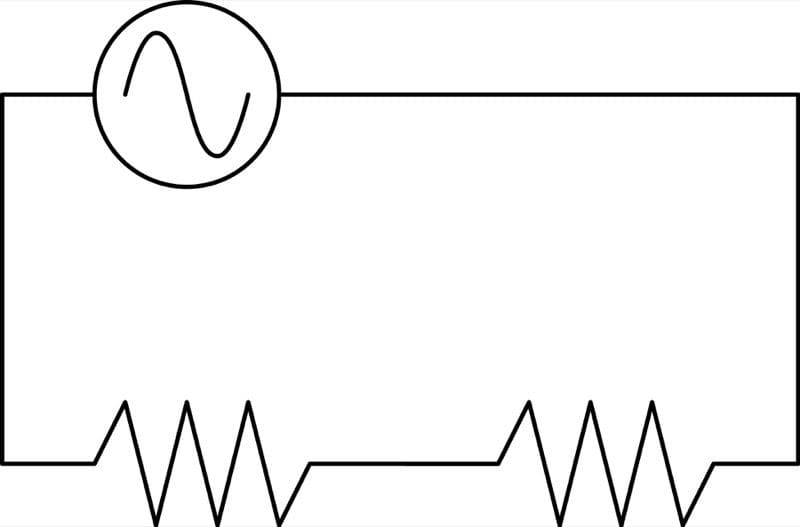
If we have multiple loads, the voltage produced by the source is divided among the loads when they are wired in series. In the image below, we have two loads in series with our single signal source.

RCA Y-Cables

If the resistance value of the two loads is the same, then the voltage produced by the source is divided equally across the loads. Half the voltage can be measured across each load. Using our 4 V preamp example, we would see 2 V across each load. However, what happens when the load resistance is not the same? We have to do some math to determine how much voltage is across each.

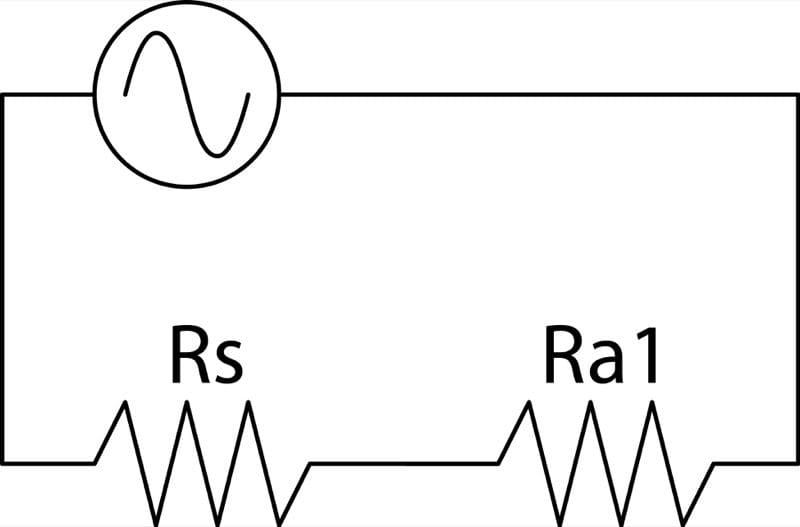
Let’s label the loads. The load on the left will be called Rs. This is the resistance of our source. For this example, we will use a value of 500 ohms. The load on the right will be our amplifier input resistance of 10,000 ohms, and we will call it Ra1.

RCA Y-Cables

We have 4 volts being produced by the source and a total circuit resistance of 10,500 ohms. We can calculate that the current flowing in the circuit is 0.0381 milliamps using Ohm’s law. Knowing the current in the circuit allows us to determine how much voltage is dropped across each resistance. For our source load, we have a resistance of 500 ohms with a current of 0.381 milliamps to produce 190.476 millivolts. The rest of the 4 V source signal or 3.809525 volts appears across the load.

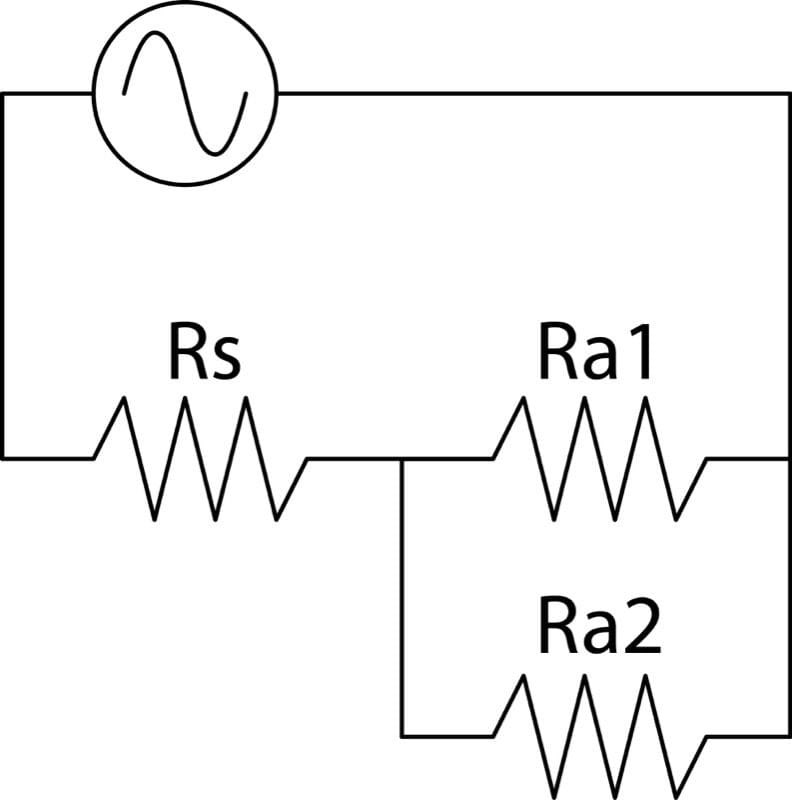
Let’s wire another amplifier in parallel with our first amplifier. This is the same effect as using a Y-cable. Our second amplifier will be called Ra2.

RCA Y-Cables

Now it is math time again. This time, our circuit has a total resistance of 5500 ohms, and as such, has a current of 0.7272 milliamps flowing in it. The voltage dropped across the source has increased to 0.363636 volts, and each amp is seeing 3.636 volts. That seems like a noticeable difference, doesn’t it?

The Decibel Scale Changes Everything

Between the two examples above, we have seen a decrease in voltage at the amplifiers by 4.772%. Does that mean our music is almost 5% quieter? No. When we talk about the ratio of voltage to volume, we need to take into account the decibel scale. Our decrease of 4.772% percent in voltage works out to -0.405 dB less output.

Before you get your knickers in a knot, you can fix that by turning the gain on your amplifier up by that amount.

A Worst-case Mathematical Example

RCA Y-CablesThis example was a worst-case scenario. What if you have a source unit with a lower output impedance? Some head units have an output impedance of 300 ohms. For that head unit, with the same 10,000 ohm input impedance on the amplifiers, the change in output by using a Y-cable would be -0.2493 dB. If you have a premium line driver in your system, the output impedance may be as low as 50 ohms. In this scenario, the loss is a paltry -0.0431 dB.

What did we learn from this? If you need to connect many amplifiers to a single source, then choose a source with a low output impedance.

RCA Y-cables as a Solution are Not Evil

If your system requires that you use a set of Y-cables to distribute the audio signal to multiple amplifiers, then go right ahead. Once your installer sets the sensitivity controls on your amps, you will never, ever know they are there.

If you have any questions about the design of your audio system or what to know about how your installer will be wiring it, talk to the salesperson and your local mobile electronics specialist retailer – they would be happy to explain things to you.

This article is written and produced by the team at www.BestCarAudio.com. Reproduction or use of any kind is prohibited without the express written permission of 1sixty8 media.

Filed Under: ARTICLES, Car Audio, RESOURCE LIBRARY

Product Spotlight: Hertz HMX 6.5 Marine Speakers

06/13/2017 By John Schwartz

Hertz HMX 6.5Hertz is proud to introduce a new line of marine and powersports products to their family of premium mobile electronic solutions. Four new amplifiers, seven new speakers and a subwoofer will provide marine and off-road enthusiasts with the same impressive performance that has made Hertz speakers, amplifiers and subwoofers a revered name in cars and trucks for decades. In this product spotlight, we take a closer look at the HMX 6.5 marine and powersport series coaxial speaker products.

HMX 6.5 Design Features

Hertz HMX 6.5The HMX 6.5 is a 6.5-inch coaxially mounted component speaker system. The system uses a polypropylene woofer cone that has been co-molded to a Santoprene rubber surround. The motor and suspension of the woofer feature a 1-inch voice coil that is centered by an aramid fiber spider. The voice coil is vented to help control heat and pressure build-up under the dust cap. Hertz has optimized the suspension for infinite-baffle applications. Silicone-encased tinsel leads offer excellent durability and reliability.

Hertz has provided an over-sized magnet for the woofer for topnotch efficiency. A marine-grade polymer injected basket encases the motor assembly for protection from the elements. There are no protrusions from the basket that could cause life jackets or fishing rods to get hung up as they are pulled past the rear of the speaker.

The speaker has a mounting depth of 3.76 inches. A soft rubber gasket on the back of the mounting flange ensures a tight seal against the boat hull to prevent leaks.

Hertz HMX 6.5The 1.4-inch tweeter PEI dome tweeter is powered by a neodymium magnet and suspended above the woofer in the grille. An acoustically transparent stainless steel mesh insert protects the tweeter from physical damage.

An acoustic lens is incorporated into the tweeter mount to increase off-axis performance. This lens helps to ensure that every seating position has great sound, even if the speakers are mounted down low in the boat. Hertz has integrated a passive crossover network into the side of the speaker chassis. The crossover system includes solid-state tweeter protection circuitry.

Speaker Specifications

Hertz HMX 6.5Hertz rates the HMX 6.5 series of speakers as having a continuous power handling capability of 75 watts, with a 150-watt peak power rating. Each driver has a nominal impedance of 4 ohms, so they are compatible with every source unit and amplifier on the market. An efficiency rating of 90dB ensures that every watt of power sent to the speaker is used efficiently.

Nature Proof Design

Hertz calls their environment design features Nature-proof. The cone, surround, chassis and grille are all made from UV-, salt-, fog- and thermal-shock–resistant marine-grade polymer materials. The design is water- and dust-resistant so it can be used in any outdoor application. The speaker terminals are gold-plated to improve the system’s overall corrosion-resistance characteristics.

Four Options for Any Application

Hertz HMX 6.5Your choice of white or black HMX 6.5 speakers is also available to be purchased with integrated RGB LED lighting. With the LED option, the optional HM RGB 1 BK wireless LED lighting controller can be purchased to further enhance your experience. The wireless control included with the HM RGB 1 BK uses radio frequency communication to allow the user to select from 256 different red, green and blue intensities. The range on the remote is specified as 65 feet.

The HM RGB 1 BK Controller includes options for color-changing patterns. It also has a built-in microphone and 3.5 mm aux input. The controller can change the lighting to the beat and tempo of your music, if you wish.

Hertz HMX 6.5 Series Speakers

As we mentioned, the HMX 6.5 series speakers are just part of the new family of marine and powersports products from Hertz. The line includes marine and powersports trim 8-inch coaxial speakers (only the black version will have the optional LED lighting) and a 10-inch subwoofer in the marine series. Two series of amplifiers round out the offerings – a four-channel and a monoblock in the compact HMP series and a four-channel and two-channel amp in the HCP series.

If your boat, ATV, motorcycle, motorhome or race trailer needs amazing sound, then look into the new marine and powersports offerings from Hertz. Your local authorized Hertz retailer can provide you with installation and pricing details.

For more information about all of the Hertz amplifiers, speakers and subwoofers, visit their website.

This article is written and produced by the team at Reproduction or use of any kind is prohibited without the express written permission of 1sixty8 media.
Filed Under: Marine Audio, PRODUCTS, RESOURCE LIBRARY Tagged With: Hertz

Differential Inputs are Your Friend

06/11/2017 By John Schwartz

Differential InputsIn the 80s and 90s, it seemed like car audio installers were often having to resolve noise issues after installing a system that included an amplifier or signal processor. In many cases, the problem was called a ground loop. However, in some cases, the noise was present because one of the signal cables passed by a source of noise. The only solution was to reroute the wire. No matter what the problem was, or what cure was applied to resolve the problem, ultimately it wasted time and frustrated installers.

Noise problems are not as common these days. They do crop up from time to time, but certainly not with the same frequency as before. One simple technology that has helped to reduce noise issues is the inclusion of differential inputs of modern amplifiers and processors. In this article, we will explain what differential inputs are, how they work, and what benefits they offer.

Amplifier Input Circuitry – Single Ended Inputs

The RCA input connections on your amplifier have a relatively easy life. They do not need to pass any significant amount of current. They do not get connected and disconnect very often. They just sit there and do their thing.

Behind the connections, where the circuitry of the amplifier starts to do its job, there are two circuit designs commonly used. The aforementioned differential input, and single ended inputs.

In a single ended input design, the shield of the RCA cable is connected to ground through a resistor. This resistor is often around 1000 Ohms. The center pin of the RCA cable, which contains our audio signal, is connected to the preamp stage of the amplifier. The preamp stage includes the sensitivity control, crossovers and so forth.

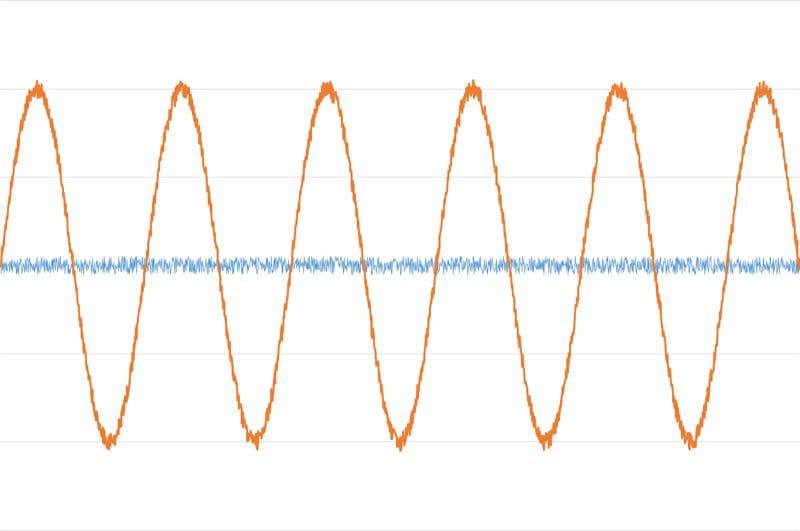
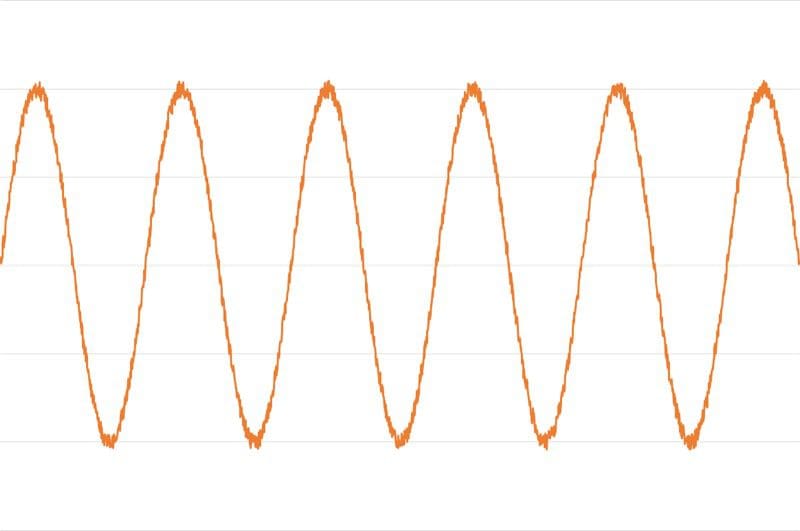
The image below shows an RCA with a sine wave and noise on both the shield and the signal conductor.

Differential Inputs

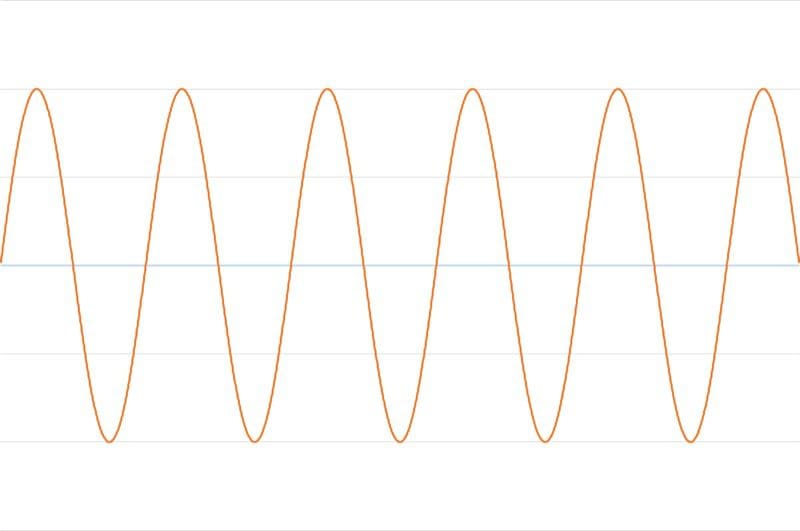
When we feed the signal shown above into an amplifier with single-ended inputs, the noise on the ground wire is ignored, and the sine wave and noise on the signal wire are amplified. The unfortunate and unwanted result is below:

Differential Inputs

Amplifier Input Circuitry – Differential Inputs

In a device with a differential input design, the shield of the RCA cable is completely isolated from the chassis. Before the audio signal passes to the preamp stage of the amplifier, it goes through an op-amp. An op-amp (or operational amplifier) is a small IC that has two inputs and a single output. One input is labeled as +, and the other as -. When we put a signal on the + input, it is passed to the output of the device with little to no change. When we put a signal on the – input, the polarity of the signal is inverted and sent to the output. In a differential input configuration, the – input of the op-amp is also connected to the shield of the RCA.

If we have an audio signal on the + input, and nothing on the – connection, the audio signal is passed through to the output of the op-amp, then on to the pre-amp stage of our amplifier.

The image below shows an RCA with noise on the shield and the signal conductors.

Differential Inputs

If we have noise induced on the shield and signal conductor of the RCA, then the noise signal on the shield is inverted and passed to the output. The inverted noise signal adds to the non-inverted signal and cancels out.

Differential Inputs

We call the system a differential input because it is looking for the difference between the shield and the signal conductors. More accurately, it subtracts any signal that is common to both conductors from the output signal.

How does Noise get into the System?

When our interconnect cables run through the vehicle, they come close to all sorts of electrical noise devices. High-current wiring, computers, sensors, electric motors and even the alternator can produce radiated noise in the form of a pulsing magnetic field. When a conductor passes through this field, a current will be imposed on the wire.

When this imposed current (or signal) reaches our amplifier, it gets amplified. If the noise is a high-frequency buzz, then that buzz is amplified, and we hear it through our speakers. Yuck!

Another source of noise is a ground loop. In a ground loop, current is flowing on the shield of our interconnect to equalize the ground potential between two devices.

Differential InputsLet’s look at an example. Perhaps someone has installed a radio in the dash of a truck and grounded that radio to the dash support. In some cases, that dash support is isolated from the truck chassis with big rubber bushings. When we connect the RCA cables from our radio to an amplifier in the trunk that has single-ended inputs, the radio seeks an improved ground location through the RCA shield. The resistor in the amp prevents massive amounts of current from flowing, but there is often enough to induce noise in the signal conductor.

A quick test for a ground loop is to pull the RCA out of the amp until only the center pin is touching. If the noise goes away, you have a ground loop. A remedy is to install a ground loop isolator. A ground loop isolator is a device with a transformer in it. The audio signal is transferred through the magnetic interaction of the transformer windings. There is no direct electrical connection between the input and output cables. With no electrical connection present, current cannot flow. The drawback of a ground loop isolator is that it can detrimentally affect the frequency response of the signal passing through it.

Do the Interconnects Matter?

For differential inputs to work, we need the noise signal to be equal on both the signal and shield conductors of our RCA cables. In a coaxial cable design, the shield can block noise from getting to the center conductor. If you use coaxial interconnects with differential inputs, the noise on both conductors is not equal and can induce noise into the signal path.

Differential Inputs

The easiest way to ensure that any induced noise is equal on both conductors is to use a twisted pair interconnect. In a twisted pair configuration, both conductors have the same effective amount of shielding and subsequently, the same amount of noise.

Differential Inputs

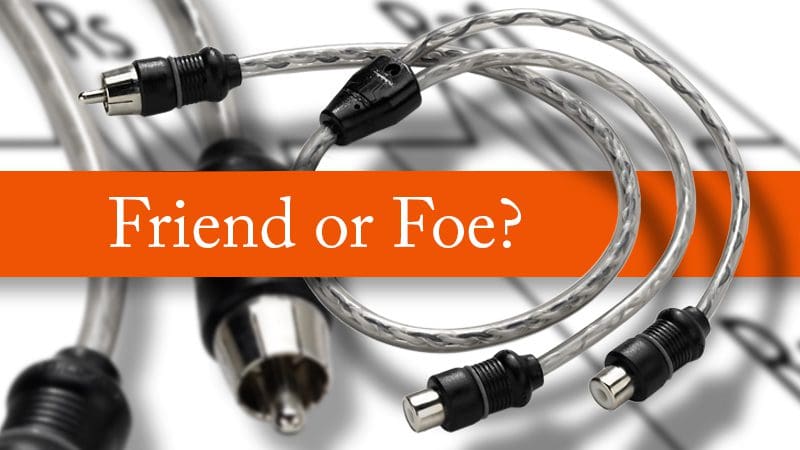
Differential Inputs are Your Friend

The next time you are shopping for an amplifier or signal processor for your car, remember that one of the questions you should be asking is if it has differential inputs. While you can certainly build a great sounding audio system around an amp with single-ended inputs, there is no point of taking the risk of having noise or installation headaches. Your local mobile electronics specialist retailer would be happy to assist you in finding an amp or processor with differential inputs.

This article is written and produced by the team at www.BestCarAudio.com. Reproduction or use of any kind is prohibited without the express written permission of 1sixty8 media.
Filed Under: ARTICLES, Car Audio, RESOURCE LIBRARY

  • « Previous Page
  • 1
  • …
  • 44
  • 45
  • 46
  • 47
  • 48
  • …
  • 82
  • Next Page »

801 EAST 82ND AVE
ANCHORAGE ALASKA 99518
907-563-8112

Copyright © 2026 | Site design by award-winning creative agency D'zine Alaska , with site support by 1sixty8 Media and Modern Media Geeks.